
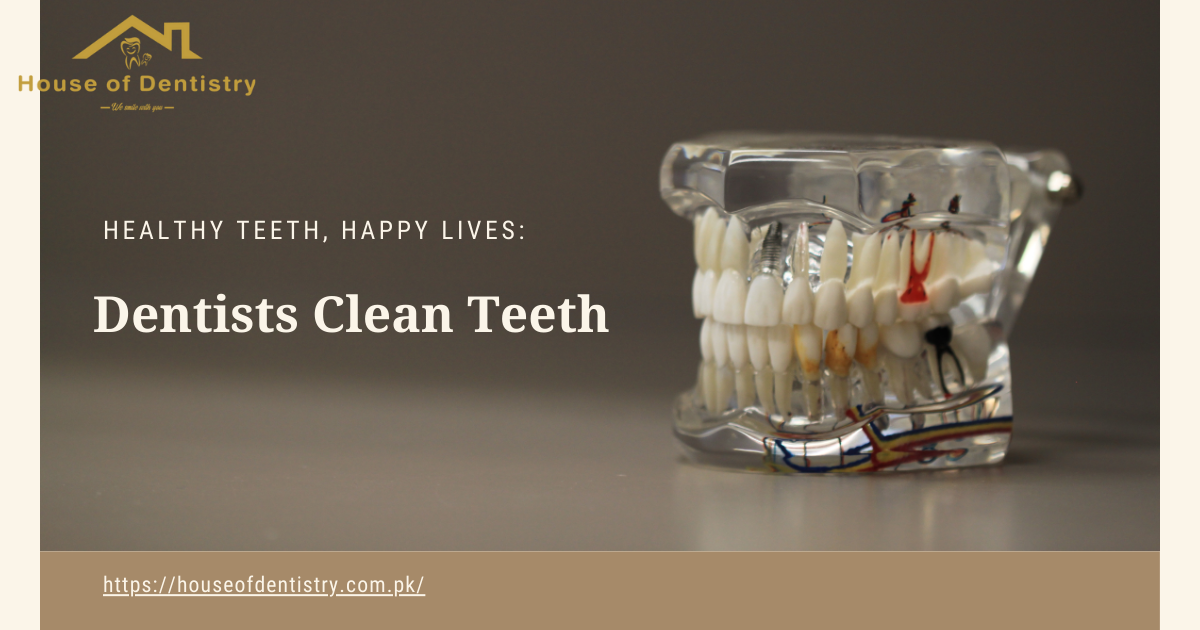
Many people fear Dentists Clean Teeth. It’s simple to comprehend their anxiety given the poking, unusual noises, and sporadic jaw pain. However, most people find that cleaning their teeth is easy and painless. You can lower your tension and better appreciate the minty-fresh outcomes if you know exactly what is happening through the procedure.
Depending on the amount of plaque and tartar on your teeth, your dentist will conduct one of the following four kinds of dental cleanings:
1. Prophylaxis Dental Wash

The definition of prophylaxis is “to prevent disease.” Prophylactic dental washes are therefore performed on healthy teeth to keep them free from glue disease and tooth decay. Using a dental scaler or water stream, prophylactic washes eliminate plaque and tartar from the front, back, and sides of teeth. The majority of dental patients just require a prophylactic cleaning, particularly if they have kept daily oral hygiene and semi-annual dental checkups.
2. Scaling and Root Planing Wash
Gingivitis and periodontitis are treated by climb and root planing cleanings, sometimes referred to as deep cleanings, which are applied to the teeth and glue pockets. Gingivitis deep cleanings are typically completed in a single dental visit. However, depending on the severity, deep cleanings for periodontitis may entail several visits and local anesthetics. The process of scaling eliminates plaque and tartar from the side of the tooth as well as from the gum pockets that develop beneath the gum line as a result of glue disease. This helps to lessen gum irritation and eliminate bacteria. In order to assist the glue in reattaching to teeth and get rid of glue pockets, the tooth roots are smoothed using a process called root planing.
3. Periodontal Maintenance Wash
This type of dental cleaning is also intended to address gum disease. Similar to climb and root planing, they clean the gum pockets and tooth side of extra plaque and tartar before smoothing out the roots if necessary. Periodontal keep cleanings are primarily distinguished by the fact that they are often carried out more often than other kinds of dental cleanings. This is due to the fact that gum disease is growing and will worsen if treatment is not received.
4. Gross Debridement Cleaning
Designed to clean teeth with a lot of plaque and tartar, gross debridement washes are the most thorough type of teeth cleaning. These patients are mostly those who have trouble keeping up with their spoken hygiene regimen or who have been avoiding the dentist for a long time. Because plaque hardens into tartar, and large amounts of tartar are very hard, an electrical tool is used to loosen the tartar during a gross debridement wash. After the excess plate and tartar have been removed, a prophylactic cleaning is done to clean the teeth further.
Signs you may have an Oral cavity
Sometimes, a very small cavity is impossible for you to find by yourself. A dentist needs to probe your tooth or take an X-ray of your teeth to detect it. A cavity will eventually start to show itself to you. These are some typical signs that a cavity is growing.
A toothache
You could find yourself sticking your tongue against your teeth because it hurts or throbs. Eating point hot, cold, or too sweet may make the pain worse.
Sensitivity
You’re discovering that one of your teeth is greatly more sensitive to changes in temperature than it used to be. You can find yourself flinching when you eat something hot or cold.
Dark or marked patches on a tooth
It could be a black or mark patch on your tooth, or it could be a white spot. In any case, it is a clue that point is wrong because it doesn’t match the rest of your tooth.
The tooth’s hole
It could be a very little hole. Alternatively, you may feel a bigger fracture or hole with your tongue. You may need dental work in the future if you can see a hole in your tooth.
Gum swelling or bleeding
Your gums, particularly those at the tooth line, may appear sore, red, or swollen. Your gums might even be bleeding a little.
Bad breath
Your meal of onions may be the cause of your foul breath. However, persistent bad breath that persists even after using mouthwash or brushing your teeth may indicate a cavity. Gum disease is frequently indicated by persistent foul breath.
What does a cavity’s beginning look like?
Any food particles that remain in your teeth have the potential to combine with oral bacteria to create plaque, a thin, sticky layer. It can even grow on your teeth close to the gum line and lead to the development of gingivitis. Cavities and tooth rot are known to be caused by gingivitis, an inflammation of the gums. You may notice that a tooth is dawn to hurt a little or that a portion of the glue line is getting a little tender. These indicators could be your body notifying you that a cavity is starting to grow.
Takeout
See your dentist on a regular basis, particularly if you event discomfort or swelling.
A dentist will consult with you to decide the best course of action, which is usually a filling, if they find a cavity or tooth rot on one of your teeth.