
Can Facial Exercises Improve Your Smile Symmetry? Proven Insights + 7 Key Facts
Smile symmetry is often used as a silent introduction. Faces make an impression before a single word is said.
Many people wonder if facial exercises can improve smile symmetry, or if this is just wishful thinking.
This article examines facial exercises and their impact on facial muscles. It also discusses their role in improving
smile symmetry. It is important to have optimism based on science and not just hype.
Understanding Smile Symmetry and Facial Balance
What does Smile Symmetry really mean?
Smile symmetry is the degree to which both sides of your mouth move equally when you smile. In an ideal
symmetrical smile the lips are evenly raised, the corners of mouth are mirrored, and the teeth look balanced in the
facial frame. Perfect symmetry is very rare. Minor asymmetries in the human anatomy are common and can be
overlooked during daily interactions.
Smile symmetry can be affected by the alignment of teeth, the structure of your jaw, muscle strength and nerve
signals, as well as habitual expressions. Since facial muscles are responsible for lip movement, an imbalance in
muscle coordination or tone can affect the appearance of a smile.
How facial muscles influence appearance
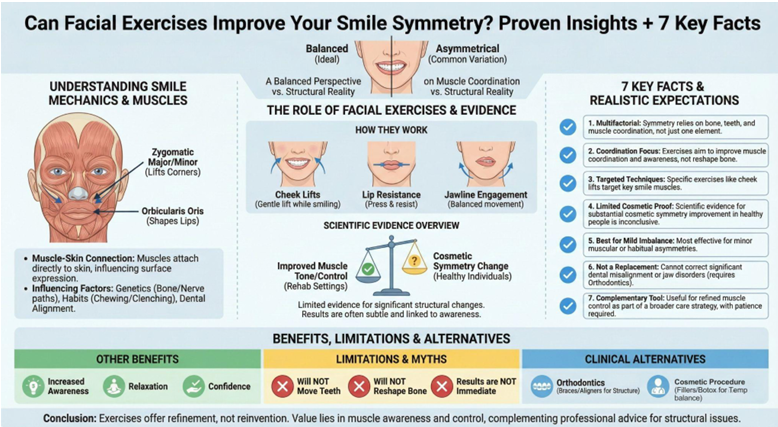
Face contains more than 40 muscles. Many of them work together to create expressions. The zygomaticus minor
and major lifts the corners of your mouth while the orbicularis ois shapes your lips. If one side is more active than
the other, it can cause the smile to tilt or look uneven.
Facial muscles are attached directly to the skin, unlike skeletal muscles. This unique structure not only allows for
subtle expressions, but can also influence the surface appearance directly.
Genetics and Habitual Muscle Use
Genetics is the blueprint. The bone structure, the nerve pathways and the muscle distribution is largely inherited.
Habits also play a part. Over time, habits such as chewing on one side or clenching your jaw can cause subtle muscle
imbalances.
It is because of this balance between habit and nature that some people try facial exercises for improving smile
symmetry.
What are facial exercises and how do they work?
Definition and Core Principles
Facial exercises are repetitive, deliberate movements that aim to strengthen and activate specific facial muscles.
Physical therapy is the basis of facial exercises. The use of targeted exercises can improve muscle coordination,
endurance and awareness.
Some advocates claim that facial exercises can improve smile symmetry through equal muscle activation on both
sides. Although the idea seems reasonable, results are heavily dependent on technique, consistency, and individual
anatomy.
Popular Facial Exercise Techniques
Cheek Lifts
When doing cheek lifts, you should smile while lifting your cheeks gently with your fingers. This exercise targets
the zygomatic muscle responsible for lifting the corners of your mouth.
Lip Resistance Movements
While smiling, you must press the lips together and resist finger pressure. These exercises are designed to
strengthen the muscles responsible for lip shape and stability.
Jawline Engagement
Exercises that focus on the jaw encourage a balanced movement of lower facial muscles. They may improve facial
coordination even though they don’t directly affect tooth position.
Claims vs. Reality
Online sources often promise dramatic results. Facial exercises only work slowly, if they do at all. When improvements
do occur, they are usually subtle and more related to muscle awareness rather than structural changes.
Does Facial Exercise Improve Smile Symmetry according to Scientific Evidence?
There is limited scientific evidence that facial exercises can improve smile symmetry. Small studies have shown that
facial exercises can improve muscle tone and control, particularly in rehabilitation settings like post-stroke therapy.
These findings, however, do not directly translate into cosmetic symmetry changes for healthy individuals.
According to a review cited by major medical organisations, facial exercises can help improve muscle awareness but are
not proven to alter facial structure or symmetry over time. Resources such as Mayo Clinic offer a cautious perspective
on facial exercises.
Expert opinions from dentists and physiotherapists
Dental professionals point out that the symmetry of a smile is heavily dependent on jaw alignment and teeth alignment.
The physiotherapists on the other side acknowledge that muscle retraining is a good way to improve coordination in
mild neuromuscular imbalances.
The majority of experts are in agreement on one thing. When structural problems are present, facial exercises cannot
replace orthodontics or medical treatment.
Limitations of Existing Research
Current research faces several challenges:
- Sample sizes are small
- Short study durations
- Subjective outcomes measurements
Due to these limitations, claims that facial exercise improves smile symmetry are more likely to be modest possibilities
than guarantees.
Benefits and limitations of facial exercises
Other Benefits of Smile Symmetry
Facial exercises may have other benefits, even if they only improve smile symmetry slightly. Regular practice increases
facial awareness, relaxes tense muscles and supports mindful expression habits.
Self-care routines that focus on the face can improve confidence in some individuals. Although psychological benefits
may not be as significant as physical changes, they are still important.
Common Myths
Facial exercises are believed to reposition teeth and reshape bones. This is incorrect. This is not true. A second
misconception is that the results will appear immediately. In reality, changes can take several months to become
noticeable.
What may or may not benefit
Facial exercises can help with:
- Mild muscular imbalance
- Asymmetry in habitual behaviour
- Postural facial tension
It is less effective in those who:
- Significant dental misalignment
- Jaw disorders
- Congenital facial asymmetry
By understanding these boundaries, you can avoid unrealistic expectations.
Facial Exercises and Clinical and Cosmetic Alternatives
Orthodontics and Dental Corrections
Orthodontic treatment directly addresses tooth alignment and bite problems, which are major contributors of smile
symmetry. Braces and aligners provide predictable, measurable outcomes that facial exercises can’t match.
Cosmetic Procedures
Dermal fillers and botulinum injections can temporarily alter muscle activity and visual equilibrium. These procedures
require medical supervision and are not without risk, but can provide noticeable results immediately.
How Facial Exercises Fit in
Facial exercises are low-impact and low-risk. Although they may be used to complement professional treatment, they
are rarely a replacement. If their role is framed more as one of support than correction, it becomes more clear and
honest.
FAQs about Facial Exercises & Smile Symmetry
Can facial exercises improve the symmetry of a smile permanently?
Although facial exercises can improve muscle coordination and structure, permanent changes are unlikely. Any improvement
tends to be subtle and maintenance-dependent.
How long will it take for me to see the results?
Results usually appear after several weeks or months of consistent practice. It is rare to see immediate results.
Can facial exercises be performed by anyone?
Generally, yes. Individuals with jaw pain, neurological conditions, or recent surgery on the face should first consult
a healthcare provider.
Can facial exercises replace orthodontic treatment for children?
No. Facial exercises do not move teeth or correct bite alignment. Orthodontic treatment is still necessary for these
issues.
How often should I do facial exercises?
The majority of routines prefer short daily sessions to infrequent intense practices. Intensity is not as important as
consistency.