
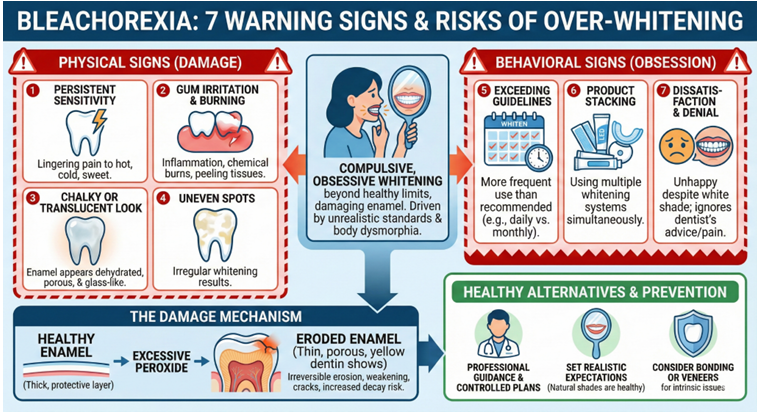
Can You Over-Whiten Your Teeth? 7 Warning Signs of Bleachorexia
Teeth whitening has become one of the most common cosmetic dental treatments worldwide. Brighter smiles are often associated with success, health, and confidence. As whitening products become more accessible and beauty standards more extreme, an important question arises: Can you over-whiten teeth?
Yes. This article explains what bleachorexia is, why it happens, how to identify warning signs, and how to whiten safely without compromising long-term dental health.
Understanding Tooth Whitening and Its Growing Popularity
Teeth whitening no longer happens only in dental clinics. Today, whitening strips, gels, pens, LED kits, and “natural” whitening products are widely available. While convenience has increased usage, it has also increased misuse.
Why Whiter Teeth Are So Desired
White teeth are widely seen as a sign of youth, cleanliness, and attractiveness. Social media, celebrity culture, and advertising reinforce the idea that “whiter is better.” Filters and edited photos often show unnaturally bright smiles, creating unrealistic expectations of what healthy teeth should look like.
Many people continue whitening even after reaching a healthy shade.
Common Teeth Whitening Methods Explained
The three main whitening options include:
- In-office professional whitening using high-concentration peroxide under supervision
- Dentist-prescribed at-home trays for controlled use
- Over-the-counter (OTC) products such as strips, gels, and LED kits
OTC products rely heavily on user compliance. Over-whitening often occurs due to overuse, product stacking, and repeated whitening cycles without breaks.
What Is Bleachorexia? A Clear Definition
Bleachorexia is a non-clinical term used to describe compulsive or obsessive tooth whitening, even when teeth are already very white or visible damage is occurring.
The Origin of the Term “Bleachorexia”
The term combines “bleach” with “anorexia,” highlighting a similar behavioural pattern. The obsession is not about food restriction, but about removing perceived tooth discoloration—often beyond what is healthy or natural.
Bleachorexia vs Normal Whitening Habits
Healthy whitening behaviour:
- Follow product instructions
- Stop once the desired shade is achieved
- Prioritise comfort and dental health
Bleachorexia behaviours:
- Whitening more frequently than recommended
- Ignoring gum irritation, pain, or sensitivity
- Feeling dissatisfied despite very white teeth
- Continuing whitening against professional advice
Psychological Factors Behind Bleachorexia
Bleachorexia may be associated with Body Dysmorphic Disorder (BDD) and obsessive tendencies. People may fixate on minor or perceived flaws—such as slightly warm tooth shades—which others see as normal. In such cases, this may require both dental care and psychological support.
Can You Over-Whiten Your Teeth? The Scientific Answer
From a scientific perspective, yes—over-whitening can damage teeth.
How Whitening Agents Affect Enamel
Most whitening products contain hydrogen peroxide or carbamide peroxide. These agents penetrate enamel to break down stain molecules. Used correctly, whitening can be safe.
However, overexposure may strip minerals from enamel, making it thinner, weaker, and more porous.
The Role of Hydrogen Peroxide and Carbamide Peroxide
- Hydrogen peroxide penetrates and acts quickly
- Carbamide peroxide converts into hydrogen peroxide gradually over time
Overuse of either can lead to enamel damage. As enamel thins, the naturally yellow dentin underneath can become more visible.
Whitening Damage Progression Timeline
- Days to weeks: Chemical burns, gum irritation, tooth sensitivity
- Weeks to months: Chalky appearance, enamel dehydration
- Months to years: Dentin yellowing, structural weakness
- Long term: Increased risk of decay, cracks, fractures, crumbling teeth
This is why teeth may appear darker or duller after excessive bleaching.
Bleachorexia: 7 Warning Signs You Should Not Ignore
Early recognition can prevent long-term damage.
Physical Warning Signs
- Persistent sensitivity to sweet, hot, or cold foods
- Gum inflammation, peeling, or burning sensations
- Teeth that look translucent or chalky-white
- Uneven whitening or white spot patches
Behavioural Red Flags
- Whitening beyond product instructions or recommended frequency
- Dissatisfaction even when teeth are already very white (e.g., A1 shade or lighter)
- Using multiple whitening products simultaneously (“product stacking”)
Dentists may suspect bleachorexia when patients minimise pain, deny sensitivity, or insist on whitening despite visible enamel changes.
Risks of Excessive Teeth Whitening
Bleachorexia does not only affect appearance; it can lead to serious oral health consequences.
Short-Term Dental Risks
- Sharp or lingering tooth pain
- Chemical burns and gum irritation
- Temporary nerve inflammation
Long-Term Oral Health Consequences
- Permanent enamel erosion
- Chronic tooth sensitivity
- Higher risk of cavities
- Cracks, fractures, and weakened tooth structure
Enamel does not regenerate once it is lost. In advanced cases, restorative treatment such as veneers, crowns, or bonding may become necessary.
Reversible vs Irreversible Effects
Potentially reversible:
- Mild sensitivity
- Temporary gum irritation
- Enamel dehydration (with remineralisation support)
Irreversible damage:
- Enamel loss
- Dentin exposure
- Structural tooth damage
- Increased long-term decay risk
How Much Whitening Is Too Much? Safe Limits
Even products marketed as “safe” can cause harm if instructions are ignored.
Dentist-Recommended Whitening Frequency
- Professional whitening: typically only as advised, often spaced widely apart
- Dentist-supervised trays: limited cycles, usually once or twice per year
- OTC strips/gels: typically no longer than 10–14 days per cycle
Whitening too frequently, repeating cycles with no breaks, or whitening monthly without guidance increases risk significantly.
Different Risks by Product Type
- OTC gels/strips/pens: higher misuse risk due to lack of supervision
- Charcoal and “natural” products: often abrasive and not risk-free
- LED kits: not automatically safer; peroxide concentration matters most
- Product stacking: cumulative peroxide exposure accelerates damage
Prevention and Healthy Whitening Alternatives
Education, realistic expectations, and professional guidance are the best safeguards against bleachorexia.
Professional Whitening vs At-Home Products
Professional whitening provides:
- Controlled peroxide concentration
- Gum protection
- Personalised treatment planning
- Early detection of enamel or gum damage
Expectation Management and Education
- Understanding natural tooth shades
- Setting realistic cosmetic goals
- Focusing on maintenance rather than repeated bleaching
A healthy smile does not need to be paper-white. A slight warmth in tooth colour can be both normal and healthier.
Enamel-Safe Cosmetic Options
- Professional polishing
- Cosmetic bonding
- Veneers for intrinsic discolouration
If compulsive behaviour is present, psychological support may be recommended to address body-image fixation.
Frequently Asked Questions (FAQs)
Is it possible to whiten your teeth for too long?
Yes. Overuse of whitening products can cause enamel weakening, sensitivity, and long-term damage.
Is bleachorexia a mental health condition?
It is not a formal clinical diagnosis, but it is commonly associated with body dysmorphic traits and obsessive-compulsive patterns.
Why do teeth look more yellow after excessive whitening?
Over-whitening can thin enamel and expose the yellow dentin beneath, making teeth appear darker or duller.
Is whitening toothpaste safe?
It can be safe when used correctly, but excessive use—especially with abrasive formulas—may contribute to enamel wear.
What should I do if my teeth hurt after whitening?
Stop whitening immediately and consult a dentist. Pain is a warning sign, not something to push through.
Can enamel recover after over-whitening?
Enamel can be remineralised to an extent, but lost enamel does not grow back.
Conclusion
So, can you over-whiten your teeth? Yes—without doubt. While teeth whitening can be safe and effective, overuse can lead to permanent enamel damage and long-term oral health problems. Bleachorexia may be fuelled by unrealistic beauty standards, psychological factors, and the easy availability of whitening products.
A healthy smile is a balance of brightness, strength, comfort, and function. Whitening should enhance oral health—not compromise it. If you are unsure, listen to your dentist and your body. Teeth usually warn you before they break.