
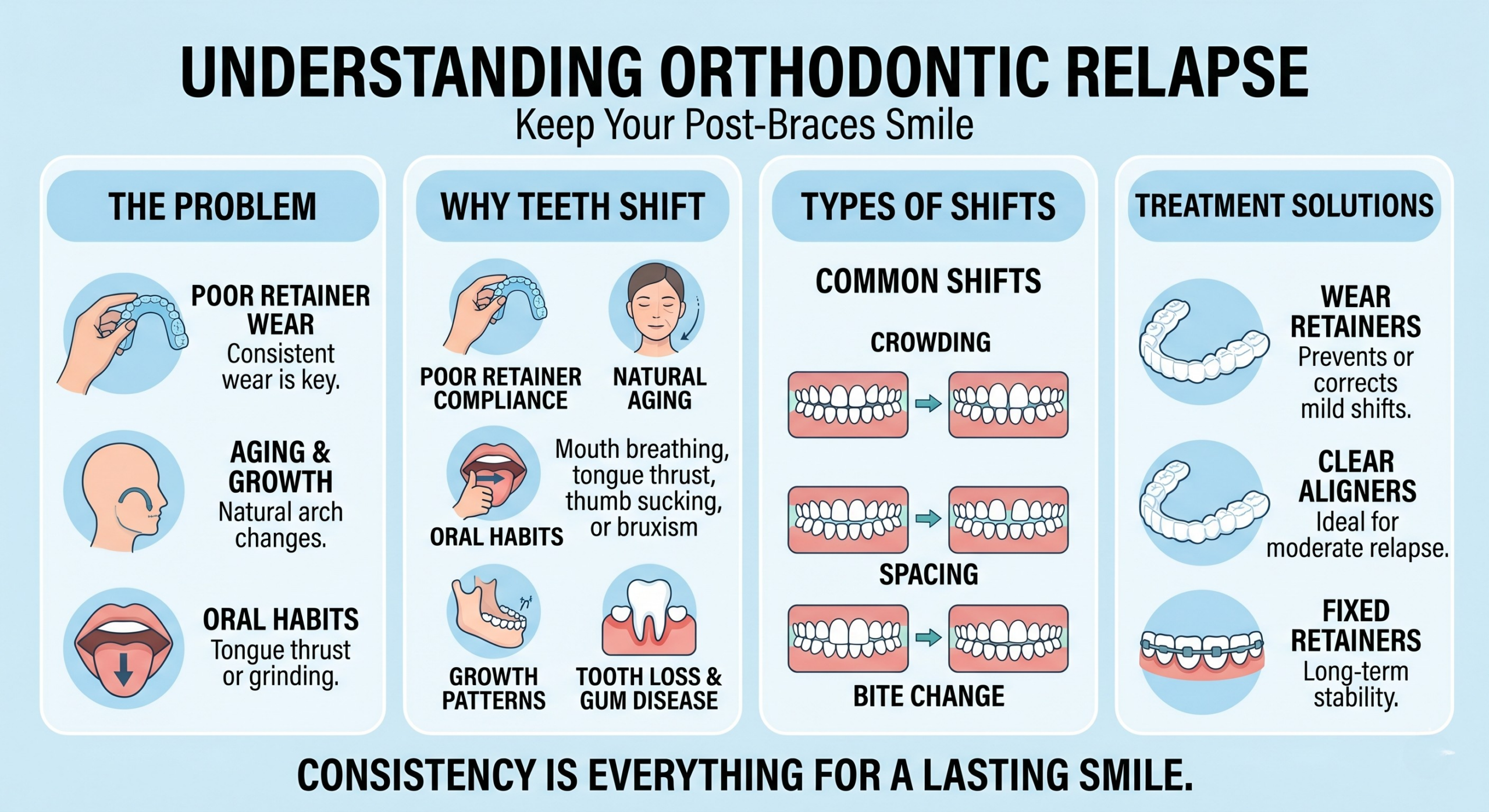
What Is Orthodontic Relapse?
Orthodontic relapse refers to the unwanted movement of teeth after orthodontic treatment has been completed. Whether a patient has worn traditional braces, ceramic braces, lingual braces, self-ligating braces, or clear aligners, teeth naturally tend to shift over time. This movement occurs because the periodontal ligament (PDL), gingival fibers, and surrounding alveolar bone require time to adapt to the new tooth positions.
During orthodontic treatment, teeth move through a process called bone remodeling, where bone resorption occurs on one side of the tooth while new bone deposition develops on the other. Even after braces are removed, connective tissue fibers may retain a form of “orthodontic memory,” creating forces that encourage teeth to move back toward their original positions. This is why orthodontic retention plays a critical role in maintaining long-term treatment results.
Why Teeth Shift After Braces
Orthodontic relapse is influenced by several biological, behavioral, and environmental factors.
Natural Aging and Bone Remodeling
As people age, subtle changes occur in the dental arches and facial structures. The maxillary arch and mandibular arch continue adapting throughout adulthood, which may gradually affect tooth alignment and occlusion. These natural aging processes can contribute to mild crowding, especially in the lower front teeth.
Poor Retainer Compliance
One of the most significant causes of orthodontic relapse is inadequate retainer wear. Retainer compliance directly impacts post-treatment stability. Patients who fail to follow their prescribed retainer wear schedule face a much higher risk of relapse.
Whether using an Essix retainer, Hawley retainer, vacuum-formed retainer, or bonded lingual retainer, consistent use is essential. Retainer wear reduces relapse risk by allowing periodontal tissues and alveolar bone sufficient time to stabilize.
Growth and Facial Development
Facial growth patterns can continue long after orthodontic treatment ends. Changes in jaw position, skeletal development, and bite relationships may influence occlusion and contribute to relapse.
Oral Habits and Functional Pressures
Certain habits place continuous pressure on teeth and increase the likelihood of relapse. These include:
- Tongue thrusting
- Mouth breathing
- Nail biting
- Thumb sucking
- Improper tongue posture
- Excessive lip pressure
- Bruxism (teeth grinding)
An open bite, for example, may recur due to tongue thrust habits, while chronic bruxism can increase orthodontic relapse risk by applying excessive forces to the teeth.
Tooth Loss and Periodontal Disease
Missing teeth create spaces that allow neighboring teeth to drift. Likewise, periodontal disease, gingivitis, plaque accumulation, and bone loss can weaken supporting structures and contribute to tooth migration. Maintaining excellent oral hygiene is essential for long-term orthodontic stability.
Types of Orthodontic Relapse
Rotational Relapse
Rotational relapse occurs when previously rotated teeth begin twisting back toward their original positions. Gingival fibers surrounding the tooth often contribute to this movement through elastic fiber recoil.
Crowding Relapse
Crowding relapse is among the most common forms of orthodontic relapse. Minor changes in arch form or insufficient retention can cause overlapping teeth, particularly in the lower anterior region.
Spacing Relapse
Spacing relapse occurs when gaps reopen between teeth. It may result from tooth loss, tongue thrusting, incomplete retention, or changes in the dental arch.
Bite Relapse
Bite relapse involves the return of a previous malocclusion, such as an overbite, underbite, open bite, or crossbite. Because proper occlusion affects chewing efficiency, speech articulation, and oral function, correcting bite relapse is often a priority.
How Orthodontists Diagnose Relapse
Orthodontists use a comprehensive diagnostic approach to evaluate relapse severity and determine the most appropriate orthodontic retreatment strategy.
The evaluation may include:
- Orthodontic consultation
- Clinical examination
- Digital orthodontic scans
- Intraoral scanning
- Panoramic X-rays
- Cephalometric analysis
- Bite assessment
- Orthodontic records review
These diagnostic tools help identify changes in tooth position, dental arch form, occlusion, and skeletal relationships. They also allow orthodontists to assess relapse risk factors and create personalized treatment plans.
Treatment Options for Orthodontic Relapse
Retainer Therapy
Mild orthodontic relapse can sometimes be corrected using specially designed retainers. Updated retention appliances may gradually reposition slightly shifted teeth while maintaining overall alignment.
Clear Aligners
Clear aligner therapy is highly effective for correcting mild to moderate relapse. Custom aligner trays apply controlled forces that reposition shifted teeth and improve smile aesthetics without the appearance of traditional braces.
Aligner therapy is commonly used to address:
- Minor crowding
- Rotational relapse
- Mild spacing
- Midline shifts
- Cosmetic refinements
Partial Braces
Partial braces may be recommended when relapse affects only a few teeth. Orthodontic brackets and wires are strategically placed to correct localized alignment problems while reducing treatment time.
Comprehensive Orthodontic Retreatment
More severe cases of relapse may require full orthodontic retreatment. Comprehensive treatment can address significant crowding, bite discrepancies, expansion relapse, extraction relapse, and complex malocclusions.
Fixed Retainers
Permanent or bonded retainers provide continuous retention by attaching a thin wire to the back surfaces of the teeth. Fixed retainers are particularly effective for maintaining lower anterior alignment and supporting long-term orthodontic stability.
Long-Term Retention Strategies
Modern orthodontic research increasingly supports the concept of lifetime retention. Since teeth naturally continue moving throughout life, long-term retention protocols are essential for preserving treatment outcomes.
Effective retention strategies include:
- Following the prescribed retainer wear schedule
- Replacing damaged retainers promptly
- Attending routine orthodontic follow-up visits
- Monitoring retainer fit
- Maintaining optimal oral hygiene
- Managing bruxism and oral habits
Patients who adhere to these recommendations experience significantly greater post-treatment stability and lower rates of orthodontic relapse.
Risks of Ignoring Orthodontic Relapse
Untreated relapse can affect both oral health and quality of life. As teeth continue shifting, patients may experience the following:
- Increased dental crowding
- Midline shifts
- Bite dysfunction
- Difficulty cleaning teeth
- Higher cavity risk
- Gum disease progression
- Reduced chewing efficiency
- Speech articulation concerns
- Declining smile aesthetics
- Reduced self-confidence
Early intervention typically requires less extensive treatment and provides better long-term outcomes.
Frequently Asked Questions
1. What is orthodontic relapse?
Orthodontic relapse occurs when teeth gradually shift from their corrected positions after braces or clear aligner treatment. This movement can result from natural aging, inadequate retainer wear, bone remodeling, facial growth, or oral habits such as tongue thrusting and teeth grinding.
2. How common is orthodontic relapse after braces?
Orthodontic relapse is relatively common because teeth naturally tend to move throughout life. Patients who do not follow their orthodontist’s retention instructions are more likely to experience noticeable tooth movement after treatment.
3. Can teeth shift years after orthodontic treatment?
Yes. Teeth can continue shifting months, years, or even decades after braces are removed. Changes in the periodontal ligament, alveolar bone, facial growth patterns, and everyday biting forces can contribute to long-term tooth movement.
4. What causes teeth to move after braces?
Several factors can contribute to post-treatment tooth movement, including inconsistent retainer wear, natural aging, bone remodeling, orthodontic memory, gum disease, missing teeth, tongue thrusting, and bruxism.
5. Can retainers fix minor orthodontic relapse?
In many cases, yes. Mild relapse can often be corrected using specially designed retainers that gently guide teeth back into alignment. More significant tooth movement may require clear aligners or braces.
6. Which retainer is best for preventing orthodontic relapse?
The best retainer depends on the patient’s needs. Essix retainers, Hawley retainers, and bonded lingual retainers are all effective options. Your orthodontist can recommend the most suitable retention method based on your treatment history and relapse risk.
7. Are clear aligners effective for treating orthodontic relapse?
Yes. Clear aligners are commonly used to correct mild to moderate orthodontic relapse. They can effectively treat crowding, spacing, rotated teeth, and minor bite issues while offering a discreet appearance.
8. How long does orthodontic relapse treatment take?
Treatment time varies depending on the severity of the relapse. Minor corrections may take only a few months, while more complex cases requiring braces or comprehensive orthodontic retreatment can take a year or longer.
9. Can a permanent retainer stop teeth from shifting?
A bonded or permanent retainer can significantly reduce the risk of relapse, especially in the lower front teeth. However, routine monitoring and good oral hygiene remain essential for long-term success.
10. Does bruxism increase the risk of orthodontic relapse?
Yes. Bruxism, or teeth grinding, can place excessive pressure on teeth and supporting structures, potentially contributing to unwanted tooth movement and orthodontic relapse over time.
11. Can wisdom teeth cause orthodontic relapse?
Research suggests that wisdom teeth are not the primary cause of orthodontic relapse. However, other factors such as aging, crowding tendencies, and inadequate retention are more strongly associated with post-treatment tooth movement.
12. What happens if orthodontic relapse is left untreated?
Ignoring orthodontic relapse can lead to worsening crowding, spacing, bite problems, difficulty cleaning teeth, increased risk of cavities and gum disease, and reduced smile aesthetics. Early treatment often results in simpler and more predictable corrections.
Conclusion
Orthodontic relapse is a common challenge that can occur after braces or clear aligner treatment. Factors such as orthodontic memory, bone remodeling, facial growth, inadequate retainer wear, periodontal disease, and oral habits all influence long-term stability. Fortunately, modern orthodontic retreatment options, including retainers, clear aligners, partial braces, and fixed retainers, can successfully restore proper tooth alignment and occlusion.
The key to preventing orthodontic relapse lies in consistent retention, excellent oral hygiene, routine follow-up care, and early intervention when tooth movement is detected. By prioritizing long-term orthodontic retention, patients can preserve their investment and enjoy a healthy, confident smile for years to come.