
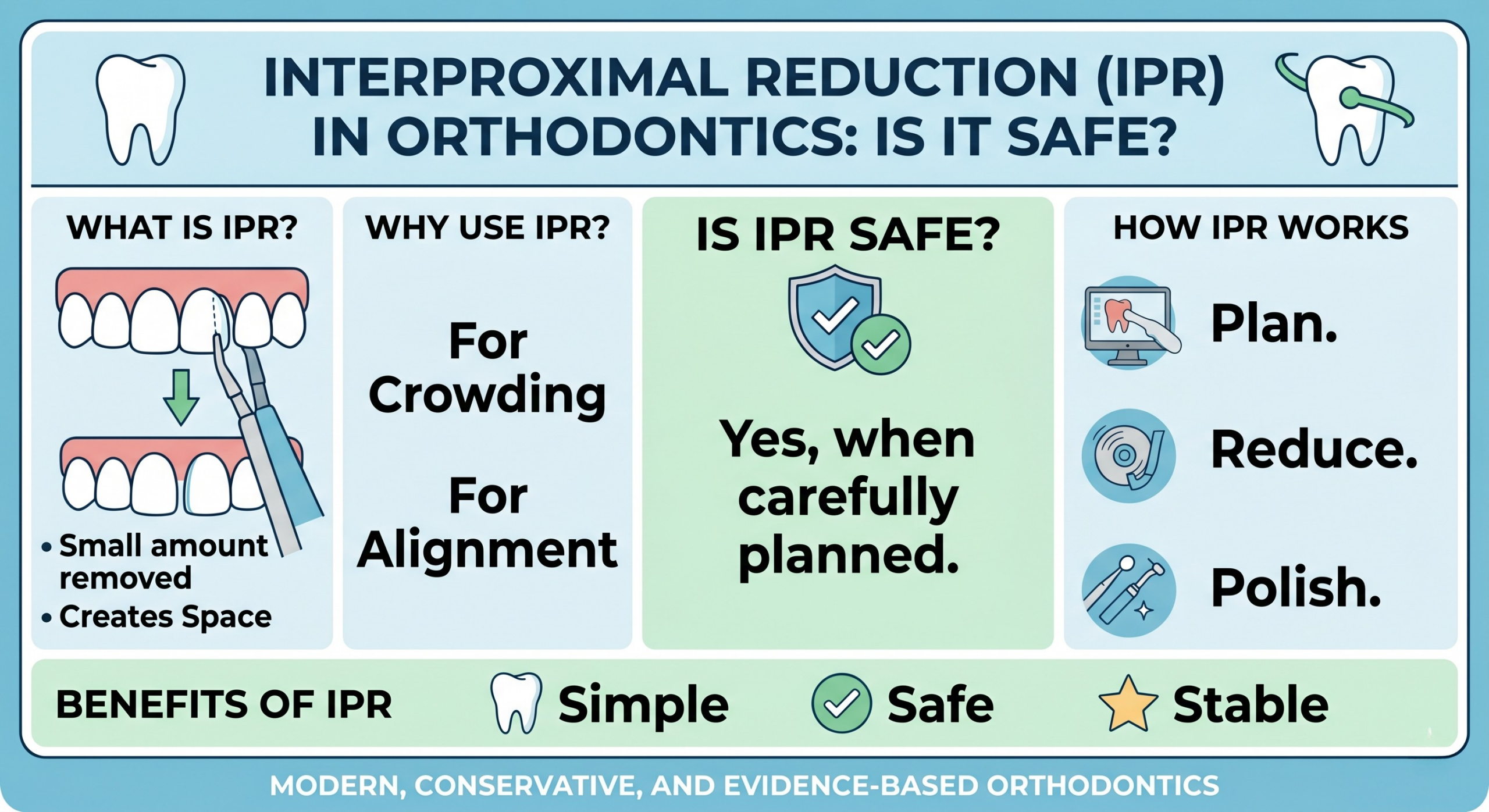
What Is Interproximal Reduction?
Interproximal Reduction (IPR), sometimes called enamel reduction, enamel reshaping, tooth slenderizing, or contact point reshaping, is a minimally invasive orthodontic procedure used to create small amounts of space between teeth. Orthodontists commonly use this technique to address mild to moderate dental crowding, tooth-size discrepancies, and arch length discrepancies while preserving the patient’s natural dentition.
Rather than removing a permanent tooth, the orthodontist carefully removes a controlled amount of enamel from the proximal surfaces of selected teeth. These surfaces include the mesial and distal surfaces where neighboring teeth meet. Because only a fraction of a millimeter of enamel is removed, IPR is considered a conservative enamel reduction technique and an important component of modern non-extraction orthodontics.
As part of orthodontic treatment planning, clinicians evaluate tooth anatomy, enamel thickness, dental arch dimensions, bite relationships, and overall oral health to determine whether interproximal reduction is appropriate. In many cases, the procedure helps create treatment space while maintaining functional occlusion and smile aesthetics.
Understanding the Basics of IPR
The outer layer of every tooth is made of dental enamel, the hardest substance in the human body. Beneath the enamel lies dentine, which helps support the tooth structure. During interproximal reduction, only the outer enamel layer is adjusted while preserving the structural integrity of the tooth.
Orthodontists often use diagnostic records, digital orthodontic scans, intraoral scanners, dental impressions, panoramic radiographs, and cephalometric analysis to determine precisely how much space is required. Digital treatment planning allows clinicians to perform space management accurately and predictably.
Why Orthodontists Use IPR
Interproximal reduction is commonly recommended when:
- Mild to moderate tooth crowding exists
- A tooth-size discrepancy is present
- Arch length discrepancy affects alignment
- Black triangles appear between teeth
- Additional space is needed for clear aligners
- Orthodontic efficiency can be improved
- Non-extraction treatment is preferred
- Smile aesthetics require refinement
In many cases, orthodontists use Bolton Analysis to evaluate proportional differences between upper and lower tooth sizes. This assessment helps determine whether IPR can improve occlusal relationships and treatment outcomes.
How Interproximal Reduction Works
The procedure is straightforward and usually performed during a routine orthodontic appointment. Before treatment begins, the orthodontist develops an individualized treatment plan based on the patient’s orthodontic diagnosis, malocclusion, crowding severity, and treatment objectives.
Tools Used During the Procedure
Several specialized instruments may be used, including:
- Abrasive strips
- Diamond-coated discs
- Mechanical reduction systems
- Enamel polishing instruments
- Thickness gauges
These tools allow precise enamel reduction while maintaining smooth proximal surfaces and natural tooth contours.
How Much Enamel Is Removed?
One of the most common concerns patients have is the amount of enamel removed during interproximal reduction. In most situations, between 0.1 mm and 0.5 mm of enamel is removed per contact point.
The orthodontist carefully calculates the required reduction to create space redistribution without compromising enamel integrity. After enamel reduction, the tooth surfaces are polished to minimize enamel surface roughness and support long-term oral health.
Benefits of Interproximal Reduction
Interproximal reduction provides numerous clinical and aesthetic advantages.
Creating Space Without Extractions
One of the greatest benefits of IPR is its ability to create treatment space without extracting healthy permanent teeth.
Advantages include:
- Preservation of natural teeth
- Conservative treatment planning
- Reduced need for extraction therapy
- Improved patient comfort
- Better maintenance of dental arch form
For many patients, this approach supports minimally invasive orthodontics while achieving excellent alignment results.
Improving Tooth Alignment
Space creation facilitates predictable tooth movement and allows orthodontic appliances to function more efficiently. Whether a patient is wearing fixed braces, metal braces, ceramic braces, lingual braces, or clear aligners, properly distributed space contributes to improved treatment predictability.
The relationship is straightforward:
- Interproximal reduction creates space.
- Space creation facilitates tooth movement.
- Tooth movement improves dental occlusion.
- Improved occlusion enhances oral function.
Enhancing Long-Term Stability
Long-term stability is a major goal of orthodontic treatment. By resolving crowding and improving occlusal stability, interproximal reduction may contribute to more stable treatment outcomes.
After treatment, orthodontic retention remains essential. Retainer wear helps maintain tooth position and reduces the risk of orthodontic relapse. Proper retention protocols support post-treatment retention and long-term treatment stability.
Is Interproximal Reduction Safe?
When performed by a qualified orthodontist, interproximal reduction is widely regarded as a safe and evidence-based procedure.
Scientific research has consistently demonstrated that carefully controlled enamel reduction does not significantly increase the risk of dental caries, tooth loss, gingivitis, or periodontal disease when oral hygiene is maintained properly.
Scientific Evidence Supporting IPR
Clinical studies show that
- Orthodontists preserve enamel integrity through careful planning.
- Controlled enamel reshaping remains within biological safety limits.
- Properly polished enamel surfaces are well tolerated.
- Long-term dental health can be maintained following treatment.
Modern orthodontic treatment planning incorporates digital scans, clinical examination findings, and detailed diagnostic records to ensure patient suitability and minimize risk.
Enamel Preservation Considerations
Although enamel does not regenerate, the oral environment contains protective mechanisms that support enamel health.
These include:
- Saliva-mediated remineralisation
- Natural remineralisation processes
- Fluoride uptake
- Fluoride remineralisation
- Good oral hygiene practices
Saliva naturally promotes remineralization by supplying essential minerals to enamel surfaces. Fluoride toothpaste further strengthens enamel and enhances resistance to demineralization.
Potential Risks and Side Effects
As with any dental procedure, interproximal reduction carries some potential risks, although complications are relatively uncommon.
Temporary Sensitivity
Some patients experience temporary tooth sensitivity after treatment. This sensitivity is generally mild and short-lived.
Triggers may include:
- Cold drinks
- Hot beverages
- Sweet foods
- Air exposure
Most cases resolve naturally within a short period.
Oral Hygiene Considerations
Maintaining excellent oral hygiene remains crucial after IPR.
Patients should:
- Brush twice daily using fluoride toothpaste
- Floss regularly
- Attend professional dental cleaning appointments
- Follow orthodontic instructions
- Monitor gum health
Poor plaque control can lead to biofilm accumulation, which increases the risk of dental caries and gingivitis. Healthy periodontal tissues provide the foundation for successful orthodontic treatment and long-term oral health.
Who Is a Good Candidate for IPR?
Not every patient requires interproximal reduction.
Ideal candidates often include individuals with:
- Mild to moderate crowding
- Healthy enamel thickness
- Healthy periodontal health
- Tooth-size discrepancies
- Minor arch length discrepancies
- Black triangles between teeth
- Clear aligner treatment plans
- Non-extraction treatment goals
However, patients with excessive tooth wear, thin enamel, severe crowding, or advanced periodontal concerns may require alternative treatment approaches.
An informed consent discussion should always include treatment alternatives, potential risks, expected benefits, and individual suitability.
Interproximal Reduction and Clear Aligners
The rise of clear aligner therapy has significantly increased the use of interproximal reduction.
Many aligner systems depend on carefully planned space creation to facilitate sequential tooth movement. During staged IPR, enamel reduction may be performed at specific points throughout treatment to improve aligner tracking and treatment predictability.
Benefits include:
- Improved aligner fit
- Enhanced aligner tracking
- Greater orthodontic efficiency
- Better final tooth positioning
- Reduced treatment complications
Additional orthodontic features such as attachment placement may also improve aligner retention and treatment effectiveness.
Aesthetic Benefits of Interproximal Reduction
Beyond crowding relief, interproximal reduction can improve smile aesthetics.
One common concern is the appearance of black triangles, also known as open gingival embrasures. These spaces can develop due to tooth shape, gum anatomy, or orthodontic movement.
By carefully reshaping contact points and modifying tooth proportions, orthodontists can:
- Reduce black triangle visibility
- Improve gingival embrasures
- Enhance smile design
- Create more harmonious tooth proportions
- Improve patient satisfaction
Aesthetic finishing and detailing are important aspects of comprehensive orthodontic care.
What to Expect During and After Treatment
Patients are often surprised by how simple and comfortable the procedure feels.
A typical appointment may include:
- Clinical examination
- Digital treatment planning review
- Measurement of required space
- Controlled enamel reduction
- Enamel polishing
- Verification of space creation
Following treatment, patients can usually resume normal daily activities immediately.
Recovery and Maintenance Tips
To protect long-term oral health:
- Maintain excellent plaque control
- Use fluoride toothpaste daily
- Stay hydrated
- Attend regular dental check-ups
- Follow retention instructions carefully
- Wear retainers as prescribed
These habits help preserve treatment results and support long-term occlusal stability.
Common Myths About Interproximal Reduction
Myth 1: IPR Damages Teeth
Reality: Conservative enamel reduction removes only small amounts of enamel while preserving tooth function and structure.
Myth 2: Teeth Become Weak
Reality: Orthodontists carefully evaluate enamel thickness before treatment to ensure safe reduction levels.
Myth 3: IPR Causes Permanent Sensitivity
Reality: Most sensitivity is temporary and resolves naturally.
Myth 4: Extractions Are Always Better
Reality: Many patients can achieve successful outcomes through non-extraction orthodontics using interproximal reduction.
Myth 5: The Procedure Is Painful
Reality: Most patients experience little to no discomfort during treatment.
Frequently Asked Questions
1. What is Interproximal Reduction (IPR) in orthodontics?
Interproximal Reduction (IPR) is a minimally invasive orthodontic procedure that involves removing a very small amount of enamel from between teeth. The goal is to create space for tooth movement, improve alignment, and reduce crowding without extracting healthy teeth.
2. Is interproximal reduction safe for teeth?
Yes. When performed by a qualified orthodontist, IPR is considered a safe and evidence-based procedure. Only a controlled amount of enamel is removed, and treatment is carefully planned to preserve enamel integrity and long-term oral health.
3. How much enamel is removed during IPR?
Typically, between 0.1 mm and 0.5 mm of enamel is removed from selected contact points. The exact amount depends on factors such as tooth-size discrepancy, crowding severity, and the overall orthodontic treatment plan.
4. Does interproximal reduction hurt?
Most patients experience little to no discomfort during the procedure. Some individuals may notice mild temporary sensitivity to hot or cold foods afterwards, but this usually resolves within a few days.
5. Can IPR damage tooth enamel permanently?
IPR removes a small amount of enamel permanently; however, the procedure is carefully controlled to stay within safe biological limits. Orthodontists evaluate enamel thickness before treatment to ensure sufficient enamel remains to protect the teeth.
6. Does enamel grow back after interproximal reduction?
No, dental enamel does not regenerate naturally. However, saliva-mediated remineralization and fluoride exposure can strengthen the remaining enamel and help maintain its resistance to decay.
7. Why is IPR often used with clear aligners?
Clear aligners require adequate space for predictable tooth movement. Interproximal reduction helps create that space, improving aligner tracking, treatment efficiency, and final tooth positioning without the need for extractions in many cases.
8. Can interproximal reduction prevent tooth extractions?
In some cases, yes. For patients with mild to moderate crowding or minor arch length discrepancies, IPR can create enough space to avoid removing permanent teeth as part of orthodontic treatment.
9. What is a tooth-size discrepancy, and how does IPR help?
A tooth-size discrepancy occurs when the size relationship between the upper and lower teeth affects how they fit together. Orthodontists may use Bolton Analysis to identify these discrepancies and use IPR to improve occlusion and alignment.
10. Does IPR increase the risk of cavities?
Research indicates that properly performed and polished IPR does not significantly increase the risk of dental caries. Maintaining good oral hygiene, regular dental check-ups, and fluoride use are important for preventing decay.
Conclusion
Interproximal Reduction (IPR) is a safe, conservative, and scientifically supported orthodontic procedure that creates valuable treatment space while preserving natural teeth. By addressing crowding, tooth-size discrepancies, arch length discrepancies, and aesthetic concerns such as black triangles, IPR plays a vital role in modern orthodontic treatment planning.
When performed by an experienced orthodontist, interproximal reduction supports predictable tooth movement, improved occlusal relationships, enhanced smile aesthetics, and long-term treatment stability. Combined with proper oral hygiene, fluoride use, regular professional care, and consistent retainer wear, IPR can help patients achieve healthy, functional, and attractive orthodontic outcomes.