
Dental bridge types like cantilever and Maryland bridges each solve different problems. Here’s how to pick the right one for your smile.
What Is a Dental Bridge and How Does It Work?
A dental bridge is a fixed restoration that fills the gap left by one or more missing teeth. Instead of leaving that space open, where neighboring teeth can drift and your bite can shift into a malocclusion, a bridge literally “bridges” the gap with an artificial tooth called a pontic. That pontic is held in place by anchoring it to an abutment tooth, and this is where dental bridge types start to differ from one another.
Not every mouth calls for the same solution. Some patients have strong, healthy teeth on both sides of the gap. Others might have just one adjacent tooth available, or none at all. That’s exactly why cantilever and Maryland bridges exist as distinct options rather than a one-size-fits-all fix. Both are conservative alternatives to a traditional fixed bridge (sometimes called a three-unit bridge), and both sidestep the need for a dental implant in cases where implants aren’t ideal or aren’t affordable. A single tooth implant or an implant-supported bridge remains an option too, but it involves surgery and a longer treatment timeline, which isn’t the right fit for every patient or budget.
Understanding how each type works, and where each one shines, puts you in a much stronger position when you’re sitting in the dentist’s chair discussing options.
Understanding Cantilever Bridges
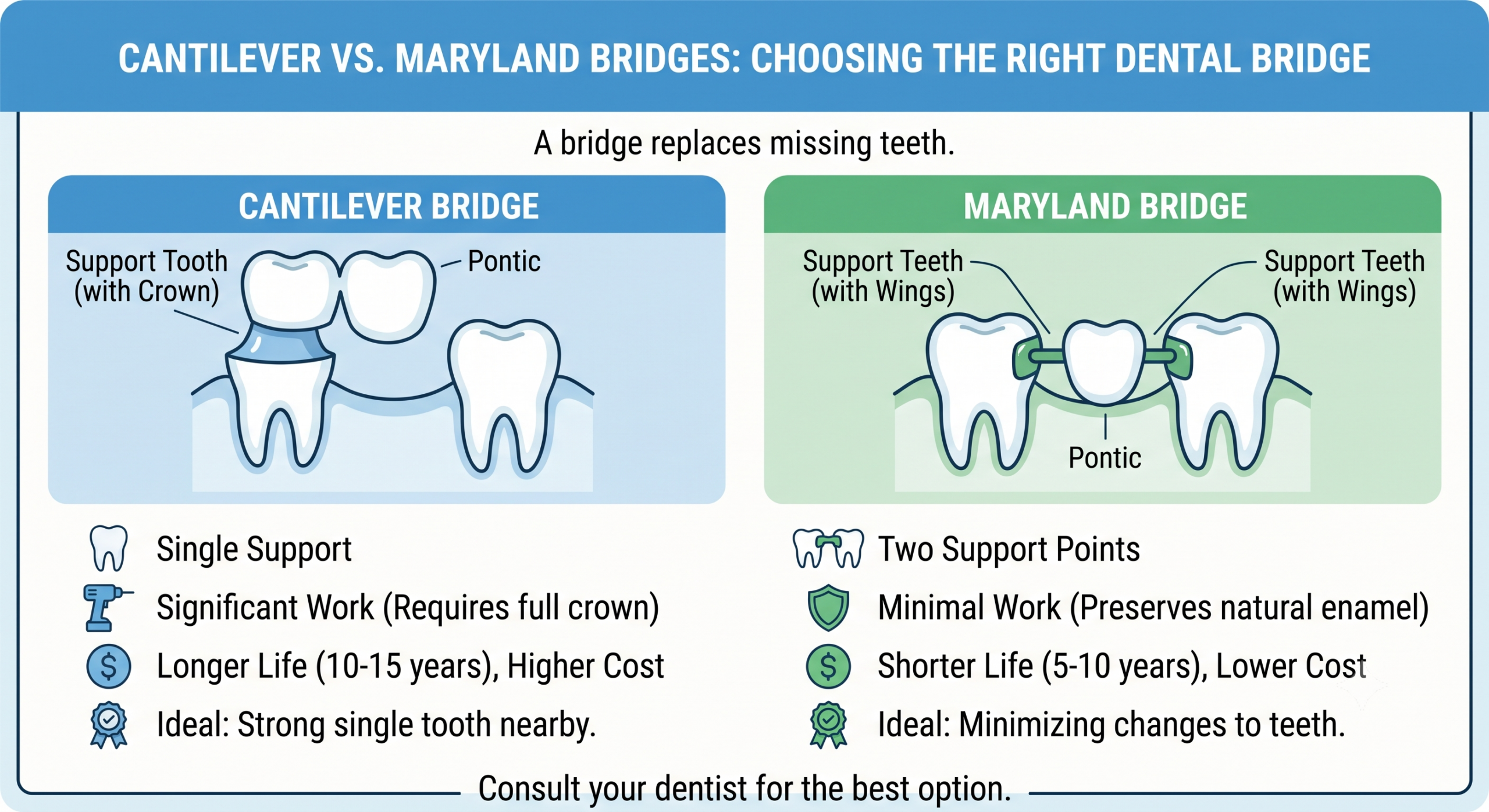
A cantilever bridge is a bit like a diving board. One end is firmly anchored, while the other end extends outward without direct support underneath it. In dental terms, this means the pontic is attached to a crown on just one side, rather than being supported by abutment teeth on both sides of the gap.
This design comes in handy when there’s only one healthy tooth next to the missing space, which happens more often than you might think, especially toward the back of the mouth or after an extraction where the tooth on the far side isn’t strong enough to anchor a crown.
How Cantilever Bridges Are Built
The process starts with reshaping the single abutment tooth so it can support a crown. Your dentist takes impressions, often using an intraoral scanner for a precise digital model, and a dental lab fabricates a bridge unit that includes the crown and the attached pontic. The crown itself is typically made from porcelain-fused-to-metal (PFM), zirconia, or lithium disilicate, each offering a different balance of strength and translucency. Zirconia in particular has become popular for its combination of durability and a natural, tooth-like appearance. Once the crown and pontic are ready, they’re cemented onto the abutment tooth as a single unit, with the pontic supported entirely by that one connection.
Because there’s no support on the far side, the abutment tooth, its periodontal ligament, and the surrounding alveolar bone take on extra biting force. That’s why dentists are selective about where cantilever bridges get placed. They tend to work best in low-stress areas of the mouth rather than spots that handle heavy chewing pressure.
Who Is a Good Candidate for a Cantilever Bridge?
Cantilever bridges suit patients who
- Have only one healthy, strong tooth adjacent to the gap
- Are missing a tooth in a lower-stress area, such as toward the front of the mouth
- Want to avoid the cost or invasiveness of an implant
- Have adequate alveolar bone density around the abutment tooth, which your dentist typically confirms with a panoramic X-ray or cone beam CT scan (CBCT) before treatment
- Don’t have active periodontal disease or significant tooth mobility affecting the abutment tooth
If your dentist recommends this option, it’s usually because your case fits these criteria well, not because it’s a “lesser” choice. It’s simply the right tool for a specific job. In more complex cases, your general dentist may refer you to a prosthodontist, a specialist credentialed by organizations like the American College of Prosthodontists for advanced restorative work.
Understanding Maryland Bridges
A Maryland bridge (also called a resin-bonded bridge) takes an entirely different approach. Rather than crowning a full tooth for support, it uses a metal or porcelain framework bonded directly to the back surfaces of the adjacent abutment teeth. Think of it as a more conservative cousin of the traditional fixed bridge, since it preserves much more of your natural tooth structure.
This type became especially popular for replacing front teeth, where appearance matters most and patients want a solution that doesn’t require grinding down healthy enamel.
How Maryland Bridges Are Built
The pontic is fused to a thin retainer wing on either side, typically made from a nickel-chromium alloy, a fiber-reinforced composite, or a porcelain framework, depending on the strength and aesthetics needed. These wings are bonded, not cemented like a crown, to the inner surfaces of the neighboring teeth using a strong resin cement after a light enamel etching technique roughens the surface for adhesion. There’s minimal to no reshaping of the abutment teeth involved, which is a major selling point for patients who are hesitant about permanently altering healthy teeth.
Because the bonding relies on adhesive strength rather than a full crown, Maryland bridges are generally reserved for areas with lighter bite forces. Biocompatibility also matters here: metal alloy frameworks are chosen carefully for patients with known sensitivities, and porcelain or composite resin alternatives are available for those who prefer a metal-free restoration.
Who Is a Good Candidate for a Maryland Bridge?
This option tends to work well for patients who:
- Are missing a front tooth and want a natural, minimally invasive fix
- Have healthy abutment teeth that don’t need crowns for other reasons, and no signs of dental caries or gingival recession at the bonding site
- Prefer to preserve as much natural enamel as possible
- Don’t have heavy bruxism (teeth grinding or clenching) that could stress the bonded retainer wings
Cantilever vs. Maryland Bridges: Key Differences
When you put these two dental bridge types side by side, a few clear patterns emerge. Let’s break down where they diverge and how each compares to other alternatives like a removable partial denture or a dental implant.
Durability and Longevity
Cantilever bridges, because they involve a full crown, tend to hold up well under moderate use, often lasting 10 to 15 years with good care. Maryland bridges, while durable for their design, rely on the strength of a bonded connection, which can be more prone to debonding over time, especially if bruxism places repeated stress on the retainer wings.
Cost Considerations
Maryland bridges are typically less expensive than cantilever bridges. Since they don’t require reshaping and crowning a healthy tooth, there’s less lab work and fewer visits involved in many cases. Cantilever bridges cost more upfront but often deliver a longer functional lifespan, which can even out the value over time. Many dental insurance plans use specific CDT codes to determine coverage for each bridge type, so it’s worth asking your provider how much of the cost is covered. Financing options like an HSA, FSA, or a dental credit line such as CareCredit can also help spread out the expense.
Aesthetic Outcomes
Both options can look natural, but Maryland bridges often edge ahead cosmetically for front teeth, since there’s no visible crown margin and the bonded wings are hidden behind the tooth. Cantilever bridges can also look great, particularly with zirconia or lithium disilicate crowns, though the crown on the abutment tooth is more noticeable up close if placed in a visible area.
Effect on Neighboring Teeth
This is where the two types diverge the most. A cantilever bridge requires reshaping a healthy tooth into a crown, which is permanent and irreversible. A Maryland bridge is far gentler, since it typically doesn’t require removing much, if any, enamel. If preserving your natural tooth structure is a priority, that’s worth bringing up directly with your dentist.
Pros and Cons at a Glance
| Feature | Cantilever Bridge | Maryland Bridge |
| Support Structure | Single abutment tooth with a full crown | Two abutment teeth with bonded retainer wings |
| Common Materials | PFM, zirconia, lithium disilicate | Nickel-chromium alloy, fiber-reinforced composite, porcelain |
| Tooth Preparation | Significant, permanent reshaping required | Minimal to none |
| Best Placement Zone | Lower-stress areas of the mouth | Front teeth, lighter bite areas |
| Average Lifespan | 10-15 years | 5-10 years, varies with bonding strength |
| Relative Cost | Higher | Lower |
| Aesthetic Result | Very good | Excellent, especially for front teeth |
| Reversibility | No | Mostly yes |
How to Choose the Right Bridge Type for Your Smile
There isn’t a universal winner between these dental bridge types, and a traditional fixed bridge, a removable partial denture, or a dental implant may outperform both in certain situations. It really comes down to your specific mouth, your bite habits, and what you value most, whether that’s longevity, cost, or preserving natural enamel.
A few practical questions can help guide the conversation with your dentist:
- How many healthy abutment teeth do I have next to the gap?
- Is the missing tooth in a high-pressure chewing zone or a lighter-use area?
- Do I have bruxism, periodontal disease, or any tooth mobility that could affect the outcome?
- How important is minimizing changes to my natural teeth?
- What’s my budget, and how does my insurance’s CDT coverage compare across bridge types?
Your dentist will also factor in your bone health, gum condition, and overall oral hygiene habits before recommending one path over the other. In more involved cases, a referral to a prosthodontist, sometimes guided by continuing education standards from groups like the Academy of General Dentistry, can help ensure you get the most appropriate long-term solution. It’s a genuinely collaborative decision, not something you have to figure out alone.
The Dental Bridge Placement Process
Regardless of which type you and your dentist choose, the general process follows a similar rhythm:
- Initial consultation and imaging. A panoramic X-ray or CBCT scan evaluates bone density and abutment tooth health, while a visual exam checks for dental caries, gingival recession, or periodontal disease.
- Tooth preparation. For cantilever bridges, this means reshaping the abutment tooth for a crown. For Maryland bridges, it’s a much lighter touch, sometimes just enamel etching to prepare the surface for resin cement bonding.
- Digital scans or impressions, plus bite registration. An intraoral scanner or traditional impression captures the shape of your teeth, and a bite registration records how your upper and lower teeth meet so the lab can avoid creating a new occlusal problem.
- Fabrication. Many labs now use CAD/CAM technology to design and mill the crown, pontic, or framework with tight precision, often faster than older manual methods.
- Temporary bridge placement. While the permanent piece is being made, you’ll usually wear a temporary to protect the area.
- Final fitting and bonding. Once the permanent bridge arrives, your dentist checks the fit, makes any occlusal adjustment needed for a comfortable bite, and either cements (cantilever) or bonds (Maryland) it into place.
Most patients find the process comfortable, and local anesthesia keeps any preparation work pain-free.
Caring for Your Dental Bridge
Whichever type you choose, a few habits will help it last:
- Brush twice daily, paying close attention to the area where the bridge meets the gum line to prevent gingival recession or new dental caries.
- Use floss threaders or a water flosser to clean underneath the pontic, since regular floss can’t always reach that space.
- Avoid biting down on very hard foods, especially with Maryland bridges, since excessive force can weaken the bonded retainer wings.
- Keep up with regular dental checkups so your dentist can monitor abutment tooth health, gum condition, and early signs of wear or loosening.
- Wear a nightguard if you have bruxism, particularly important for protecting a Maryland bridge’s bonded connection.
Good habits go a long way. A well-maintained bridge, cantilever or Maryland, can comfortably outlast its average expected lifespan.
Frequently Asked Questions
1. Are cantilever bridges bad for your teeth?
Not inherently. They do place extra stress on the single abutment tooth and its supporting alveolar bone, which is why dentists reserve them for lower-pressure areas of the mouth. With proper placement and care, they’re a safe, reliable option.
2. How long do Maryland bridges typically last?
Most Maryland bridges last somewhere between five and ten years, though this varies based on bruxism, oral hygiene, and how well the resin cement bond holds up over time.
3. Can a Maryland bridge be used for back teeth?
It’s uncommon. Maryland bridges rely on bonding strength rather than a full crown, so the retainer wings generally aren’t strong enough for the heavier chewing forces found in the back of the mouth.
4. Is a cantilever bridge more painful than other bridge types?
No, the discomfort level is similar to any bridge procedure. You’ll receive local anesthesia during preparation, and any post-procedure sensitivity typically fades within a few days.
5. Which option is cheaper, a cantilever or Maryland bridge?
Maryland bridges are usually the more budget-friendly choice, since they require less tooth preparation and simpler lab work. Cantilever bridges cost more but often last longer, and checking your plan’s CDT coverage for each can clarify your actual out-of-pocket cost.
6. Do dental insurance plans cover these bridge types?
Many plans cover a portion of the cost for both types under specific CDT procedure codes, though coverage details vary widely. It’s worth confirming with your insurance provider and your dental office before starting treatment and asking about HSA, FSA, or CareCredit financing if needed.
7. Can I switch from a Maryland bridge to a different type later?
Yes. Since Maryland bridges are minimally invasive, they generally don’t limit your future options. If it fails or you’d prefer a different solution down the road, you can transition to a cantilever bridge, a traditional fixed bridge, a removable partial denture, or a dental implant.
Conclusion
Choosing between cantilever and Maryland bridges isn’t about picking the “better” option in general. It’s about matching the right dental bridge type to your specific situation, your remaining abutment teeth, your bite habits, and your priorities around cost, appearance, and long-term durability. A cantilever bridge offers strength and longevity when you’ve got one solid anchor tooth to work with. A Maryland bridge offers a gentler, more conservative fix that’s especially well-suited to front teeth.
The best next step is a conversation with your dentist, or a prosthodontist for more complex cases, who can evaluate your mouth directly with the right imaging and diagnostics and walk you through which option fits your needs.