
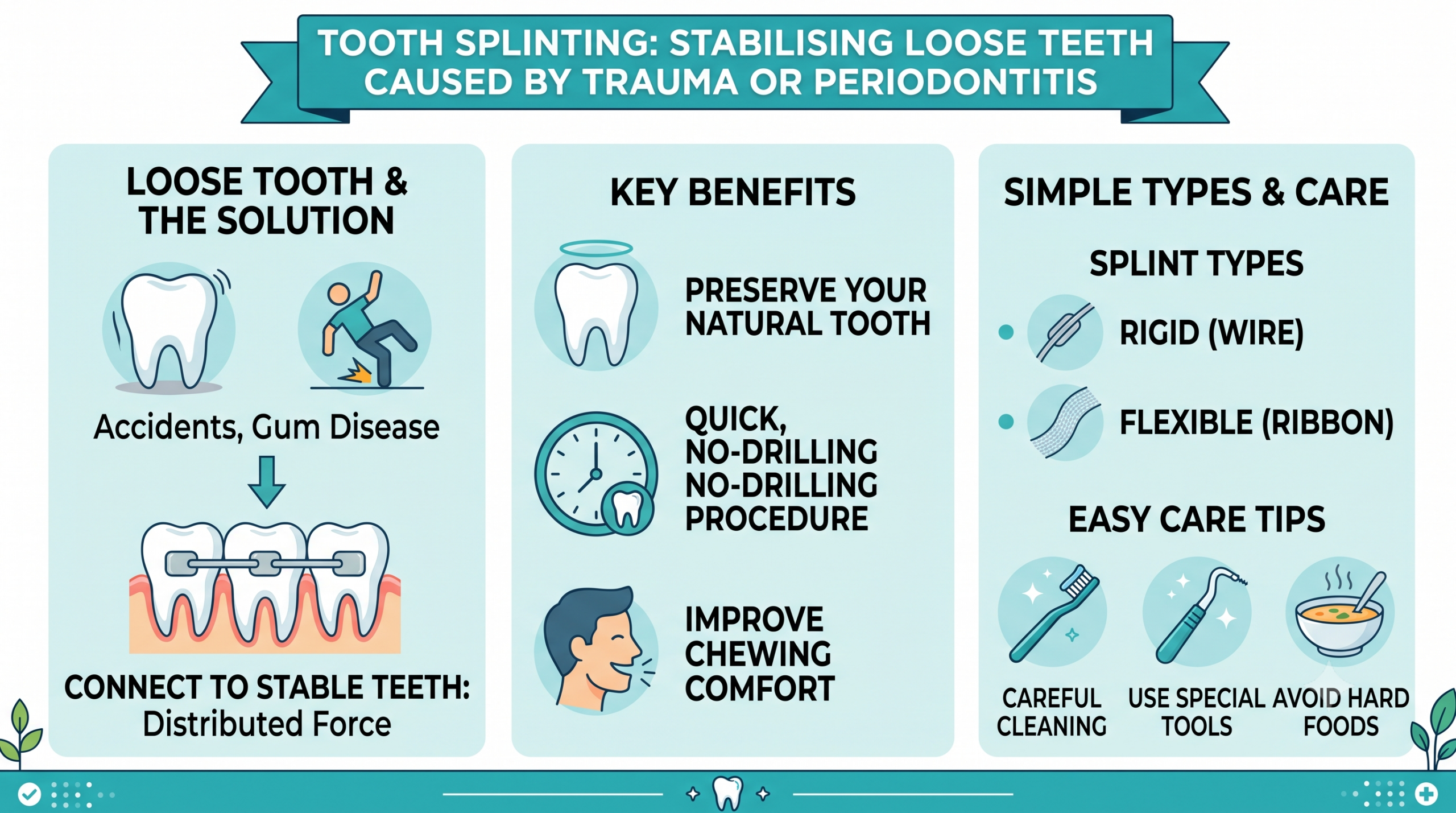
A loose tooth is unsettling, whether it happened in a split second from a fall or crept up slowly over months of gum disease. The good news is that you don’t automatically need an extraction. Tooth splinting is a well-established dental technique that stabilizes mobile teeth long enough for the surrounding bone and periodontal ligament to heal or holds teeth securely when periodontal support has been compromised. This article walks through what tooth splinting involves, when dentists recommend it, and what patients can expect before, during, and after treatment.
What Is Tooth Splinting?
Tooth splinting is a dental procedure that joins a loose tooth to its neighboring, stable teeth. Think of it like a cast for a broken bone, except instead of plaster, dentists use a thin wire, fiber-reinforced ribbon, or composite resin material bonded to the back or front surfaces of the teeth. This splint acts as a bridge, distributing biting forces across several teeth instead of concentrating stress on the injured one.
The technique isn’t new. Dentists have splinted teeth for decades, but materials have improved dramatically. Modern splints are thinner, more comfortable, and far less noticeable than older metal-based versions. In many cases, patients barely notice the splint is there once it’s bonded in place.
Splinting doesn’t replace a tooth or repair a fracture inside it. Instead, it addresses mobility, the wobbling or shifting of a tooth within its socket, giving the periodontal ligament (PDL) fibers and surrounding alveolar bone the stability they need to reattach and recover.
Why Teeth Become Loose: Trauma or Periodontitis
Tooth mobility isn’t a condition on its own; it’s a symptom of something else going on beneath the gumline. Two causes account for the vast majority of splinting cases.
Traumatic Dental Injuries
A blow to the face, a sports collision, a fall, or a car accident can partially dislodge a tooth from its socket without knocking it out entirely. This is called a subluxation or, in more severe cases, a luxation injury. The periodontal ligament, the network of fibers anchoring the tooth root to the cementum on the root surface, gets stretched or torn, and the tooth becomes mobile.
A more severe outcome is avulsion, where the tooth is knocked completely out of its socket. Avulsion is a genuine dental emergency. If a tooth is replanted quickly, ideally within an hour, and then splinted, the odds of long-term survival improve significantly. The International Association of Dental Traumatology (IADT) publishes widely followed clinical guidelines covering exactly how avulsed and luxated teeth should be handled, including specific splinting durations for each injury type.
Kids and teenagers experience these injuries frequently during contact sports or playground accidents, but adults aren’t immune either. Even a seemingly minor knock can loosen a tooth enough to require stabilization.
Periodontal Disease Progression
Chronic gum disease works differently but arrives at the same outcome. Untreated periodontitis gradually destroys the alveolar bone and connective tissue supporting teeth, often accompanied by gingival recession that exposes more of the root surface. As the foundation weakens, teeth begin to drift, shift position, and eventually loosen. In more advanced cases, furcation involvement, where bone loss reaches the point between the roots of multi-rooted teeth, can accelerate mobility further. Unlike a traumatic injury, this process happens gradually, often over years, and patients may not notice mobility until it’s fairly advanced.
In periodontitis cases, splinting isn’t just about healing; it’s about preventing further drift and making chewing more comfortable while a periodontist or general dentist treats the underlying gum disease, typically starting with scaling and root planing to remove subgingival plaque and biofilm from the root surfaces.
How Tooth Splinting Works
Dentists typically choose from a few material types: stainless steel wire, fiber-reinforced composite ribbon, or a rigid composite resin bar, sometimes paired with glass ionomer cement. Fiber-reinforced splints have become the most popular option because they’re tooth-colored, thin, and flexible enough to allow a small amount of natural tooth movement, which actually supports healing rather than hindering it.
The splint material is laid across the back, or occasionally the front, surface of the loose tooth and the two or three stable teeth on either side. An etchant, usually a phosphoric acid gel, is applied first to prepare the enamel surface so the bonding resin adheres properly. No drilling or removal of tooth structure is usually necessary, which makes the procedure quick and generally painless.
Types of Dental Splints
| Splint Type | Material | Common Use Case | Duration |
| Rigid Splint | Stainless steel wire or heavy composite resin | Severe trauma, root fractures | Several weeks to months |
| Flexible Splint | Fiber-reinforced ribbon | Mild to moderate mobility | 2 to 4 weeks (trauma); months to permanent (periodontal) |
| Removable Splint | Custom acrylic retainer or night guard | Mild periodontal mobility, bruxism management | Ongoing, as needed |
Rigid splints hold teeth completely still. They’re generally reserved for more severe injuries, such as fractures near the root or significant displacement, where any movement could interfere with healing.
Flexible splints allow a controlled, minor degree of movement. Research has shown that some physiological movement actually encourages the periodontal ligament to heal in a healthier, more functional way compared to completely immobilizing the tooth, and it also lowers the risk of ankylosis, a complication where the tooth fuses directly to the alveolar bone instead of healing through the ligament.
For patients with periodontitis-related mobility who don’t need round-the-clock stabilization, a removable splint resembling a retainer or night guard can hold teeth in place, particularly overnight when bruxism, or teeth grinding, places extra strain on already weakened gums.
When Is Tooth Splinting Recommended?
Not every loose tooth needs splinting, but a dentist will typically consider it when:
- A tooth has been partially dislodged from trauma and shows visible or measurable mobility
- Periodontal disease has caused noticeable tooth movement or drifting
- A patient is having difficulty chewing comfortably due to tooth instability
- Splinting can prevent a tooth from worsening while other treatments, such as scaling and root planing, root canal therapy, or guided tissue regeneration to rebuild lost bone, take effect
- The alternative would be extraction, and the tooth still has a reasonable chance of stabilizing
A thorough clinical exam, plus X-rays or, in more complex trauma cases, a cone beam CT (CBCT) scan, helps the dentist assess bone levels, root condition, and whether a fracture exists that a standard 2D X-ray might miss.
The Tooth Splinting Procedure: Step by Step
Diagnosis and Assessment
Before any splint goes on, the dentist grades the degree of mobility using the Miller Mobility Index, a standard scale running from Grade I (slight movement) to Grade III (severe movement, including vertical displacement). A percussion test and pulp vitality test are also typically performed after trauma to check whether the nerve inside the tooth has been affected. If periodontitis is the cause, a periodontal charting exercise measures pocket depth around each tooth to understand how much support remains and whether a periodontist referral is warranted.
Splint Placement
Once the treatment plan is confirmed, the procedure itself is straightforward:
- The teeth are cleaned and dried thoroughly
- Etchant gel is applied to the enamel surface to help the bonding resin adhere
- The splint material is positioned across the loose tooth and its stable neighbors
- A curing light hardens the bonding resin within seconds
- An occlusal adjustment is performed, checking the bite to ensure the splint doesn’t interfere with normal chewing
Most splinting appointments take between 30 and 60 minutes, and patients can typically eat and speak normally right afterward, though softer foods are recommended for the first day or two.
How Long Does a Dental Splint Stay in Place?
Duration depends entirely on the underlying cause. For traumatic injuries, IADT guidelines generally recommend splints stay in place for one to four weeks depending on the specific injury, just long enough for the periodontal ligament to reattach and stabilize. Leaving a rigid splint on too long after trauma can actually raise the risk of root resorption or ankylosis, so follow-up visits are essential to remove the splint at the right time.
For periodontitis-related mobility, splinting often becomes a longer-term or even permanent solution, since the underlying bone loss doesn’t regenerate on its own without additional procedures like guided tissue regeneration. In these cases, the splint functions more like ongoing structural support than a temporary healing aid.
Caring for Your Teeth After Splinting
Splints create small gaps and surfaces where plaque and biofilm can accumulate more easily than usual. Patients will need to adjust their brushing and flossing technique, and dentists often recommend a water flosser or interdental brushes to clean beneath the splint material effectively. Skipping this step can lead to gum inflammation right around the treated area, which defeats the purpose of the splint in the first place.
For the first week or so, sticking to softer foods and avoiding biting directly into hard items, think apples, crusty bread, or ice, reduces stress on the healing tooth. Chewing on the opposite side of the mouth when possible also helps.
Benefits of Tooth Splinting
- Preserves the natural tooth instead of resorting to extraction
- Non-invasive, with no drilling or removal of healthy tooth structure in most cases
- Relatively quick procedure, often completed in a single visit
- Distributes chewing forces evenly, reducing strain on the weakened tooth
- Cost-effective compared to extraction followed by an implant or bridge
- Aesthetically discreet, especially with tooth-colored fiber splints
Risks and Limitations of Tooth Splinting
Splinting isn’t a cure-all, and it’s worth understanding the limitations upfront. It doesn’t reverse bone loss from periodontitis; it simply provides mechanical support while other treatments, potentially including a periodontist’s care, address the disease itself. Splints left rigid for too long after a traumatic injury carry a risk of ankylosis or root resorption, both of which can shorten a tooth’s long-term prognosis. Splints can also make certain areas harder to clean, increasing biofilm and plaque buildup if oral hygiene isn’t adjusted accordingly. Occasionally, the bonding material can debond, wear, or chip and need repair. And in cases of severe trauma, an avulsion with a long extra-oral time, or advanced periodontal destruction with significant furcation involvement, a tooth’s prognosis may be too poor for splinting to make a meaningful difference, in which case extraction and replacement become the more realistic option.
Tooth Splinting vs. Extraction: Making the Right Choice
Deciding between saving a loose tooth through splinting and removing it altogether comes down to several factors: how much alveolar bone support remains, whether the root is intact, the patient’s oral hygiene habits, and the tooth’s overall long-term prognosis.
That said, a tooth with minimal bone support, an unrepairable root fracture, or a poor long-term outlook may be better extracted and replaced, rather than splinted temporarily only to fail again later. This is often where a general dentist brings in an endodontist for root-related concerns or a periodontist for bone and gum-related concerns to weigh in on the tooth’s true prognosis.
Cost of Tooth Splinting
Costs vary widely depending on geographic location, the number of teeth involved, and whether the splint is temporary or intended as a longer-term solution. Generally, splinting is significantly less expensive than extraction followed by an implant, since it doesn’t involve surgical placement or a lengthy healing and restoration process. Many dental insurance plans cover at least a portion of splinting when it’s deemed medically necessary following trauma or a periodontitis diagnosis, though coverage specifics differ between providers.
Frequently Asked Questions
1. Does tooth splinting hurt?
Most patients report little to no discomfort during the procedure itself since no drilling is involved. There may be mild tenderness around the treated area for a day or two afterward, similar to what you’d feel after any dental bonding work.
2. Can I eat normally with a dental splint?
You can eat relatively normally, though softer foods are recommended for the first few days, and biting directly into hard foods on the splinted side should be avoided until your dentist confirms the tooth has stabilized.
3. How do I clean around a tooth splint?
A water flosser, interdental brushes, or floss threaders work well for cleaning beneath and around the splint to keep biofilm from building up. Your dentist or hygienist can show you the specific technique for your splint type.
4. Will the splint be visible when I smile?
Fiber-reinforced splints are tooth-colored and typically placed on the back surface of the teeth, making them nearly invisible in everyday conversation and smiling.
5. What happens if the splint comes loose?
Contact your dentist right away. A debonded splint isn’t providing the stabilization your tooth needs, and it should be reattached or replaced promptly.
6. Is tooth splinting permanent?
It depends on the cause. Trauma-related splints are usually temporary, removed once healing is confirmed through follow-up mobility checks. Periodontal splints, on the other hand, are often left in place long-term since the underlying bone support doesn’t regenerate on its own.
Conclusion
Tooth splinting offers a practical, minimally invasive way to save a loose tooth rather than jumping straight to extraction. Whether the cause is a sudden traumatic injury or the slow progression of periodontitis, splinting gives compromised teeth the mechanical support they need to heal or function comfortably long-term. If you’re dealing with a wobbly tooth, don’t wait for it to worsen. A prompt evaluation gives your dentist, and if needed, a periodontist or endodontist, the best chance to recommend splinting while your tooth still has a strong prognosis for recovery.