
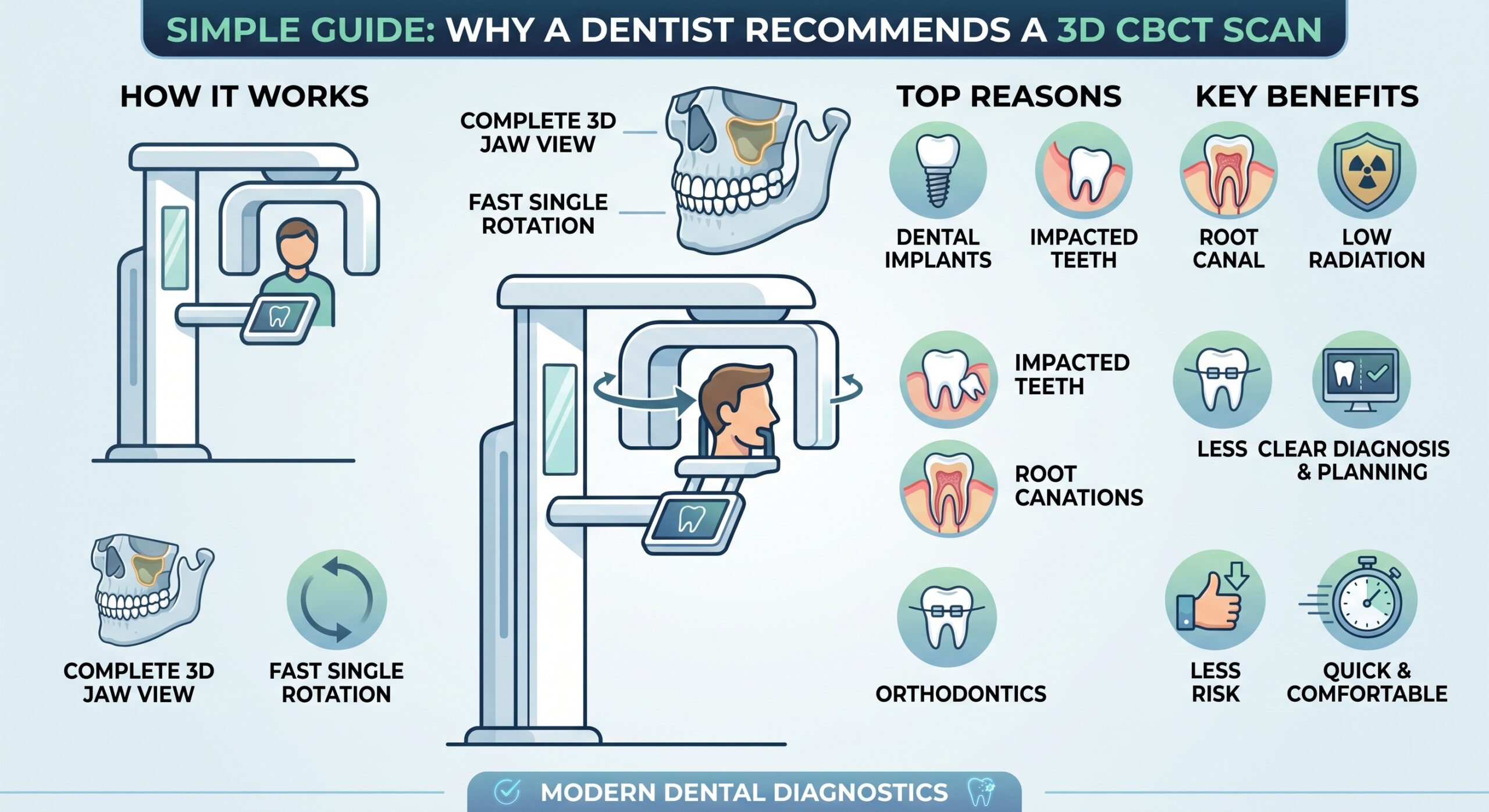
If your dentist has recently suggested a CBCT scan, you might be wondering what it is and why a standard X-ray is not enough. Cone Beam Computed Tomography, or CBCT, is a specialized type of dental imaging that has become an essential diagnostic tool in modern dentistry. Unlike traditional two-dimensional X-rays, a CBCT scan produces a detailed three-dimensional view of your teeth, jawbone, nerve pathways, and soft tissues in a single scan.
This article explains what a CBCT scan is, how it works, why your dentist might recommend one, and what you can expect during the procedure.
What Is a CBCT Scan?
CBCT stands for Cone Beam Computed Tomography. It is a specialized imaging technique that uses a cone-shaped X-ray beam to capture multiple images from different angles around your head. A computer then reconstructs these images into a single three-dimensional model.
Traditional dental X-rays, such as bitewings or panoramic radiographs, capture flat, two-dimensional images. While useful for spotting cavities or checking bone levels, they cannot show the true depth, width, and spatial relationship of structures inside your mouth and jaw. CBCT fills that gap by giving your dentist a complete volumetric picture, allowing them to view your anatomy from any angle, including cross sections that would be impossible to see with standard X-rays.
CBCT machines are compact enough to fit in many dental offices and typically complete a full scan in under a minute, with a significantly lower radiation dose than a traditional medical CT scan.
How Does CBCT Imaging Work?
During a CBCT scan, you sit or stand while the machine’s arm rotates around your head one time. As it rotates, the cone-shaped X-ray beam and a digital detector capture a series of images. Specialized software then stitches these images together to build a 3D reconstruction of your jaw, teeth, sinuses, nerve canals, and surrounding bone.
The entire process is painless and noninvasive. Most scans take between 10 and 40 seconds, though the appointment itself, including positioning and preparation, may take a bit longer. Once complete, your dentist can view the scan on a computer screen, rotating and slicing through the image to examine specific areas in detail.
Why Your Dentist Might Recommend a CBCT Scan
There are many clinical situations where a 3D view offers a level of detail that two-dimensional imaging simply cannot match. Here are some of the most common reasons your dentist might order a CBCT scan.
Dental Implant Planning
Before placing a dental implant, your dentist needs precise measurements of your jawbone, including its height, width, and density, as well as the exact location of nerves and sinuses. A CBCT scan allows for accurate implant placement planning, reducing the risk of complications such as nerve damage or sinus perforation, and helping ensure the implant is positioned for long-term stability and a natural-looking result.
Evaluating Impacted Teeth
Wisdom teeth and other impacted teeth do not always emerge in predictable positions. A CBCT scan gives your dentist or oral surgeon a clear view of exactly where an impacted tooth is located relative to nerves, adjacent teeth, and the jawbone. This information helps determine the safest extraction approach and can reduce the risk of nerve injury during surgery.
Root Canal Diagnosis and Treatment
Root canal systems can be complex, with extra canals, curves, or fractures that are difficult to detect on a flat X-ray. CBCT imaging helps your dentist identify hidden canals, assess the extent of infection, and detect root fractures, improving the accuracy of both diagnosis and treatment planning.
Diagnosing Jaw and TMJ Disorders
For patients experiencing jaw pain, clicking, or difficulty opening their mouth, a CBCT scan can provide detailed images of the temporomandibular joint (TMJ). This helps your dentist assess the joint structure and identify issues such as bone degeneration or joint misalignment that might not be visible on standard imaging.
Detecting Cysts, Tumors, and Bone Abnormalities
CBCT scans are highly effective at revealing cysts, tumors, or other abnormal growths within the jawbone, along with their exact size and location. Early detection through 3D imaging allows for more precise treatment planning and can help preserve healthy surrounding bone and tissue.
Airway and Sinus Evaluation
Because a CBCT scan captures the entire craniofacial region, it can also be used to evaluate the sinuses and airway. This is particularly useful for patients being assessed for sleep apnea or chronic sinus issues connected to their dental health.
Orthodontic and Surgical Treatment Planning
For complex orthodontic cases or jaw surgery, a 3D view of the skeletal structure helps your dentist or orthodontist plan tooth movement and surgical corrections with far greater precision than traditional imaging allows.
Is a CBCT Scan Safe?
CBCT imaging does involve exposure to X-ray radiation, but the dose is considerably lower than that of a traditional hospital CT scan, often by a significant margin depending on the field of view and machine settings. Dentists follow the ALARA principle, which stands for “As Low As Reasonably Achievable,” meaning imaging is only recommended when the diagnostic benefit clearly outweighs the minimal risk involved.
If you are pregnant, or if you have had recent radiation exposure from other medical procedures, let your dentist know beforehand so they can determine whether the scan is appropriate or whether it should be postponed.
What to Expect During a CBCT Appointment
A CBCT scan is a quick and comfortable procedure. Here is a general idea of what the appointment involves:
- You will be asked to remove any metal objects, such as jewelry, glasses, or removable dental appliances, since metal can interfere with image quality.
- You will be positioned in the machine, either sitting, standing, or lying down depending on the equipment used.
- You will be asked to stay still and may bite down on a small positioning guide to keep your jaw steady.
- The machine’s arm will rotate around your head while the scan is taken. This typically lasts under a minute.
- Once finished, you can resume normal activities immediately. There is no recovery time needed.
Your dentist will then review the 3D images, often with you present, to explain their findings and discuss next steps for your treatment.
The Benefits of CBCT Over Traditional X-rays
Compared to standard dental X-rays, CBCT offers several distinct advantages:
- Three-dimensional visualization of teeth, bone, nerves, and soft tissue
- Greater diagnostic accuracy for complex cases
- Improved treatment planning for implants, extractions, and root canals
- Reduced need for exploratory or repeat procedures
- Lower radiation dose than a conventional medical CT scan
- Faster imaging time, usually completed in under a minute
These benefits translate into safer procedures, more predictable outcomes, and often a smoother overall treatment experience for the patient.
Frequently Asked Questions
Is a CBCT scan painful?
No. The scan is completely painless. You simply remain still while the machine rotates around your head.
How much radiation does a CBCT scan involve?
The radiation dose varies depending on the size of the area being scanned, but it is generally much lower than a traditional medical CT scan and comparable to, or only slightly higher than, a full set of traditional dental X-rays.
How long does a CBCT scan take?
The actual scanning time is usually between 10 and 40 seconds. The full appointment, including positioning, may take a bit longer.
Will my dental insurance cover a CBCT scan?
Coverage varies by provider and by the reason for the scan. Many insurance plans cover CBCT imaging when it is medically necessary, such as for implant planning or surgical evaluation. It is best to check with your insurance provider or your dental office’s billing team beforehand.
Can children have a CBCT scan?
Yes, CBCT scans can be performed on children when clinically necessary, and machines are often adjusted to use the lowest possible dose for a child’s smaller anatomy.
Do I need to do anything to prepare for a CBCT scan?
No special preparation is needed. You will simply be asked to remove any metal objects such as jewelry or removable dental appliances before the scan.
Final Thoughts
A CBCT scan gives your dentist a level of insight that traditional X-rays cannot provide. Whether you are preparing for a dental implant, being evaluated for impacted wisdom teeth, or undergoing treatment planning for a more complex procedure, this 3D imaging technology helps ensure your treatment is based on the most accurate and complete picture of your oral anatomy available. If your dentist has recommended a CBCT scan, it is a sign they are prioritizing precision and safety in your care.