
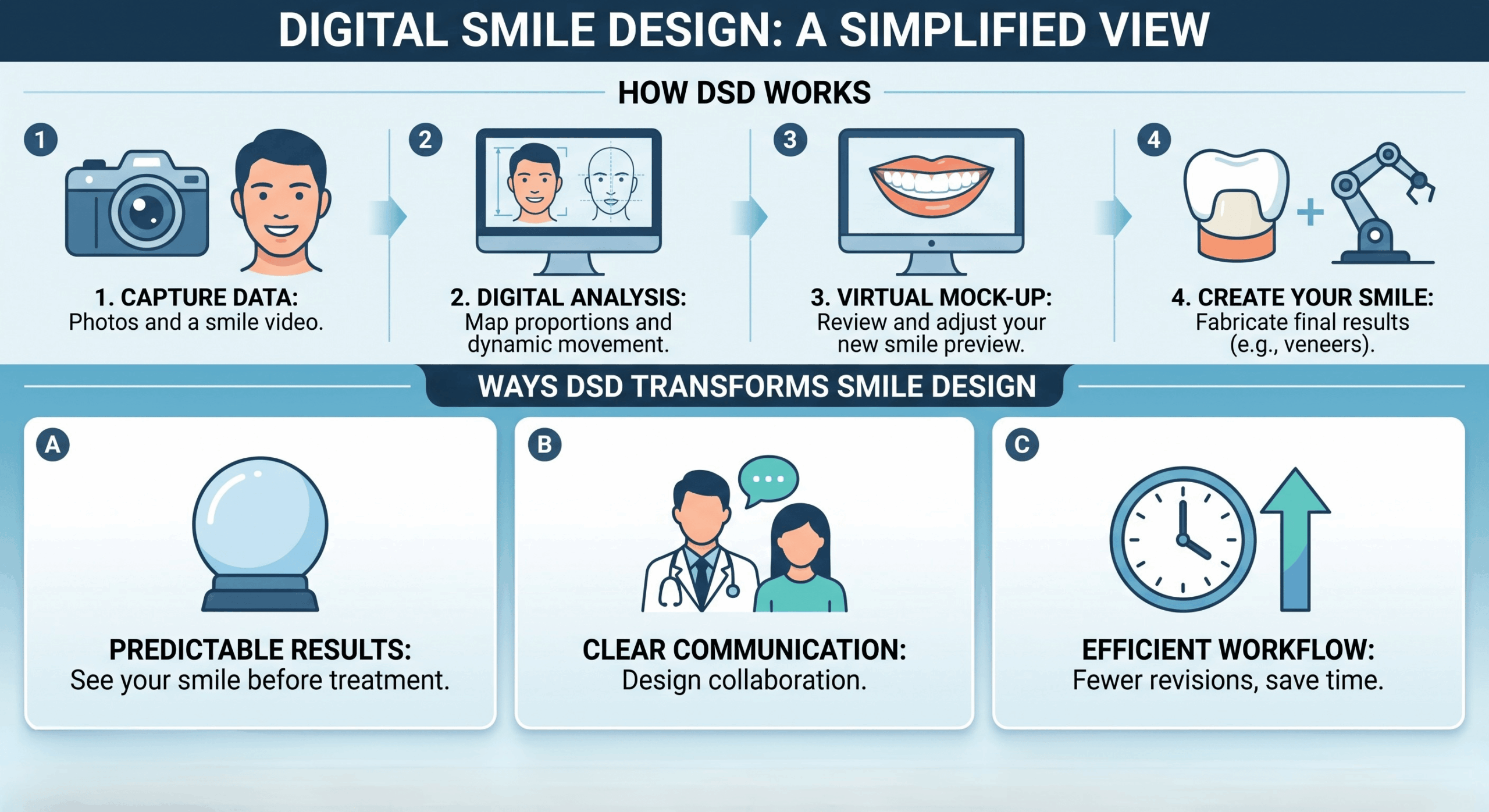
Digital Smile Design (DSD) lets you preview your cosmetic dentistry results before treatment starts. Discover 7 ways this technology is transforming smile design dentistry.
Choosing to redesign your smile is a big decision, and it’s completely natural to wonder what the outcome will actually look like before you commit. That’s exactly the gap that digital smile design was built to close. Instead of relying on guesswork or a verbal description of “whiter, straighter teeth,” you can now see a realistic preview of your new smile before a single tooth is touched.
This shift matters because cosmetic dentistry is deeply personal. A smile that looks stunning on someone else might not suit your facial structure, lip line, or personality at all. Digital smile design solves this problem by putting planning tools directly into the hands of your dentist, so the two of you can shape a result that’s tailored specifically to you. Let’s break down what this technology is, how it works, and the seven ways it’s changing smile design dentistry for the better.
What Is Digital Smile Design?
Digital Smile Design, often shortened to DSD, is a structured, technology-driven approach to planning cosmetic dental treatment. It combines photography, video, and specialized software to build a digital blueprint of your ideal smile before any clinical work begins. Rather than treatment happening in isolation, tooth by tooth, DSD treats the smile as a complete design project, factoring in your lips, gums, facial proportions, and even how you speak and laugh.
The core idea is simple: dentistry produces better, more predictable results when it’s planned visually first and executed second. This isn’t just a marketing gimmick, either. It’s a genuine shift in workflow that many dental practices have adopted because it reduces miscommunication and improves patient satisfaction.
The Origins of DSD in Modern Dentistry
The DSD concept was formalized by Brazilian prosthodontist Dr. Christian Coachman, who wanted a more reliable way to bridge the gap between what patients imagined and what dentists could technically deliver. Traditional smile makeovers often relied on wax models or a dentist’s freehand sketch, both of which left plenty of room for miscommunication. Digital tools changed that equation almost overnight, giving dental teams a shared visual language to plan around.
Since its introduction, DSD has been adopted internationally and is now taught in continuing education courses for cosmetic and restorative dentists. It’s not tied to one particular software brand; instead, it’s a philosophy of smile planning that several software platforms now support.
How Digital Smile Design Works, Step by Step
Understanding the mechanics of DSD helps explain why it produces such reliable results. The process typically unfolds across a handful of clearly defined stages, each building on the last.
1. Facial and Smile Photography
The process begins with a detailed photographic session. Your dentist will capture close-up images of your teeth and gums, along with wider shots of your full face at rest and while smiling. These photos aren’t just for record-keeping. They’re the raw material that software will later use to map proportions and simulate changes.
Lighting, angle, and consistency matter a great deal here, which is why practices offering DSD typically use standardized photography protocols rather than casual snapshots.
2. Video Analysis of Speech and Movement
A smile isn’t static, so photos alone don’t tell the whole story. Many DSD workflows include short video clips of you talking, smiling naturally, and laughing. This helps the dentist understand how your lips move and how much tooth structure is visible during normal conversation, not just in a posed photo.
3. Digital Proportion Mapping
Once the images and videos are collected, your dentist uses specialized software to overlay measurement grids and reference lines onto your face and smile. These lines help identify asymmetries, midline shifts, or proportion imbalances that might not be obvious at first glance. This step draws on established principles of dental esthetics, including tooth width-to-height ratios and golden proportion guidelines.
4. The Virtual Mock-Up
This is the stage most patients find genuinely exciting. Using the data gathered in the earlier steps, the software generates a digital mock-up of your new smile, essentially a simulation showing what your teeth could look like after treatment. You and your dentist can review this together, discussing adjustments to tooth shape, length, color, or alignment before any physical treatment plan is finalized.
Software Tools Used in DSD Planning
Several platforms support digital smile design workflows, and many practices use a combination of tools depending on the case. Common categories include:
- Facial and smile analysis software for proportion mapping
- Intraoral scanning systems that capture precise 3D models of your teeth
- CAD/CAM design programs used to plan veneers, crowns, or bridges
- 3D printers or milling units that can produce a physical mock-up you can try in your mouth
7 Ways DSD Transforms the Smile Design Process
DSD isn’t just a nice-to-have add-on to traditional cosmetic dentistry. It genuinely changes how treatment is planned, communicated, and delivered. Here are seven specific ways it makes a difference.
1. You See Your Results Before Treatment Begins
Perhaps the single biggest advantage of digital smile design is that it removes the guesswork. Instead of imagining what “a little whiter and a bit straighter” might look like, you get an actual visual simulation. This alone eliminates a huge amount of pre-treatment anxiety, since you’re not stepping into the unknown.
2. Better Communication Between You and Your Dentist
Words are imprecise. What one person calls “natural-looking” might strike another as too plain, or too dramatic. DSD gives you and your dentist a shared visual reference, so adjustments can be discussed concretely: “Can we make the front teeth slightly shorter?” or “Could the color be one shade warmer?” That kind of specific feedback simply isn’t possible with a purely verbal consultation.
3. More Predictable, Consistent Outcomes
Because the design is mapped out digitally before treatment, there’s far less room for surprises partway through. Your dental team, and often the lab technicians fabricating your veneers or crowns, are all working from the same blueprint. That consistency tends to translate into results that closely match what was planned from the outset.
4. Reduced Chair Time and Fewer Revisions
When a treatment plan is well-defined before you sit in the chair, procedures tend to move more efficiently. Fewer mid-treatment adjustments are needed because most of the decision-making happened during the planning phase, not during the appointment itself. That can mean fewer visits and less time spent on revisions after the fact.
5. Personalized Treatment Planning
DSD isn’t a one-size-fits-all template. Because it factors in your unique facial proportions, lip dynamics, and gum line, the resulting plan is built around your features rather than a generic idea of an attractive smile. This personalization is part of what makes DSD results tend to look natural rather than artificial.
6. Stronger Collaboration With Dental Labs
For treatments involving custom restorations, such as veneers or crowns, digital files can be shared directly with the dental laboratory. This reduces the chances of miscommunication between the clinic and the lab, since technicians are working from precise digital specifications rather than a written prescription alone.
7. Increased Confidence Going Into Treatment
Finally, there’s a simple psychological benefit. Patients who’ve seen a realistic preview of their new smile tend to feel more confident and at ease heading into treatment. That confidence can make the entire experience, from consultation through final placement, considerably less stressful.
What Procedures Pair Well With Digital Smile Design?
DSD isn’t a treatment on its own. Rather, it’s a planning framework that supports a range of cosmetic and restorative procedures.
Porcelain Veneers
Veneers are one of the most common applications for DSD, since shape, length, and shade all play a major role in the final look. Digital planning helps ensure the veneer design harmonizes with your lips and face before the lab fabricates a single unit.
Dental Crowns and Bridges
For patients needing multiple crowns or a bridge, DSD helps maintain consistent proportions across several teeth at once, which is much harder to judge accurately without a digital reference.
Orthodontic and Gum Contouring Combinations
Some smile makeovers involve more than one type of treatment, such as minor orthodontic movement paired with gum contouring or whitening. DSD can map out how these combined changes will look together, so the final result feels cohesive rather than disjointed.
Digital Smile Design vs. Traditional Smile Planning
| Factor | Traditional Planning | Digital Smile Design |
| Preview of results | Verbal description or wax model | Realistic digital or physical mock-up |
| Communication | Relies on subjective language | Visual, measurable references |
| Precision | Estimated by eye | Proportion-based digital mapping |
| Lab collaboration | Written prescriptions | Shared digital files |
| Revisions | Often occur mid-treatment | Largely resolved during planning |
| Patient involvement | Limited before treatment | Active input on the design itself |
Is Digital Smile Design Right for You?
DSD tends to be a good fit if you’re considering a noticeable cosmetic change, such as veneers, a full smile makeover, or multiple crowns, and you want clarity on the outcome before committing. It’s also worth asking about if you’ve had a less-than-ideal experience with cosmetic work in the past and want a more predictable process this time around.
That said, not every dental office offers DSD, since it requires specific training and software. If this kind of planning appeals to you, it’s worth asking your dentist directly whether they use digital smile design or a comparable digital workflow.
What to Expect at Your DSD Consultation
A typical DSD consultation starts with the photography and video capture described earlier, followed by a review session where your dentist walks you through the proposed design. You’ll likely have the opportunity to request changes, whether that’s adjusting tooth length, brightness, or overall shape, before the plan is finalized. Some practices can even produce a temporary physical mock-up, sometimes worn directly in your mouth, so you can get a feel for the new dimensions before permanent treatment starts.
Frequently Asked Questions
1. How long does a digital smile design consultation take?
Most DSD consultations take between 60 and 90 minutes, covering photography, video capture, and an initial review of the proposed design.
2. Does digital smile design cost extra?
Some practices include DSD as part of their cosmetic consultation fee, while others charge a separate planning fee. It’s best to ask your dental office directly, since pricing varies by location and case complexity.
3. Can I request changes to the digital mock-up?
Yes. The mock-up is meant to be a collaborative starting point, and most dentists welcome specific feedback on shape, length, or shade before finalizing your treatment plan.
4. Is digital smile design only for veneers?
No. While veneers are a common application, DSD is also used for crowns, bridges, gum contouring, and combination treatments involving orthodontics or whitening.
5. How accurate is the digital preview compared to the final result?
DSD previews tend to be quite close to the final outcome, since the same measurements and design data are used to fabricate the actual restorations. Minor variations can still occur based on individual tooth response to treatment.
6. Do I need a physical mock-up, or is the digital preview enough?
This depends on your preference and your dentist’s workflow. Some patients are comfortable proceeding from the digital preview alone, while others prefer to try a temporary physical mock-up before committing to permanent treatment.
7. Is digital smile design available for older patients or complex dental cases?
Yes. DSD can be adapted for complex cases, including full-mouth reconstructions, and isn’t limited by age. Your dentist will assess whether it’s appropriate based on your specific dental history.
Conclusion
Digital smile design has changed what patients can reasonably expect from cosmetic dentistry. Rather than hoping a treatment plan will turn out well, you can review a realistic preview, give specific feedback, and walk into treatment with genuine confidence about the outcome. If you’re considering a smile makeover, it’s well worth asking whether your dental practice offers DSD as part of the planning process.