
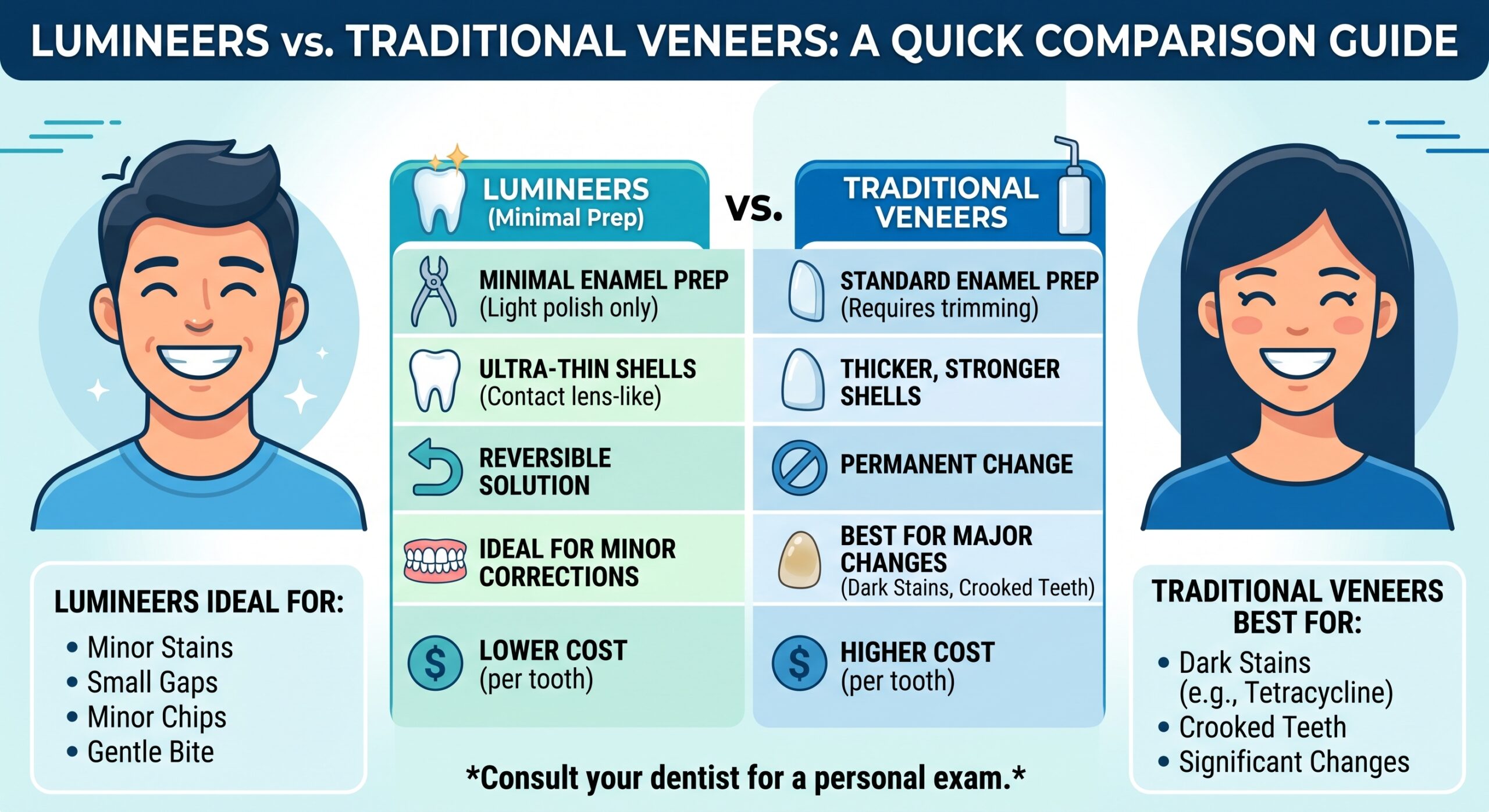
Minimal prep veneers protect more of your natural enamel while giving you a brighter smile. Compare Lumineers and traditional veneers on cost, look, and lifespan.
Why Minimal Prep Veneers Are Getting So Much Attention
Minimal prep veneers have changed how people think about smile makeovers. Not long ago, getting veneers meant your dentist had to file down a good amount of healthy tooth. Today, thinner options let dentists reshape smiles with far less drilling. That’s welcome news if you’ve been nervous about permanent changes.
Here’s the big question, though. Are minimal prep veneers, like Lumineers, really better than traditional veneers? The honest answer is “it depends.” Both can look stunning, but they suit different teeth, budgets, and goals.
This guide covers what minimal prep veneers are, how they compare, and who gets the best results. This article is for information only, so please get a personal exam from your dentist before you decide.
What Are Minimal Prep Veneers?
Minimal prep veneers are thin shells, usually porcelain or ceramic, that bond to the front of your teeth. Your dentist removes very little enamel, or none at all, before placing it. They can cover small chips, gaps, stains, and uneven shapes.
How Minimal Prep Veneers Work
Your dentist takes photos and scans of your teeth. A dental lab then crafts thin shells that match your shade and shape. At the placement visit, your dentist cleans each tooth, applies a bonding agent, and attaches the veneer with dental cement. A curing light hardens it in seconds.
Because minimal prep veneers are so thin, often around 0.3 millimeters, they sit on the tooth much like a contact lens sits on your eye.
What “Prep” Actually Means
“Prep” is short for preparation. It’s the step where a dentist trims a thin layer of enamel from the tooth. Enamel is the hard outer coating of your teeth, and your body can’t grow it back.
Traditional veneers usually need about 0.5 millimeters removed. With minimal prep veneers, the dentist may remove only a tiny amount. Some people call this “no-prep,” but a light polish or slight reshaping is still common.
Popular Brands and Types
Lumineers is the best-known name, made by DenMat. Other options include Vivaneers and Durathin veneers. Ask your dentist which lab they use and why. A skilled dentist and a quality lab often matter more than the brand on the box.
Lumineers vs. Traditional Veneers: Head-to-Head
Let’s compare them on the points that matter most to real patients.
Thickness and Enamel Removal
Thickness is the main difference. Lumineers are about 0.2 to 0.3 millimeters thick. Traditional porcelain veneers run about 0.5 to 0.7 millimeters. That small gap changes how much tooth your dentist needs to reshape.
Fewer changes to your natural teeth can also leave you more options later. Still, less prep isn’t always better. If a tooth sticks out, adding a veneer without trimming can make it look bulky.
Material, Strength, and Look
Both types use porcelain or ceramic, which reflects light much like real enamel. Traditional veneers are thicker, so the lab can layer color and hide dark stains. Ultra-thin, minimal-prep veneers are more translucent. They look lovely on lighter teeth but can let dark spots show through.
Side-by-Side Comparison Table
| Feature | Minimal Prep Veneers | Traditional Veneers |
| Thickness | 0.2 to 0.3 mm | 0.5 to 0.7 mm |
| Enamel removal | None to very little | Usually 0.3 to 0.5 mm |
| Reversibility | Often more reversible | Not reversible |
| Masking dark stains | Limited | Very good |
| Crooked teeth | Mild cases only | Better for bigger changes |
| Lifespan | 10 to 20 years | 10 to 15 years |
| Cost per tooth (US) | $800 to $2,000 | $900 to $2,500 |
These are general ranges. Your dentist, city, and habits will change the numbers.
Cost Differences
Many people assume minimal prep veneers cost far less. In truth, the gap is often small, because you’re still paying for a custom porcelain shell, lab fees, and your dentist’s skill. Most insurance plans treat veneers as cosmetic, so coverage is rare. Ask about payment plans, and don’t shop by price alone. Cheaper work that needs early replacement costs more in the long run.
Longevity and Durability
Both kinds can last a decade or more with good care. Because minimal prep veneers keep more natural enamel, the tooth underneath stays healthier if a veneer ever needs replacing. That’s a real advantage for younger patients.
Who Makes a Good Candidate for Minimal Prep Veneers?
Not everyone qualifies, and that’s okay. A good dentist will tell you the truth rather than just sell you a treatment.
Ideal Candidates
You’re likely a strong fit for minimal prep veneers if you have:
- Healthy teeth and gums, with no active decay
- Mild discoloration or light surface stains
- Small gaps between teeth
- Minor chips or uneven edges
- A gentle bite, with little or no grinding
Veneers bond best to healthy enamel, so good hygiene and regular checkups help a lot.
When Traditional Veneers Win
Sometimes traditional veneers are simply the better tool.
Dark Stains and Discoloration
Deep stains from tetracycline or root canal treatment can be tough to hide. Ultra-thin shells are translucent, so dark tones may peek through. Traditional veneers can be layered with an opaque base that blocks the stain better.
Crooked or Misaligned Teeth
Veneers can hide small misalignments, but they can’t move teeth. For bigger problems, braces or clear aligners first, then veneers to finish the look, often gives the healthiest result.
The Process, Aftercare, and Risks
Knowing what to expect calms pre-appointment nerves. The good news is that minimal prep veneers often mean a quicker, more comfortable process than many people picture.
Step-by-Step Treatment Timeline
- Consultation. Your dentist checks your teeth, gums, and bite, and you discuss goals and shade.
- Planning and scans. Digital scans or impressions guide the lab.
- Light prep, if needed. For minimal prep veneers, this step may be tiny or skipped.
- Lab creation. Your custom shells usually take one to three weeks.
- Placement. Your dentist checks fit and color, then bonds each veneer.
- Follow-up. A short visit confirms your bite and gum health.
Caring for Your Veneers
- Brush twice a day with a soft brush and non-abrasive toothpaste.
- Floss gently every day.
- Avoid chewing ice, pens, or hard candy.
- Wear a night guard if you grind your teeth.
- Limit coffee, tea, and red wine, or rinse with water afterward.
- Visit your dentist every six months.
Veneers don’t get cavities, but the tooth underneath still can.
Possible Risks and Drawbacks
Possible drawbacks of minimal prep veneers include a bulky look without enough trimming, gum irritation from poorly fitted edges, chipping under heavy force, limited color coverage, and short-term sensitivity. Most problems trace back to poor case selection or technique. Choose an experienced cosmetic dentist and ask to see before-and-after photos of real patients.
Frequently Asked Questions
1. Are minimal prep veneers reversible?
Often more so than traditional veneers. If no enamel is removed, they can sometimes come off with the tooth largely intact. Any enamel that’s removed won’t grow back.
2. Do minimal prep veneers hurt?
Most patients feel little to no pain. Many cases don’t need numbing, and mild sensitivity usually fades within days.
3. How long do minimal prep veneers last?
With good care, they commonly last 10 to 20 years. Grinding, chewing hard foods, and skipping checkups can shorten that.
4. Are Lumineers better than traditional veneers?
Not always. Lumineers suit healthy, lighter teeth that need small changes. Traditional veneers handle dark stains, bigger shape changes, and crooked teeth better.
5. Can minimal prep veneers fix crooked teeth?
Only mild cases. Veneers can hide tiny misalignments but can’t move teeth. Orthodontics may need to come first.
6. How much do minimal prep veneers cost?
Roughly $800 to $2,000 per tooth in the US. Prices depend on your dentist, location, and materials.
7. Can I whiten veneers?
No. Porcelain doesn’t respond to whitening gels. Whiten your natural teeth first, then match the veneers to that shade.
Conclusion
Minimal prep veneers offer a gentle, modern way to improve your smile. They protect more natural enamel, often need fewer changes to your teeth, and can look wonderfully natural. Traditional veneers still win for dark stains, larger shape changes, and heavier bites.
The best option is the one that fits your teeth, goals, and budget. Book a consultation with an experienced cosmetic dentist, bring photos of smiles you love, and ask for a preview of your results.