Biomimetic dentistry repairs damaged teeth by copying nature’s design. Discover 7 powerful ways it saves natural teeth, cuts risk, and lasts longer.
Imagine fixing a cracked tooth in a way that feels like the tooth was never damaged. That’s the promise of biomimetic dentistry. Instead of drilling away large portions of your tooth and covering it with a rigid crown, this approach rebuilds the tooth so it flexes, absorbs pressure, and carries chewing forces just like nature intended.
If you’ve ever wondered why some fillings crack or why a crown can still lead to problems years later, you’re not alone. Many patients are now asking about biomimetic dentistry because they want treatment that protects what they’ve got. In this guide, we’ll walk through what it is, how it works, and why so many people feel optimistic about it. Let’s dive in.
What Is Biomimetic Dentistry?
The word “biomimetic” comes from two Greek roots: “bios,” meaning life, and “mimesis,” meaning to copy. So biomimetic dentistry simply means dentistry that copies life. More specifically, it copies the structure, strength, and behavior of a healthy natural tooth.
In practice, biomimetic dentistry focuses on three big goals:
- Preserve as much healthy tooth structure as possible.
- Bond restorative materials tightly to the tooth.
- Rebuild the tooth so it handles stress the way an untouched tooth does.
Traditional dentistry often treats a tooth like a machine part. When something breaks, it gets cut out and replaced. Biomimetic dentistry sees the tooth as a living, working system. Because of that, every choice the dentist makes aims to keep the tooth alive, flexible, and strong for decades.
It’s also worth saying that biomimetic dentistry isn’t a single product or gadget. It’s a mindset backed by science, along with a set of techniques and materials that work together. Dentists who practice it often take extra training, because the steps require patience and precision.
The Philosophy Behind Biomimetic Dentistry
At its heart, biomimetic dentistry rests on a simple idea: nature already solved the problem. A healthy tooth can handle thousands of chewing cycles every day for a lifetime. Our job, then, is to copy that design instead of fighting it.
Why Nature Is the Best Blueprint
Think about a bamboo stalk. It bends in the wind without snapping because its structure spreads stress along its length. Teeth work in a similar way. They flex slightly when you bite down, and that tiny movement keeps forces from building up in one spot.
Older restorations, such as large metal fillings, don’t flex like that. They’re stiff, and the tooth around them is not. Over time, that mismatch can create tiny cracks. A biomimetic dentistry approach avoids this by choosing materials and methods that move and respond like natural tooth tissue.
A Short History of the Approach
The ideas behind biomimetic dentistry grew out of research on adhesive dentistry in the 1950s and 1960s. Once scientists learned that materials could bond directly to enamel and dentin, the door opened. Dentists no longer had to cut a tooth into a special shape just to hold a filling in place.
Over the following decades, researchers studied how teeth carry stress. By the early 2000s, the term “biomimetic” was being used to describe a full treatment philosophy. Today, it continues to grow as new bioactive materials and better bonding systems arrive.
How a Natural Tooth Works
To understand why biomimetic dentistry makes sense, you first need a quick tour of tooth anatomy. A tooth isn’t one solid block. It’s a smart, layered structure.
Enamel: The Hard Shield
Enamel is the outer layer, and it’s the hardest substance in your body. It’s made mostly of minerals, which makes it great at resisting wear. However, enamel is also brittle. By itself, it would chip or crack under heavy pressure.
Dentin: The Flexible Core
Right beneath the enamel sits dentin. It’s softer and more elastic. Dentin acts like a shock absorber, cushioning the enamel above it. It also contains thousands of microscopic tubes that connect to the nerve inside the tooth. That’s why exposed dentin can feel sensitive.
The Dentin-Enamel Junction
Where the two layers meet is called the dentin-enamel junction. This boundary is a marvel of natural engineering. It’s scalloped and slightly flexible, which stops cracks from traveling from the enamel into the dentin. When dentists preserve this junction, they protect one of the tooth’s best built-in defenses. That’s a core rule in biomimetic dentistry.
Traditional vs. Biomimetic Dentistry
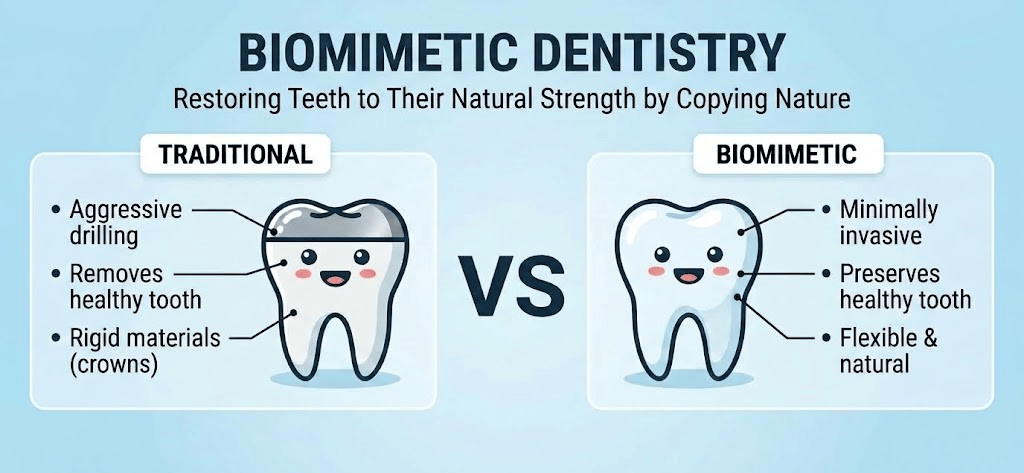
Both approaches can fix a tooth, but they start from very different places. Here’s a quick side-by-side look.
| Feature | Traditional Approach | Biomimetic Dentistry |
| Philosophy | Replace damaged parts. | Restore natural function. |
| Tooth removal | Often significant | As little as possible |
| Main materials | Metal, ceramic, rigid crowns | Bonded composites, bioactive, and fiber-reinforced materials |
| Stress handling | Rigid, can transfer stress | Flexible, spreads stress |
| Nerve protection | Higher risk of later problems | Aims to keep the nerve healthy |
| Time per visit | Often shorter | Often longer, more detailed |
| Long-term goal | Fix the problem. | Prevent the next problem. |
As you can see, biomimetic dentistry trades speed for care. A visit may take longer, but the payoff is a tooth that’s closer to its original state.
7 Powerful Ways Biomimetic Dentistry Restores Teeth
Now let’s get to the heart of it. Here are seven ways biomimetic dentistry helps bring teeth back to their natural strength and function.
1. Minimally Invasive Preparation
First off, biomimetic dentistry removes only what’s truly diseased. Dentists use magnification, special dyes, and gentle tools to find and clear decay without taking extra healthy tissue. Every bit of enamel and dentin saved is a bit of strength kept.
This matters because a tooth never grows back. Once it’s cut away, it’s gone. By staying conservative, you keep more of your natural tooth for life.
2. Immediate Dentin Sealing
Next comes a clever step called immediate dentin sealing. Right after the tooth is prepared, the dentist seals the exposed dentin with a bonding layer. This happens before any impression or final material goes on.
Why does it help? Freshly cut dentin is wide open, and bacteria and fluids can sneak in. Sealing it right away reduces sensitivity and gives a cleaner, stronger bond. It’s like putting a lid on a jar before the contents spill.
3. Strong Adhesive Bonding
Bonding is the backbone of biomimetic dentistry. Modern adhesives connect the restoration directly to enamel and dentin, so the tooth and the material act as one unit. That’s very different from old-style fillings, which just sat in a hole and held on by shape alone.
A well-bonded restoration also seals the edges. That keeps out bacteria and lowers the chance of new decay sneaking in underneath.
4. Stress-Reducing Layering
When composite resin hardens, it shrinks a little. That shrinking creates stress. To handle this, the dentist builds the restoration in thin layers, curing each one with a special light.
This layering technique spreads the stress out and helps mimic the natural layers of enamel and dentin. It takes more time, but it leads to a tougher, better-looking result.
5. Fiber Reinforcement
For larger repairs, dentists may add a layer of woven glass fibers. These fibers act like the rebar in concrete. They stop cracks from spreading and help the tooth absorb force.
Studies have shown that fiber-reinforced restorations can improve resistance to fracture in certain cases. For many patients with big cavities, this means a better shot at skipping a crown.
6. Bioactive Materials
Some modern materials release minerals like calcium, phosphate, and fluoride. These bioactive materials help strengthen the tooth structure around them and may even support remineralization. In other words, the filling doesn’t just sit there. It helps the tooth heal.
This is one of the most exciting areas in biomimetic dentistry, because it moves care from simply repairing to truly supporting your oral health.
7. Cuspal Protection and Crack Prevention
Finally, biomimetic dentistry pays close attention to the cusps, the pointed parts of your back teeth. When a tooth is weakened, these cusps can flex too much and crack. Dentists may cover or reinforce them using bonded materials, such as an onlay, to guard against that.
By protecting the cusps early, the tooth stays safer from fractures that could otherwise lead to root canals or even extraction.
Materials Used in Biomimetic Dentistry
Choosing the right material is a big part of biomimetic dentistry. The goal is to match the tooth’s own stiffness and strength as closely as possible. Here are the main players:
- Composite resins: Tooth-colored, bondable, and easy to shape. They’re the workhorse of the approach.
- Glass ionomer cements: These release fluoride and bond well to dentin, so they’re handy as a base layer.
- Fiber-reinforced composites: Woven fibers add strength in high-stress areas.
- Bioactive restoratives: These release minerals that help protect and rebuild nearby tooth tissue.
- Bonded ceramics and resin onlays: Used when a tooth needs more coverage but still shouldn’t be crowned.
What’s missing from this list? Large metal restorations and heavy, full-coverage crowns, unless they’re truly needed. That’s a big difference from many older treatment plans.
What to Expect During Treatment
If you’re thinking about biomimetic dentistry, it helps to know what a visit looks like. Here’s the general flow.
- Exam and diagnosis. Your dentist checks for decay, cracks, and bite problems. They’ll often use magnification and digital images.
- Gentle numbing. You’ll get local anesthesia, so you stay comfortable.
- Conservative cleaning. Only decayed or damaged tissue comes out.
- Sealing and bonding. The dentist seals the dentin and applies adhesive in a carefully controlled, dry area.
- Layered rebuilding. The tooth is built back up in thin layers, with fibers or special bases added if needed.
- Shaping and bite check. The dentist polishes the tooth and makes sure it fits your bite perfectly.
Because of the attention to detail, appointments can run longer than you might expect. Still, most patients find the process comfortable, and many feel it’s worth the extra time.
Benefits and Limitations
No treatment is perfect, so let’s look at both sides.
Key Benefits
- Saves more of your natural tooth.
- May lower the need for root canals and crowns.
- Reduces post-treatment sensitivity in many cases.
- Looks natural, since materials match tooth color.
- Supports long-term oral health.
Possible Limitations
- It can take more chair time.
- Fewer dentists have advanced training in this area.
- Costs may be higher at first than a basic filling.
- Severely broken teeth may still need a crown or other treatment.
Even with those points, most patients and dentists feel the benefits clearly outweigh the downsides, especially over many years.
Who Is a Good Candidate?
Plenty of people can enjoy biomimetic dentistry. You may be a great match if you:
- Have a new cavity or an old, failing filling.
- Have a cracked tooth that hasn’t yet reached the nerve.
- Want to avoid a crown or root canal if possible.
- Care about keeping your natural teeth for life.
That said, every mouth is different. Your dentist will review your X-rays, bite, and overall health before recommending a plan. If a tooth is too far gone, they’ll tell you honestly and walk you through other options.
Cost and Longevity
Let’s talk money. Biomimetic dentistry can cost more per visit than a standard filling, mainly because it takes more time, skill, and specialized materials. Prices vary a lot by location and by dentist, so it’s smart to ask for an estimate before you begin.
However, think about the bigger picture. A tooth that avoids a root canal, a crown, or an implant can save you a good deal of money over time. When a restoration is well bonded and well designed, it can last many years, and the tooth stays healthier in the meantime. For many families, that long-term value makes the upfront cost feel reasonable.
How to Choose a Biomimetic Dentist
Since biomimetic dentistry relies on technique, the dentist you pick matters. Here’s what to look for:
- Extra training: Ask about courses or certifications in adhesive and biomimetic methods.
- Magnification tools: Loupes or microscopes help with precision.
- Isolation methods: A rubber dam keeps the tooth dry, which is vital for strong bonding.
- Before-and-after cases: Good dentists are proud to share their results.
- Clear communication: They should explain your options in plain language and answer your questions.
Frequently Asked Questions
1. What is biomimetic dentistry in simple terms?
Biomimetic dentistry is a way of treating teeth that copies how natural teeth are built. It uses gentle methods and bondable materials to keep as much of your tooth as possible and to restore its strength and flexibility.
2. Is biomimetic dentistry painful?
No, it’s generally comfortable. You’ll receive local anesthesia, just like with a regular filling. Many patients report less sensitivity afterward, since the dentist seals the tooth carefully.
3. How long do biomimetic restorations last?
It depends on the tooth, your bite, and your home care. Well-done restorations can last many years, and some last a decade or longer. Regular checkups and good brushing and flossing help them last even more.
4. Is biomimetic dentistry more expensive than regular dentistry?
It can cost more at the start because it takes extra time and special materials. On the flip side, it may help you avoid pricier treatments later, such as crowns, root canals, or implants.
5. Can biomimetic dentistry replace a crown?
Sometimes, yes. If enough healthy tooth remains, a bonded and reinforced restoration or an onlay can do the job without a full crown. But if a tooth is badly broken, a crown may still be the best choice.
6. Can biomimetic dentistry fix a cracked tooth?
In many cases, it can. When a crack hasn’t reached the nerve, bonding and reinforcement can help hold the tooth together and stop the crack from spreading. Your dentist will examine the tooth first to be sure.
7. Does insurance cover biomimetic dentistry?
Coverage varies by plan. Insurance often covers the basic filling or onlay code, even if the technique is more advanced. Ask your dentist’s office to check your benefits before treatment.
Conclusion
Biomimetic dentistry offers an encouraging path for anyone who wants to keep their natural teeth strong and healthy. By saving healthy tooth structure, bonding materials tightly, and rebuilding teeth in ways that copy nature, this approach helps restore both strength and function. It’s thoughtful, careful, and focused on the long run.