
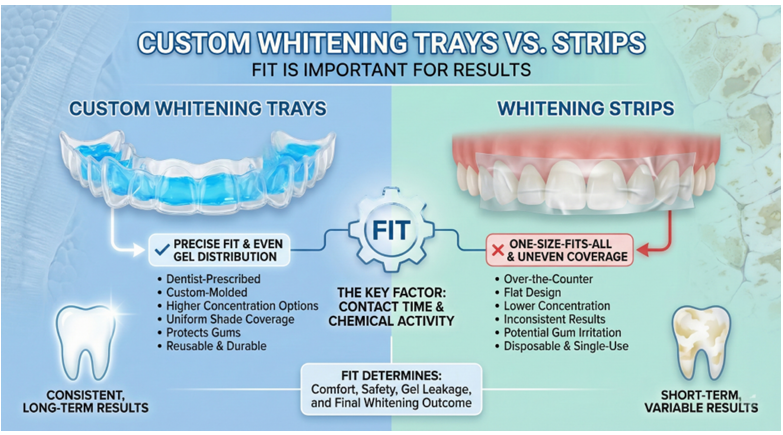
Custom Whitening Trays vs. Strips: Fit Is Important for Results
In the United States, teeth whitening is one of the most popular cosmetic dental procedures.
The debate over custom whitening strips vs. trays continues to grow as people strive for a brighter smile.
Both options use peroxide-based bleaching agents, but their effectiveness is heavily dependent on the fit of the product.
Gradual tooth discoloration is common. Pigments in food, drinks, tobacco, and even ageing can penetrate enamel and dentin.
The whitening agents break down the pigments by oxidation. For oxidation to take place evenly, however, the whitening agents
must remain in constant contact with the teeth surface. Fit is a key factor.
What Causes Tooth Discoloration?
Extrinsic and intrinsic discolorations are both possible. Extrinsic stains are those that affect the surface of the enamel
and can be caused by smoking, coffee, red wine, or tea. Intrinsic stains are those that develop within the teeth and can be
caused by trauma, ageing, or certain medications. Both types of stains require a controlled exposure to whitening agents in
order to achieve predictable results.
What Are the Different Types of Whitening Agents?
Most bleaching systems use carbamide or hydrogen peroxide. Concentration varies depending on the delivery method.
Under professional supervision, custom whitening trays allow for higher concentrations. Whitening strips are safer with lower doses.
What Are Custom Whitening Trays?
Dentists prescribe custom whitening trays that are designed to fit the exact shape of each patient’s teeth.
These trays are made using digital scans or dental impressions to ensure a tight and secure fit.
How Custom Trays Are Made
A dental evaluation is the first step. The impressions are used to make trays that conform to the contours of each tooth.
This customized approach ensures that gel is distributed evenly and minimizes any leakage.
Materials and Fit Precision
Thermoplastics of medical grade are used to make custom trays. The tight fit holds the whitening gel firmly in place and allows
for prolonged, controlled contact with enamel. This precision has a direct impact on the whitening results.
What Are Teeth Whitening Strips?
The strips are flexible, thin plastic coated with a whitening agent. These strips are available in a wide range of stores without a prescription.
How to Apply Teeth Whitening Strips
The strip is placed on the teeth, and then left there for a specified time (usually 30 minutes).
The flat design is simple but does not allow for individual adaptations to tooth shapes.
Limitations of One Size Fits All
The whitening strips cannot accommodate differences in tooth alignment, spacing, or arch shape because they are mass-produced.
It can lead to uneven whitening of teeth, particularly near the gumline or between teeth.
The Differences Between Strips and Custom Whitening Trays
Fit is the key difference between custom whitening strips and trays. Fit is what determines the amount of whitening agent that spreads evenly,
the length of time it remains active, and the comfort level.
Fit and Gel Distribution
Custom-made trays ensure that gel is evenly distributed across all surfaces of the teeth. Strips can shift or wrinkle causing inconsistent coverage.
Contact Time and Whitening Efficiency
Trays can be worn for extended periods, even overnight, with professional supervision. Strips can only be used for a limited time, slowing overall progress.
Fit Is Important for Whitening Results
Fit is more than a cosmetic feature. Fit directly impacts chemical activity, colour consistency, and oral safety.
The Uniformity of Shade and Coverage of Enamel
Uneven peroxide contact is caused by a poor fit. With custom trays, each tooth is exposed to the same amount of peroxide.
This results in uniform whitening.
Protect Your Gums and Control Sensitivity
Gel leakage can cause irritation and increased sensitivity. This risk is reduced by a precise tray seal, which makes treatment more comfortable.
Comfort, Compliance, and Daily Use
Comfort influences consistency. If a whitening method feels awkward or irritating, users are less likely to complete treatment.
Wear Time and Lifestyle Compatibility
Custom trays are stable and can be worn while resting. Strips may loosen during speaking or salivation, which can shorten effective wear time.
User Experience Over Weeks
Over multi-week use, trays tend to maintain comfort and results. Strips often cause increasing sensitivity due to uneven gel exposure.
Safety and Dentist Supervision
From an Experience, Expertise, Authoritativeness, and Trust perspective, professional involvement matters.
Professional Oversight Benefits
Dentist-supervised whitening ensures correct peroxide concentration, fit evaluation, and monitoring of enamel health.
This reduces long-term risks.
Risks of Improper Fit
Ill-fitting strips can overlap gums or miss enamel areas, increasing irritation and reducing effectiveness.
Custom trays mitigate these risks through design.
For clinical guidance, the American Dental Association provides evidence-based recommendations on whitening safety.
Cost, Longevity, and Value Comparison
The upfront cost is different, but the long-term value is quite different.
Short-Term vs. Long-Term Investment
Whitening strips initially appear to be cheaper. Repeated purchases of custom trays often cost more than the initial purchase price.
Reusability and Maintenance
Gel refills can be used to reuse custom trays for many years. Strips are disposable and single-use.
The Best Candidates for Each Whitening Technique
Not all options are suitable for every patient.
Custom Trays Benefit Who Most?
Custom whitening trays are most beneficial for people with severe discoloration or dental restorations.
Who Should Choose Whitening Strips?
People seeking mild whitening, quick touch-ups, or short-term results may prefer strips, provided expectations remain realistic.
Evidence-Based Comparison Table
| Feature | Custom Whitening Trays | Whitening Strips |
|---|---|---|
| Fit | Individually tailored | One-size-fits-all |
| Whitening Consistency | High | Moderate |
| Sensitivity Risk | Lower | Higher |
| Reusability | Yes | No |
| Professional Supervision | Yes | No |
Frequently Asked Questions
Are custom whitening trays better than strips?
Yes, in most cases. The precise fit improves gel contact, safety, and whitening consistency.
How long do results last with custom trays?
With proper maintenance, results can last years with occasional touch-ups.
Do whitening strips damage enamel?
Whitening strips are generally safe for enamel, but uneven fit can increase sensitivity.
Which option whitens faster?
Custom trays often show faster results due to longer and more controlled exposure.
Are custom trays worth the cost?
For long-term whitening and comfort, custom trays provide far better value.
Can I use both methods together?
Some dentists may recommend whitening strips as a basic treatment, but trays should be the primary treatment.
Conclusion: Choosing the Right Whitening Solution
The comparison of custom whitening trays vs. strips ultimately comes down to fit. Fit governs effectiveness, comfort, safety, and longevity.
While whitening strips offer convenience, custom trays deliver precision, predictability, and professional oversight.
For individuals seeking reliable and uniform whitening results, fit is not optional. It is essential.