
Missing teeth can affect far more than your smile. They can reduce chewing efficiency, alter speech articulation, contribute to jawbone resorption, and even impact facial aesthetics over time. Fortunately, modern restorative dentistry offers reliable solutions to replace missing teeth, with dental implants and dental bridges being the two most common options.
When comparing dental implants vs. bridges, many patients focus on appearance and cost. However, long-term stability, oral health preservation, and overall quality of life are equally important considerations. Understanding how each treatment works can help you make an informed decision that supports your long-term dental health goals.
Why Replacing Missing Teeth Is Important
A missing tooth is more than a cosmetic concern. When a tooth is lost, the surrounding structures begin to change. The alveolar bone that once supported the tooth root no longer receives stimulation from chewing forces. As a result, bone resorption and gradual jawbone deterioration can occur.
Missing teeth may also lead to:
- Shifting of neighboring teeth
- Bite misalignment (occlusion problems)
- Increased risk of gum disease
- Reduced masticatory efficiency
- Changes in facial support and smile symmetry
- Difficulty speaking and chewing certain foods
Replacing a missing tooth promptly helps maintain oral function, preserve bone density, and support long-term oral health.
Understanding Dental Implants
A dental implant is a prosthetic tooth replacement designed to mimic the structure of a natural tooth. Unlike traditional restorations, an implant replaces both the visible crown and the missing tooth root.
A typical implant system includes the following:
- A titanium implant fixture placed into the jawbone
- An implant abutment that connects the fixture to the restoration
- A custom dental crown that restores appearance and function
The success of dental implants depends on a biological process called osseointegration. During this process, the titanium implant integrates with the jawbone, allowing osteoblasts to form new bone around the implant surface. This bone remodeling process creates exceptional stability and helps preserve the surrounding alveolar bone.
Modern implant treatment often involves advanced technology such as Cone Beam Computed Tomography (CBCT), digital impressions, intraoral scanners, and guided implant surgery to improve precision and treatment outcomes.
In cases where bone loss has already occurred, procedures such as bone grafting or a sinus lift may be recommended to increase implant eligibility and support long-term success.
Understanding Dental Bridges
A dental bridge is a fixed partial denture that replaces one or more missing teeth by using adjacent teeth for support. The replacement tooth, known as a pontic, fills the gap left by the missing tooth.
Traditional bridges consist of the following:
- One or more pontics
- Retainer crowns
- Supporting abutment teeth
Several types of bridges are available, including:
Traditional Bridges
The most common type, supported by crowns placed on adjacent teeth.
Maryland Bridges
A conservative option that uses a metal or ceramic framework bonded to neighboring teeth.
Cantilever Bridges
Used when only one adjacent tooth is available for support.
Implant-Supported Bridges
These bridges are anchored by dental implants rather than natural teeth, combining the benefits of both treatment approaches.
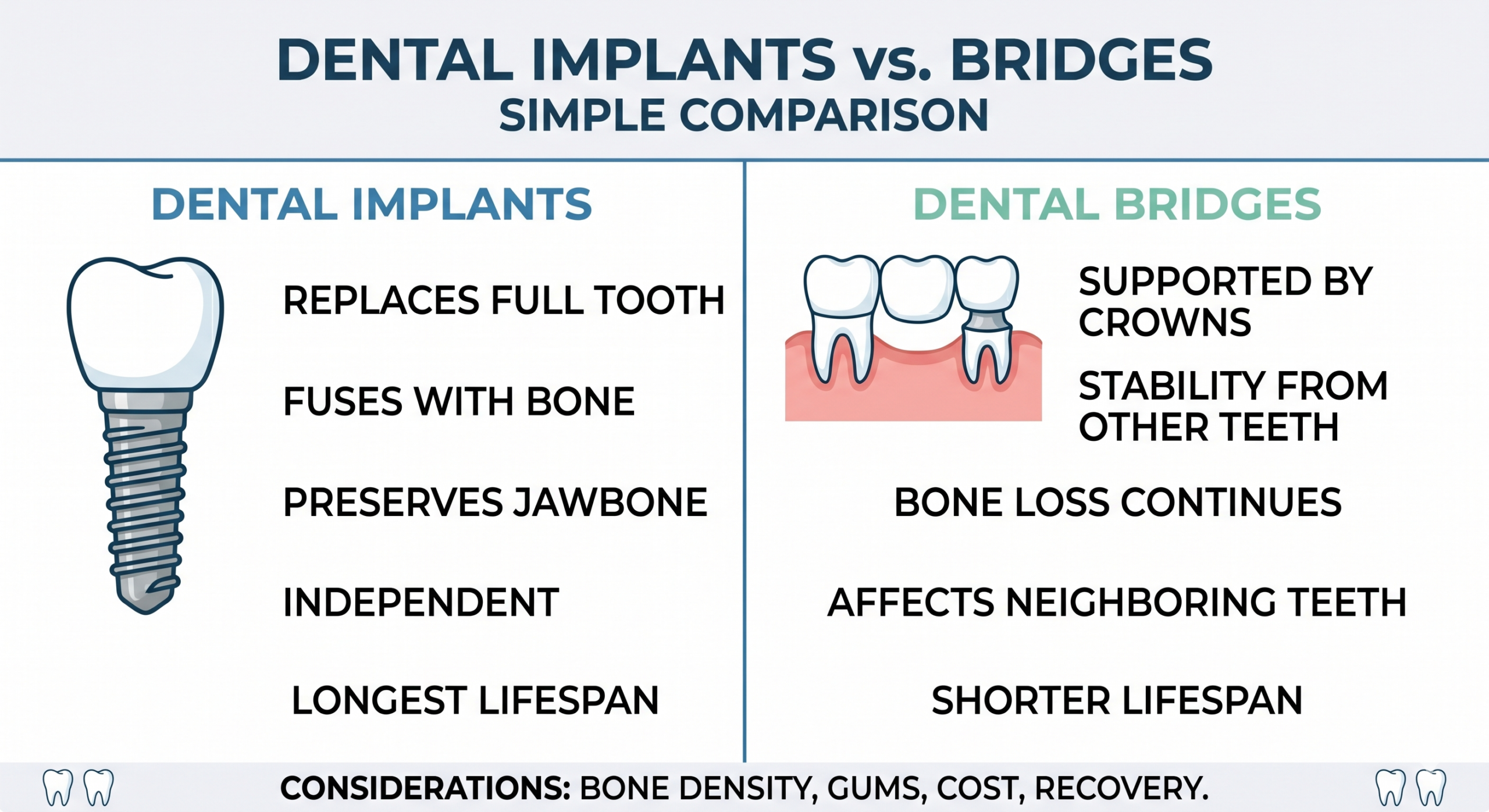
Unlike implants, bridges do not replace the tooth root. While they restore function and appearance effectively, they cannot provide jawbone stimulation or prevent bone resorption beneath the missing tooth area.
Dental Implants vs. Bridges: Key Differences
Although both options restore missing teeth, their approach and long-term effects differ significantly.
Bone Preservation
One of the biggest differences between dental implants and bridges is their impact on jawbone health.
A dental implant integrates with the jawbone and provides stimulation during chewing. This jawbone stimulation helps preserve bone density and reduce bone loss.
Semantic Triplet:
- Dental Implant preserves Alveolar Bone
- Jawbone Stimulation reduces Bone Resorption
A bridge, however, rests above the gum line and does not interact with the underlying bone. As a result, gradual bone loss may continue over time.
Impact on Adjacent Teeth
Traditional bridges require healthy neighboring teeth to be prepared as abutment teeth. This process involves removing enamel and placing crowns on teeth that may otherwise be healthy.
Semantic Triplet:
- Abutment Tooth supports Dental Bridge
- Dental Bridge relies on Adjacent Teeth
Dental implants are independent restorations and do not require modification of surrounding teeth.
Durability
Dental implants are designed to function like natural tooth roots and are capable of withstanding significant bite force.
Bridges can also be durable, but their lifespan often depends on the condition of the supporting teeth and the integrity of the dental cement used to secure them.
Long-Term Stability Comparison
Long-term stability is often the deciding factor when choosing between dental implants and bridges.
Why Implants Offer Superior Stability
Dental implants are widely considered the gold standard for tooth replacement because they become integrated with the jawbone.
Semantic Triplets:
- Osseointegration provides Implant Stability
- Titanium Implant supports Dental Crown
- Bone Density influences Implant Success
The stability of implants offers several advantages:
- Strong chewing performance
- Improved speech function
- Preservation of facial structure
- Reduced risk of tooth shifting
- Long-lasting esthetic results
With proper oral hygiene and regular dental visits, implants can remain functional for decades.
Stability of Dental Bridges
Dental bridges provide reliable function but depend on the health of the abutment teeth.
Potential long-term concerns include:
- Decay around supporting crowns
- Gum recession
- Bridge fracture
- Dental cement failure
- Structural wear
Semantic Triplets:
- Dental Bridge replaces Missing Teeth
- Pontic fills Tooth Gap
- Dental Cement secures Bridge Restoration
While many bridges last well over a decade, they generally require replacement more frequently than implants.
Factors That Influence Treatment Success
Whether you choose implants or bridges, several factors can affect treatment outcomes.
Gum Health
Healthy gums provide a stable foundation for any dental restoration.
Semantic Triplets:
- Gum health supports implant stability
- Periodontal Disease Affects Implant Outcomes
Patients with gingivitis or periodontitis may require periodontal treatment before receiving implants or bridges.
Bruxism
Bruxism, or teeth grinding, can place excessive stress on restorations.
Semantic Triplet:
- Bruxism increases restoration wear
Night guards are often recommended to protect both implants and bridges from excessive bite forces.
Smoking
Smoking is a well-established risk factor for dental complications.
Semantic Triplet:
- Smoking increases Implant Failure Risk
Tobacco use may interfere with wound healing, tissue integration, and long-term implant success.
Recovery and Maintenance
Dental Implant Recovery
Implant treatment typically requires several stages:
- Comprehensive oral examination
- CBCT scan and treatment planning
- Implant placement
- Healing and osseointegration
- Abutment placement
- Crown attachment
Most patients experience manageable discomfort following surgery, which can usually be controlled with standard pain management techniques and post-operative care instructions.
A soft-food diet may be recommended during the early healing period.
Dental Bridge Recovery
Bridge treatment generally involves less healing time because no surgical procedure is required.
Patients often return to normal activities immediately after placement, although temporary sensitivity may occur while adapting to the restoration.
Long-Term Maintenance
Both options require consistent oral hygiene.
Recommended maintenance includes:
- Brushing twice daily
- Daily flossing
- Professional cleanings
- Routine dental examinations
For bridge patients, cleaning beneath the pontic is particularly important to prevent plaque accumulation and tartar buildup.
Semantic Triplets:
- Oral Hygiene improves restoration lifespan.
- Regular Dental Visits support long-term success.
Cost Considerations
Bridges generally have a lower upfront cost than dental implants. However, cost should be evaluated over the lifetime of the restoration.
Patients should consider:
- Initial treatment fees
- Insurance coverage
- Out-of-pocket expenses
- Financing options
- Potential replacement costs
Many patients discover that while implants require a larger initial investment, their longevity may provide greater long-term value.
Flexible Spending Accounts (FSAs) and Health Savings Accounts (HSAs) may also help offset treatment costs.
Who Is a Good Candidate for Each Option?
Ideal Candidates for Dental Implants
Dental implants may be recommended for patients who:
- Have adequate bone density
- Maintain good oral hygiene
- Are free of uncontrolled periodontal disease
- Desire a long-term solution
- Want to preserve jawbone health
Treatment may involve an oral surgeon, periodontist, or prosthodontist depending on the complexity of the case.
Ideal Candidates for Dental Bridges
Bridges may be suitable for patients who:
- Prefer a non-surgical treatment
- Need faster tooth replacement
- Have medical conditions that limit surgery
- Face budget constraints
- Have healthy adjacent teeth available for support
Which Option Offers Better Long-Term Stability?
For most patients, dental implants provide superior long-term stability. Their ability to integrate with the jawbone, preserve alveolar bone, maintain chewing performance, and function independently of neighboring teeth gives them a significant advantage.
Bridges remain an effective and proven treatment option, especially when surgery is not desirable or feasible. However, because they rely on adjacent teeth and do not prevent bone loss, they generally have a shorter lifespan and may require replacement sooner.
Ultimately, the best choice depends on your oral health, bone structure, budget, lifestyle, and long-term treatment goals. A comprehensive evaluation and personalized treatment plan can help determine which solution is best suited to your needs.
Frequently Asked Questions
1. Are dental implants more durable than dental bridges?
Yes. Dental implants are generally more durable than dental bridges because they integrate directly with the jawbone through a process called osseointegration. With proper care, implants can last 20 years or more, while bridges typically require replacement after 10 to 15 years.
2. Do dental implants prevent bone loss?
Yes. Dental implants help preserve the alveolar bone by stimulating the jawbone during chewing. This stimulation reduces bone resorption, which commonly occurs after tooth loss. Traditional dental bridges do not provide this benefit because they do not replace the tooth root.
3. Which option is more affordable: implants or bridges?
Dental bridges usually have a lower upfront cost than implants. However, implants often provide better long-term value because they tend to last longer and may require fewer replacements or repairs over time.
4. Can I get a dental implant if I have bone loss?
Possibly. Many patients with reduced bone density can still receive dental implants after procedures such as bone grafting or a sinus lift. A CBCT scan and comprehensive dental evaluation can determine whether additional treatment is needed.
5. Are dental bridges easier to maintain than implants?
Not necessarily. Dental implants can be brushed and flossed similarly to natural teeth. Bridges require additional cleaning techniques, including floss threaders or interdental brushes, to remove plaque from beneath the pontic and around the supporting teeth.
6. How long does it take to complete implant treatment?
The timeline varies depending on the patient’s oral health and whether additional procedures are required. In many cases, implant treatment takes several months because the implant must fully integrate with the jawbone before the final crown is attached.
7. Can dental implants fail?
Although dental implants have a high success rate, failure can occur due to factors such as peri-implantitis, smoking, poor oral hygiene, uncontrolled diabetes, or insufficient bone support. Regular dental visits and proper home care significantly reduce these risks.
8. Who is a better candidate for a dental bridge?
A dental bridge may be a good option for patients who want a faster treatment, prefer to avoid surgery, have insufficient bone for implants, or are seeking a lower initial treatment cost.
Conclusion
When comparing dental implants and bridges, both options can successfully restore missing teeth and improve oral function. However, dental implants generally provide superior long-term stability because they replace the tooth root, preserve alveolar bone, maintain chewing efficiency, and function independently of adjacent teeth.