
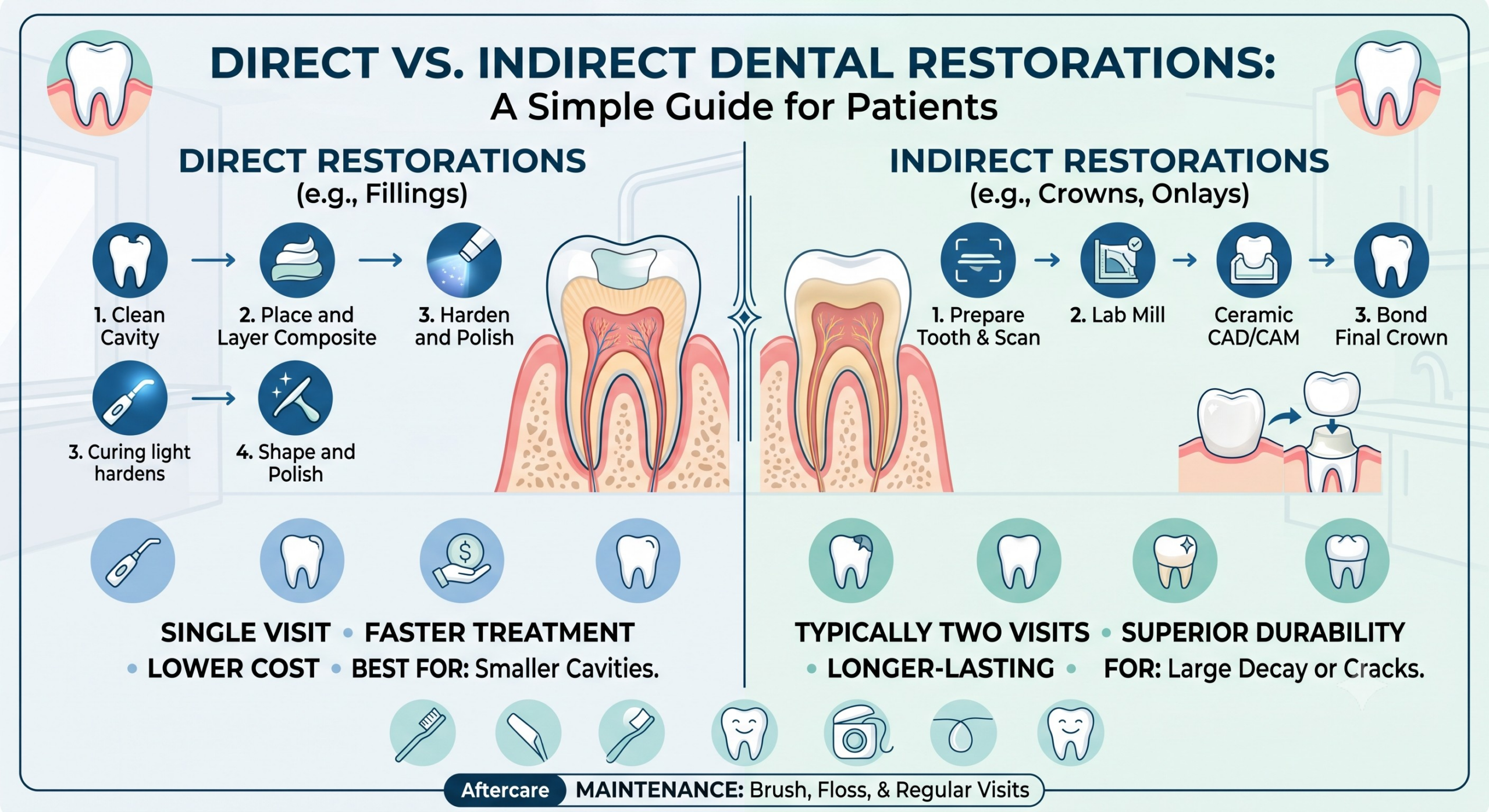
Direct vs. indirect restorations differ in materials, chair time, and durability. Discover which option fits your smile and budget best.
What Are Dental Restorations?
Dental restorations repair teeth that have been damaged by decay, fracture, or wear. Whenever a dentist removes a cavity or repairs a chip, they need a way to rebuild the missing tooth structure, and that’s where restorations come in. Broadly speaking, restorations fall into two categories: direct and indirect. Understanding direct vs. indirect restorations helps you make sense of your treatment plan and feel confident about what’s happening in the chair.
In this guide, we’ll walk through what each type of restoration involves, the materials dentists use, and the pros and cons you should weigh before your next appointment.
What Is a Direct Restoration?
A direct restoration is exactly what it sounds like: your dentist builds it directly onto your tooth in one visit. After removing decay or preparing the damaged area, the dentist places a soft, moldable material into the cavity, shapes it to match your bite, and hardens it right there in the chair. It’s a quick, efficient way to fix smaller cavities and minor chips.
Because everything happens in a single appointment, direct restorations tend to be less expensive and more convenient for patients with busy schedules. You won’t need to wear a temporary filling while you wait for a lab to finish your permanent one.
Common Materials Used in Direct Restorations
Dentists typically choose from a handful of tried-and-true materials for direct restorations:
- Composite resin A tooth-colored material that bonds well and blends in naturally with surrounding teeth.
- Amalgam A durable silver-colored alloy that’s been used for over a century, though it’s less common today due to aesthetic preferences.
- Glass ionomer: Often used for smaller fillings or restorations near the gumline, valued for releasing fluoride over time.
- Resin-modified glass ionomer A hybrid material that combines some of the strength of composite with the fluoride release of glass ionomer.
Each material has its own strengths, and your dentist will recommend one based on the location of the cavity, how much force the tooth will bear, and your cosmetic preferences.
The Direct Restoration Procedure, Step by Step
- The dentist numbs the area with local anesthesia.
- Decayed or damaged tooth structure is removed.
- The remaining tooth surface is cleaned and prepped.
- The chosen material is layered into the cavity.
- A curing light hardens composite resin (amalgam and glass ionomer set chemically).
- The dentist shapes and polishes the restoration to match your bite.
The whole process usually takes 20 to 60 minutes, depending on the size and location of the restoration.
What Is an Indirect Restoration?
Indirect restorations take a different route. Rather than building the restoration in your mouth, the dentist takes an impression or digital scan of the prepared tooth, and a lab (or an in-office milling machine) fabricates the restoration outside of your mouth. Once it’s ready, your dentist bonds or cements it into place during a follow-up visit, or sometimes the same day if your practice uses same-day CAD/CAM technology.
Indirect restorations are generally recommended for teeth with more extensive damage, where a direct filling wouldn’t hold up well under the pressure of chewing. Because they’re crafted outside the mouth under more controlled conditions, they often achieve a tighter fit and greater strength.
Common Materials Used in Indirect Restorations
- Porcelain (ceramic) Prized for its natural, tooth-like translucency and stain resistance.
- Gold alloy: Extremely durable and gentle on opposing teeth, though less popular for its metallic appearance.
- Zirconia is known for exceptional strength, making it a solid choice for molars that bear heavy chewing forces.
- Porcelain-fused-to-metal (PFM) combines the strength of a metal substructure with a porcelain outer layer for a more natural look.
The Indirect Restoration Procedure, Step by Step
- The dentist numbs the area and removes decay or damaged structure.
- The tooth is shaped to accommodate the restoration.
- An impression or digital scan captures the tooth’s exact contours.
- A temporary restoration is placed to protect the tooth while the permanent piece is made.
- The lab (or in-office mill) fabricates the final restoration, often over one to two weeks.
- At a follow-up visit, the dentist checks the fit, adjusts as needed, and bonds the restoration permanently.
If your dental practice offers same-day crowns using CEREC or similar technology, steps three through six can happen in a single visit, cutting out the temporary restoration phase entirely.
Direct vs. Indirect Restorations: Key Differences
Now that you know how each type works, let’s compare them side by side.
| Factor | Direct Restoration | Indirect Restoration |
| Number of visits | Usually one | One or two (unless same-day) |
| Chair time per visit | 20-60 minutes | 60-90 minutes, plus lab time |
| Best for | Small to moderate cavities | Larger cavities, cracked or weakened teeth |
| Typical materials | Composite, amalgam, glass ionomer | Porcelain, zirconia, gold, PFM |
| Durability | Good, moderate lifespan | Excellent, longer lifespan |
| Cost | Generally lower | Generally higher |
| Aesthetics | Very good with composite | Excellent, highly customizable |
Chair Time and Number of Visits
If your schedule is tight, a direct restoration is hard to beat. It’s completed in a single sitting, so you can walk out with a fully restored tooth the same day. Indirect restorations, unless your dentist has same-day milling equipment, typically require a second visit once the lab has finished the piece.
Strength and Durability
Indirect restorations generally win out when it comes to sheer strength. Materials like zirconia and gold alloy hold up remarkably well under the repetitive force of chewing, which is why dentists often reach for them on molars or teeth that have lost significant structure. Direct restorations are plenty strong for smaller repairs, but they may not be the best fit for a tooth that’s already compromised by a large crack or extensive decay.
Cost Considerations
Cost is often the deciding factor for many patients, and it’s easy to see why. Direct restorations require less lab work and fewer appointments, which usually translates to a lower price tag. Indirect restorations involve additional steps, lab fees, and sometimes a specialized technician’s craftsmanship, all of which add to the overall cost. That said, many dental insurance plans cover a portion of both types, so it’s worth checking your benefits before assuming one option is out of reach.
Aesthetics and Color Matching
Modern composite resin does an impressive job of blending with your natural tooth color, so direct restorations on front teeth can look remarkably seamless. Indirect restorations, particularly those made from porcelain or zirconia, can be custom-shaded and layered by a skilled technician to mimic the translucency of real enamel. For highly visible teeth, many patients find indirect restorations offer the most polished, natural-looking result.
When Your Dentist Might Recommend a Direct Restoration
Your dentist will likely suggest a direct restoration if
- The cavity or chip is small to moderate in size.
- The tooth still has enough healthy structure to support a filling.
- You’re looking for a faster, more budget-friendly option.
- The affected tooth isn’t under heavy chewing pressure.
These restorations are the workhorses of everyday dentistry, and for good reason. They’re efficient, reliable, and well-suited to the majority of routine cavities.
When Your Dentist Might Recommend an Indirect Restoration
An indirect restoration tends to make more sense when
- The tooth has lost a significant portion of its structure.
- A root canal has left the tooth more brittle and prone to fracture.
- The restoration needs to withstand heavy biting forces, such as on a molar.
- You want the most durable, long-lasting solution available.
If your dentist recommends a crown, inlay, onlay, or veneer, you’re looking at an indirect restoration. These options are built to handle more demanding situations where a simple filling wouldn’t be enough.
How Long Do Direct and Indirect Restorations Last?
Longevity varies quite a bit depending on material, oral hygiene, and how much wear and tear the tooth endures. Composite fillings typically last 5 to 10 years, while amalgam fillings can last even longer, sometimes 10 to 15 years or more. Indirect restorations tend to outlast their direct counterparts: porcelain crowns often last 10 to 15 years, and gold or zirconia restorations can last 15 to 20 years or longer with proper care.
Of course, these are averages. A restoration that isn’t cared for properly, or a tooth that’s subjected to excessive grinding, may need replacement sooner. Regular checkups let your dentist catch early signs of wear before they become bigger problems.
Caring for Your Restoration After Treatment
Whichever restoration you receive, a few simple habits will help it last as long as possible:
- Brush twice daily with a fluoride toothpaste.
- Floss gently around the restored tooth to prevent decay at the margins.
- Avoid chewing on ice, hard candy, or other overly hard foods.
- Wear a nightguard if you grind your teeth while sleeping.
- Keep up with routine dental checkups so small issues get caught early.
Frequently Asked Questions
1. Is a filling a direct or indirect restoration?
A standard filling is almost always a direct restoration. Your dentist places and shapes the material directly in your mouth during a single visit.
2. Are crowns always indirect restorations?
Yes, traditional crowns are fabricated outside the mouth, whether in a dental lab or through same-day milling technology, which makes them indirect restorations by definition.
3. Which lasts longer, a direct or indirect restoration?
Indirect restorations generally last longer thanks to their stronger materials and precise, lab-crafted fit. Direct restorations, though, still offer solid durability for smaller repairs.
4. Does insurance cover indirect restorations?
Many dental insurance plans cover at least a portion of indirect restorations, though coverage levels vary. It’s a good idea to confirm your specific benefits before treatment.
5. Can a direct restoration be converted to an indirect one later?
Yes, if a direct filling fails or the tooth sustains further damage, your dentist can remove it and replace it with an indirect restoration like a crown or onlay.
6. Do indirect restorations require more than one appointment?
Usually, yes, unless your dental practice offers same-day crown technology. Traditional indirect restorations require a temporary placement while the lab crafts the permanent piece.
7. Which option is more affordable?
Direct restorations are typically the more budget-friendly choice since they involve less lab work and fewer appointments overall.
Conclusion
Choosing between a direct and an indirect restoration ultimately comes down to the extent of the damage, your budget, and how long you’d like the repair to last. Direct restorations offer a quick, cost-effective fix for smaller cavities, while indirect restorations provide superior strength and longevity for more extensive damage. Your dentist is the best resource for weighing these factors against your specific dental history, so don’t hesitate to ask questions at your next appointment. With the right restoration in place, you’ll be back to a comfortable, confident smile in no time.