
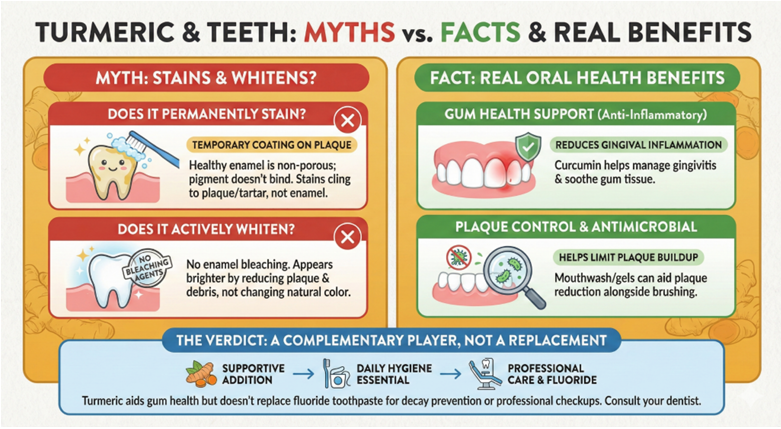
Does Turmeric Stain Teeth or Whiten Them? (Myth Busting)
Turmeric is widely celebrated for its healing properties, but its role in oral care often sparks
confusion. Some people swear it whitens teeth naturally, while others worry it causes stubborn
yellow stains. To clear the myths, let’s examine turmeric through the lens of dentistry,
evidence-based science, and oral health rather than social media trends.
A Brief History of Turmeric in Oral Care
Long before modern toothbrushes, fluoride toothpaste, and water flossers, early civilizations
relied on medicinal herbs to maintain oral hygiene. Turmeric, derived from the
Curcuma longa plant and native to Southeast Asia and India, was commonly used in
traditional medicine to treat inflammation and infections, including those affecting the mouth
and gums.
Turmeric appears in several forms today: powder, tablets, gels, and extracts. The terms
“turmeric,” “curcuma,” and “curcumin” are often used interchangeably. Curcumin is the active
compound responsible for most of turmeric’s biological effects.
Does Turmeric Stain Teeth?
At first glance, the concern seems reasonable. Turmeric’s intense yellow pigment stains skin,
fabric, and kitchen surfaces easily. However, tooth enamel behaves very differently.
Healthy enamel is highly mineralized and relatively non-porous. Turmeric pigments do not
chemically bind to enamel, meaning they do not permanently discolor teeth. In most cases:
- Turmeric temporarily coats plaque or surface debris
- Brushing removes turmeric residue
- Clean enamel resists permanent staining
If teeth appear yellow after using turmeric, the pigment is usually clinging to plaque or tartar,
not the enamel itself.
When Turmeric Can Cause Discoloration
Turmeric may contribute to visible staining in certain situations:
- Plaque buildup traps turmeric pigment
- Tartar deposits retain surface stains
- Porous restorations (bonding, crowns, veneers) absorb pigment
This is why consistent brushing and flossing remain essential when experimenting with
natural remedies.
Can Turmeric Actually Whiten Teeth?
This is where the biggest myth exists.
Turmeric does not bleach enamel or change the natural color of teeth. According to guidance
aligned with the American Dental Association, true whitening requires active agents such as
hydrogen peroxide or carbamide peroxide.
So why do some people notice a brighter smile after using turmeric?
- Turmeric reduces plaque accumulation
- Reduced plaque improves surface cleanliness
- Cleaner surfaces appear brighter
In many turmeric toothpastes, the mild whitening effect comes from added ingredients such
as baking soda, hydrated silica, or calcium carbonate — not from turmeric itself.
Oral Health Benefits Beyond Whitening
While turmeric is not a whitening agent, research suggests it may support oral health in other
meaningful ways.
Anti-Inflammatory Effects on Gums
Curcumin has been shown to reduce inflammatory responses in gum tissue:
- Curcumin reduces gingival inflammation
- Reduced inflammation improves gingivitis management
Clinical studies published in the Journal of Clinical & Diagnostic Research report that
curcuma-based gels can be effective in managing gingival inflammation. Research conducted
at M.A. Rangoowala Dental College further suggests that curcumin mouthwash may be
comparable to chlorhexidine in antimicrobial and anti-inflammatory effects for periodontal
patients.
Plaque Control and Antimicrobial Action
Turmeric’s benefits extend beyond gum tissue:
- Turmeric mouthwash reduces plaque buildup
- Plaque reduction lowers gingivitis risk
A study from Bharati Vidyapeeth Deemed University found that turmeric-based mouthwash
helped control plaque when used alongside proper brushing and flossing. However,
fluoride toothpaste remains the gold standard for cavity prevention.
Other Emerging Oral Health Potential
Ongoing research continues to explore turmeric’s:
- Antioxidant properties
- Antibacterial and antifungal activity
- Wound-healing potential in oral tissues
While promising, these benefits require further clinical evidence before turmeric can be
formally recommended as a primary dental treatment.
Should You Use Turmeric on Your Teeth?
Turmeric can be a supportive addition to oral care, but it is not a replacement for proven
dental practices.
- Turmeric may support gum health
- Fluoride toothpaste prevents tooth decay
- Professional dental care ensures long-term oral health
DIY remedies should never replace daily brushing, flossing, and routine dental checkups.
Always consult your dentist before adding turmeric-based products to your routine,
especially if you have restorations or existing gum disease.
Final Verdict: Myth Busted
- Turmeric does not permanently stain healthy teeth.
- Turmeric does not truly whiten enamel.
- Turmeric may improve the appearance of teeth by reducing plaque and inflammation.
In short, turmeric is not a miracle whitening solution, but it is not a dental villain either.
Its real value lies in its potential anti-inflammatory and antimicrobial support, making it a
complementary — not cosmetic — player in oral health.
Frequently Asked Questions
Does turmeric stain teeth permanently?
No. On clean enamel, turmeric does not cause permanent staining.
Why do my teeth look yellow after using turmeric?
The pigment may temporarily cling to plaque or tartar, which brushing typically removes.
Can turmeric replace whitening toothpaste?
No. Turmeric lacks the bleaching agents required for true whitening.
Is turmeric safe for gums?
Moderate use may support gum health due to its anti-inflammatory properties, but it should
not replace professional dental care.
Do dentists recommend turmeric for whitening?
Dentists do not recommend turmeric as a whitening agent, though some acknowledge its
antibacterial benefits when used responsibly.