
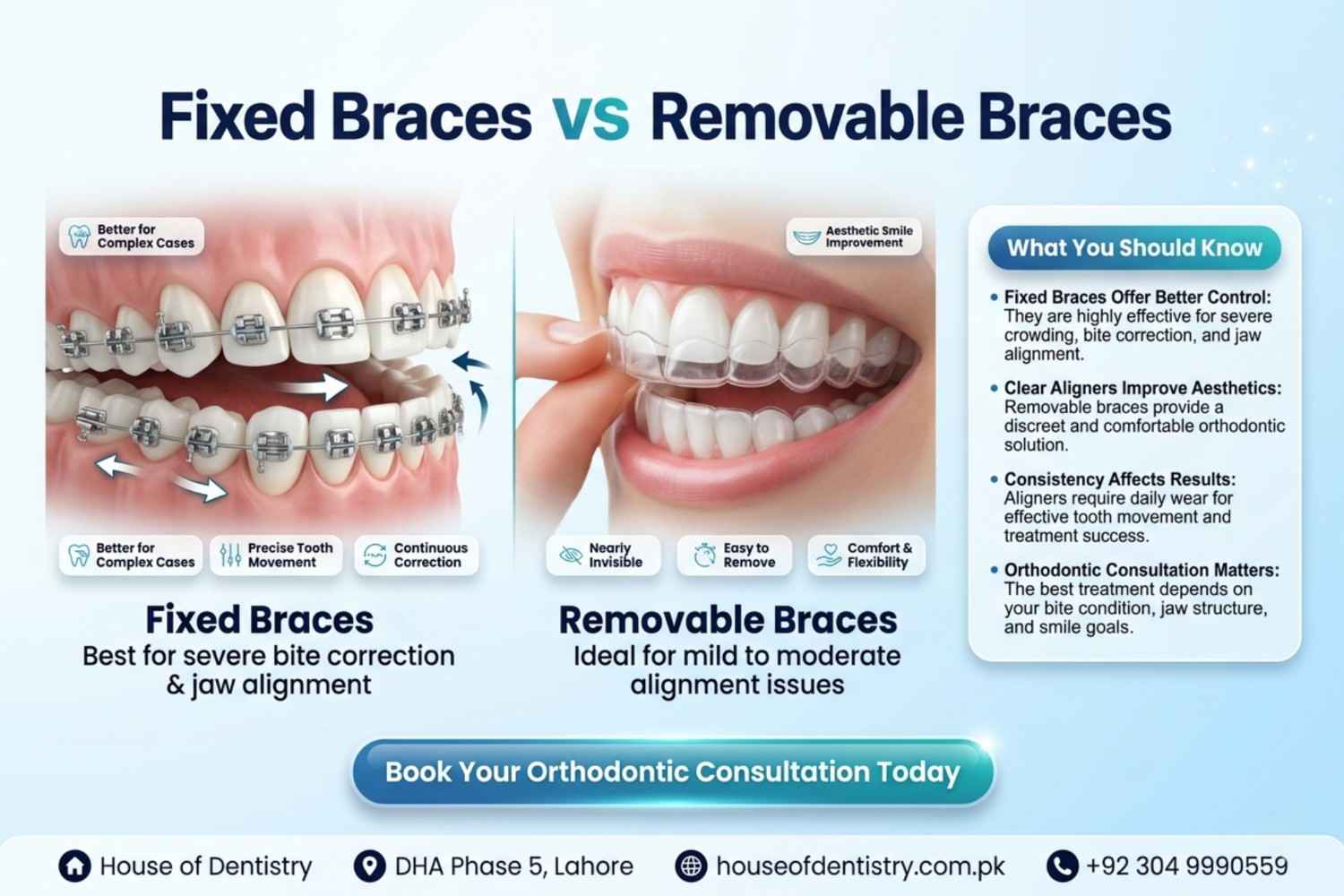
Fixed vs. Removable Braces: Assessing the Best Option for Complex Cases
Orthodontic treatment has evolved dramatically over the years, offering patients advanced solutions for correcting dental malocclusion, crowded teeth, jaw irregularities, and bite alignment problems.
Today, patients can choose between fixed braces and removable braces depending on the severity of their condition, treatment goals, lifestyle preferences, and oral health needs.
Understanding Fixed Braces
Fixed braces are orthodontic appliances permanently attached to the teeth throughout treatment. They usually consist of stainless steel braces or ceramic bracket systems connected by orthodontic wires, archwires, brackets, and elastics that gradually move teeth into proper alignment.
Types of Fixed Braces
- Traditional metal braces
- Ceramic braces
- Lingual orthodontics
- Self-ligating braces
- Stainless steel bracket systems
Advantages of Fixed Braces
Superior Control for Complex Tooth Movement
Fixed braces provide orthodontists with advanced anchorage control and torque control, making them highly effective for correcting severe crowding, Class II malocclusion, Class III malocclusion, posterior crossbite, midline discrepancy, deep bite, open bite, misaligned jaw conditions, impacted teeth, and significant spacing problems.
More Predictable Results
Fixed appliances work continuously without relying heavily on patient compliance. Since the brackets and archwires remain attached to the teeth, orthodontists can maintain consistent orthodontic force throughout the treatment process.
- Improve bite correction
- Support facial symmetry
- Enhance jaw alignment
- Correct severe occlusion problems
- Deliver long-term orthodontic results
Better for Extraction Cases
Complex orthodontic treatment sometimes requires tooth extraction to create space for alignment. Fixed braces are especially effective in extraction cases because they allow controlled space closure and accurate tooth positioning.
Disadvantages of Fixed Braces
Oral Hygiene Difficulties
Brackets and wires can trap food particles and increase plaque accumulation. Without proper oral hygiene maintenance, patients may face gingivitis risk, tooth decay, enamel demineralisation, and white spot lesions.
Dietary Restrictions
Patients with fixed braces should avoid sticky foods, hard candies, popcorn, and chewing ice because these foods can damage orthodontic wires and brackets.
Initial Discomfort
Patients commonly experience temporary soreness after adjustments because fixed appliances apply pressure to stimulate bone remodelling and tooth movement.
Understanding Removable Braces
Removable braces are orthodontic devices that patients can remove while eating, brushing, or flossing. Clear aligner therapy has become one of the most popular removable orthodontic treatments due to its discreet appearance and flexibility.
Types of Removable Braces
- Clear aligners
- Invisalign treatment
- Functional appliances
- Active removable retainers
Advantages of Removable Braces
Improved Smile Aesthetics
Clear aligners are nearly invisible, making them popular among adult and teen orthodontic patients who prioritise appearance and confidence during treatment.
- Improve smile aesthetics
- Increase self-esteem
- Provide discreet orthodontic treatment
- Allow greater social comfort
Easier Oral Hygiene Maintenance
Since removable braces can be taken out, patients can brush and floss more effectively. This reduces plaque build-up and lowers the risk of gum inflammation and tooth decay.
Greater Comfort and Flexibility
Clear aligners typically have smooth surfaces that reduce irritation inside the mouth. Patients can also continue eating most foods because aligners are removed during meals.
Digital Treatment Planning
- Digital impressions
- Virtual orthodontic monitoring
- Customised orthodontic treatment plans
- SmartTrack material technology
- Aligner refinement procedures
Disadvantages of Removable Braces
Requires Strong Patient Compliance
Removable braces only work effectively when patients wear them consistently for 20 to 22 hours daily. Poor treatment adherence can delay progress and reduce treatment effectiveness.
Less Effective for Severe Cases
Although clear aligner therapy can correct mild to moderate malocclusion, severe orthodontic issues often require fixed appliances for precise biomechanical control.
- Severe tooth rotation
- Complex bite correction
- Significant jaw discrepancies
- Large vertical tooth movements
- Advanced anchorage control needs
Risk of Damage or Loss
Because removable appliances are not permanently attached, patients may accidentally lose or damage them.
Fixed Braces vs. Removable Braces for Complex Cases
When assessing the best braces for severe crowding and advanced bite correction, fixed braces remain the gold standard for most orthodontists.
Fixed appliances provide superior biomechanics of tooth movement because they deliver constant pressure and allow detailed adjustments throughout treatment.
Cases Best Treated with Fixed Braces
- Severe crowding
- Misaligned jaw structures
- Significant overbite or underbite correction
- Open bite treatment
- Deep bite correction
- Posterior crossbite correction
- Impacted teeth management
- Cases requiring tooth extraction
Cases Suitable for Removable Braces
- Mild crowding
- Minor spacing issues
- Cosmetic tooth alignment
- Small bite corrections
- Adult patients seeking discreet treatment
How Orthodontists Decide Between Fixed and Removable Appliances
Orthodontists create personalised treatment plans after evaluating jaw structure, severity of malocclusion, tooth positioning, bone density, facial balance, age, oral health, speech adaptation concerns, and lifestyle preferences.
An orthodontic consultation typically includes 3D dental scanning, digital impressions, X-rays, occlusion analysis, and treatment planning discussions.
Treatment Time Comparison
Fixed Braces
Fixed braces often produce faster and more predictable results in complex orthodontic treatment because they apply continuous force without interruption.
Average treatment duration: 18 to 36 months
Removable Braces
Clear aligners may work efficiently for mild to moderate cases, but inconsistent wear can extend treatment time significantly.
Average treatment duration: 12 to 30 months for less severe cases
Oral Hygiene Tips During Orthodontic Treatment
Patients with Fixed Braces Should:
- Use floss threaders daily
- Brush after every meal
- Avoid sugary snacks
- Use orthodontic wax for irritation
- Attend regular dental cleanings
Patients with Removable Aligners Should:
- Clean aligner trays regularly
- Remove aligners before eating
- Brush before reinserting aligners
- Store aligners properly to avoid damage
Post-Treatment Retention and Relapse Prevention
After active orthodontic treatment ends, orthodontic retention becomes critical. Teeth naturally attempt to shift back into their previous positions, which is known as orthodontic relapse.
- Preserve tooth alignment
- Maintain bite correction
- Support long-term treatment stability
- Protect orthodontic investment
Cost Considerations
The cost of orthodontic treatment varies based on case complexity, treatment duration, appliance type, digital technology used, and maintenance requirements.
Fixed Braces
Traditional metal braces are often more affordable and highly effective for advanced orthodontic solutions.
Removable Braces
Clear aligners may cost more because they involve custom aligners, digital treatment planning, 3D scanning technology, and multiple aligner refinement stages.
Comfort, Lifestyle, and Daily Function
Fixed Braces May Be Better If You:
- Need major bite correction
- Require precise tooth movement
- Want predictable treatment outcomes
- Have severe orthodontic problems
Removable Braces May Be Better If You:
- Prioritise aesthetics
- Prefer flexible eating habits
- Want easier oral hygiene routines
- Have mild orthodontic concerns
Frequently Asked Questions
Are fixed braces better than removable braces for complex orthodontic cases?
Yes, fixed braces are generally more effective for complex orthodontic treatment. They provide continuous pressure, better anchorage control, and more precise tooth movement.
Can removable braces fix severe crowding?
Removable braces and clear aligners can treat mild to moderate crowding, but severe crowding often requires fixed braces for predictable results.
Which option works faster: fixed braces or removable aligners?
For severe orthodontic problems, fixed braces typically work faster because they remain attached to the teeth and apply constant orthodontic force.
Are clear aligners as effective as metal braces?
Clear aligners are highly effective for mild to moderate orthodontic concerns. However, traditional metal braces usually perform better in complex cases.
Do removable braces require more discipline?
Yes, removable braces rely heavily on patient compliance. Patients must wear aligners consistently and follow treatment instructions carefully.
Are fixed braces more painful than removable braces?
Fixed braces may cause temporary soreness after adjustments. Removable aligners are generally considered more comfortable, although mild discomfort can occur when switching trays.
Can adults choose fixed braces for orthodontic treatment?
Yes, many adults choose fixed braces for advanced bite correction and long-term treatment effectiveness. Ceramic braces and lingual braces also offer more discreet options.
Can clear aligners improve bite problems?
Yes, clear aligners can improve mild to moderate bite problems. However, severe bite correction cases often respond better to fixed orthodontic appliances.
Final Thoughts
Both fixed braces and removable braces play important roles in modern orthodontics, but the ideal choice depends on the complexity of the dental condition, patient lifestyle, and long-term treatment goals.
Fixed braces remain the most effective solution for severe malocclusion, complex bite correction, jaw alignment issues, and advanced orthodontic treatment because they provide continuous pressure, superior anchorage control, and predictable tooth movement.
Meanwhile, removable braces and clear aligner therapy offer excellent aesthetic and lifestyle advantages for patients with mild to moderate orthodontic concerns who can maintain strong patient compliance.
A professional orthodontic consultation with digital treatment planning and a comprehensive oral evaluation is the best way to determine which orthodontic appliance will provide the safest, fastest, and most effective path towards a healthier, more confident smile.