
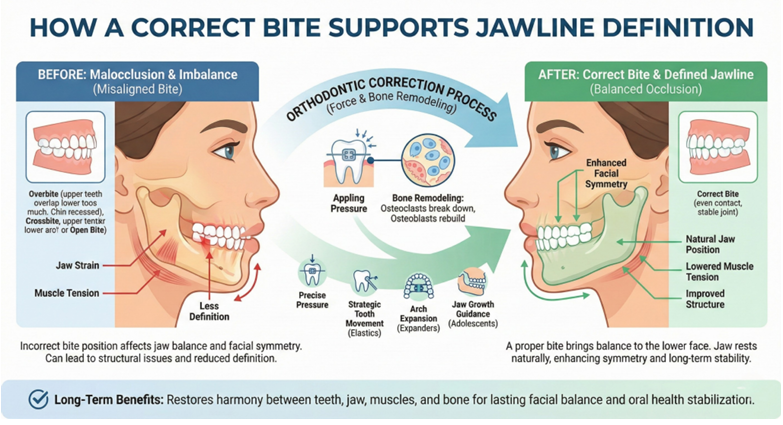
How a Correct Bite Supports Your Jawline Definition
Orthodontic treatment is not just about straightening teeth. It also plays a crucial role
in maintaining jawline definition by correcting bite problems and positioning the jaw properly.
A balanced bite supports structural harmony in the lower face, allowing the jaw to rest in its natural position.
When teeth and jaws align correctly, facial symmetry improves, muscle tension decreases,
and long-term oral health stabilizes.
Understanding Bite Problems (Malocclusion)
In dentistry, an incorrect bite is known as malocclusion. Malocclusion affects more than
your teeth — it influences jaw positioning, facial balance, and even posture. Since the jaw
forms the lower third of your face, imbalance can directly affect jawline definition.
A correct bite allows upper and lower teeth to meet evenly, distributing chewing forces
properly and keeping the jaw joint stable.
Types of Bite Problems
Overbite (Class II)
An overbite occurs when upper teeth excessively overlap lower teeth. In skeletal Class II cases,
the lower jaw may sit too far back, reducing chin projection and jawline definition.
- Enamel wear
- Gum irritation
- Speech issues
- Jaw strain
Underbite (Class III)
An underbite occurs when the lower jaw extends beyond the upper jaw. This can create
uneven bite forces and a prominent lower jaw.
- Chewing difficulty
- Jaw discomfort
- Uneven tooth wear
Crossbite
A crossbite happens when upper teeth bite inside the lower arch, potentially causing:
- Tooth wear
- Gum recession
- Asymmetrical jaw growth
- Long-term bone stress
Open Bite
An open bite occurs when upper and lower front teeth do not meet. It affects chewing efficiency
and speech clarity and may be linked to childhood habits like thumb-sucking or tongue thrusting.
Jaw Asymmetry
Jaw asymmetry may result from uneven skeletal growth or trauma. In some cases,
it affects the temporomandibular joint (TMJ), leading to clicking or discomfort.
The Biology Behind Bite Correction
Braces apply controlled, continuous force to teeth. This pressure stimulates the
periodontal ligament, triggering bone remodeling.
- Osteoclasts break down bone on one side.
- Osteoblasts rebuild bone on the other side.
This biological process allows teeth to gradually move into healthier positions while
maintaining structural integrity.
How Braces Improve Jawline Definition
Precise Pressure Application
Brackets and archwires guide tooth movement through continuous low-force pressure,
improving jaw alignment.
Strategic Tooth Movement
Class II and Class III mechanics use elastics to reposition the jaw relationship,
enhancing facial symmetry.
Arch Expansion
Palatal expanders widen the upper jaw to correct crossbites, creating space
for proper alignment and balanced jaw structure.
Jaw Growth Guidance
In adolescents, functional appliances guide skeletal development.
Early evaluation (around age seven) is recommended by orthodontic associations.
Vertical Control
Vertical elastics help close open bites, improving chewing efficiency
and reducing muscle strain.
Types of Braces for Bite Correction
- Metal Braces – Effective for complex cases.
- Ceramic Braces – Tooth-colored for improved aesthetics.
- Lingual Braces – Placed behind teeth.
- Self-Ligating Braces – Reduced friction systems.
- Clear Aligners – Suitable for mild to moderate cases.
Diagnostic Tools Used in Orthodontics
- Digital scans
- 3D imaging
- Cephalometric analysis
- Bite registration records
Accurate diagnosis ensures treatment targets dental or skeletal causes effectively.
The Orthodontic Treatment Journey
Initial Evaluation
Comprehensive examination to determine the root cause of malocclusion.
Personalized Treatment Plan
Appliance selection and timeline planning.
Active Treatment Phase
Regular adjustments to maintain controlled tooth movement.
Retention Phase
Retainers stabilize corrected alignment and prevent relapse.
Benefits Beyond Aesthetics
- Reduced enamel wear
- Improved periodontal health
- Reduced TMJ strain
- Improved muscle balance
Realistic Expectations
Treatment typically lasts between 12–36 months depending on case complexity.
Mild soreness after adjustments is normal. Retainer compliance is essential for long-term stability.
Frequently Asked Questions
Can braces improve jawline definition?
Yes. By correcting malocclusion and stabilizing jaw positioning, braces enhance facial symmetry.
How long does bite correction take?
Most treatments last between 12 and 36 months.
Are retainers necessary?
Yes. Retainers prevent teeth from shifting back after treatment.
Can correcting my bite reduce jaw pain?
Balanced occlusion reduces strain on the TMJ and surrounding muscles.