
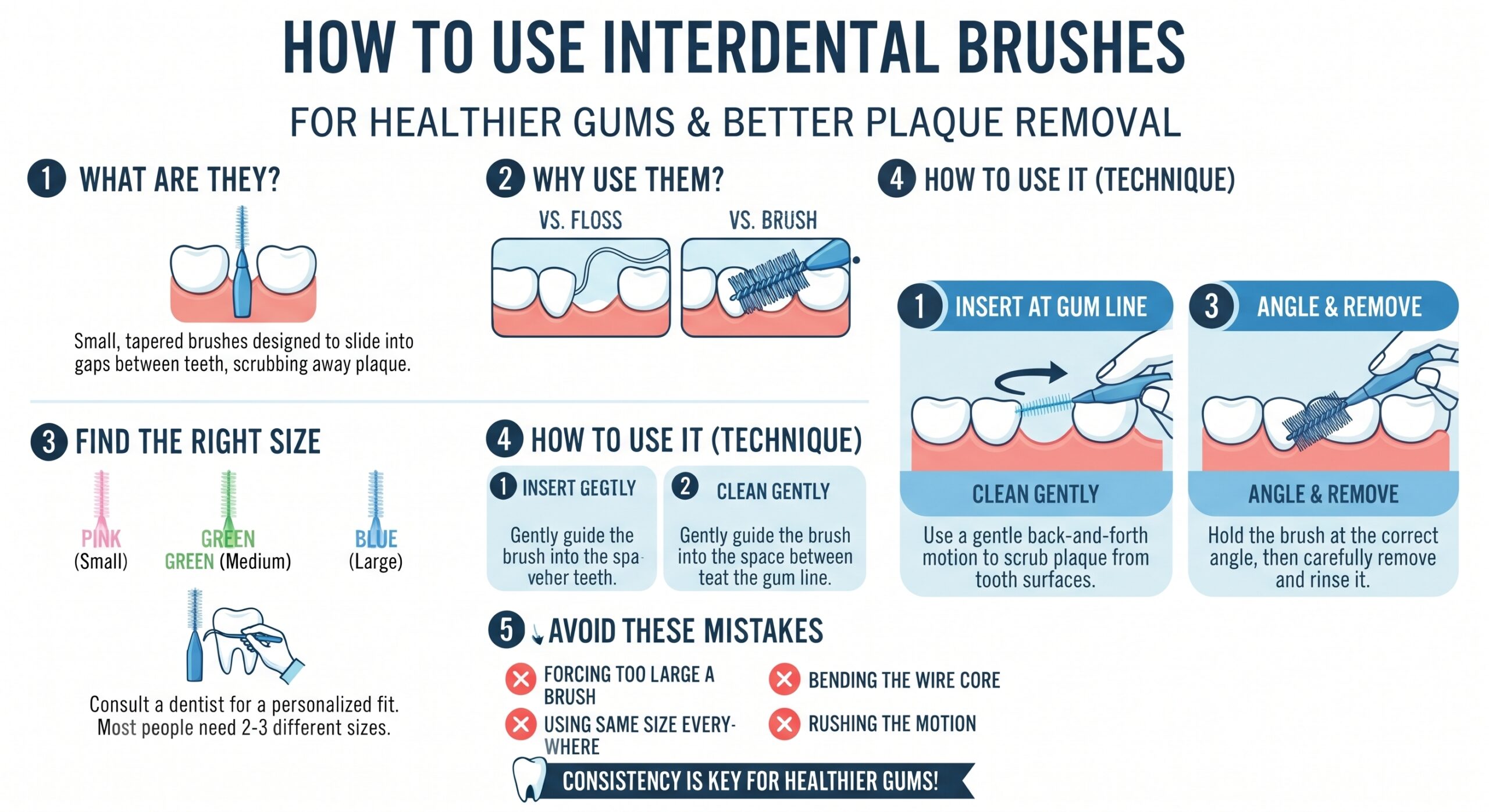
Interdental brushes remove up to 40% more plaque than flossing alone. Learn the correct technique, sizing tips, and daily routine for healthier gums.
Plaque does not stop at the surface of your teeth. It settles quietly between them too, in spaces your toothbrush bristles simply cannot reach. That is where interdental brushes come in, and once you learn how to use them properly, they can transform how thoroughly you clean your mouth every single day.
What Are Interdental Brushes?
Interdental brushes are small, tapered brushes designed to slide into the gaps between your teeth. Each one has a thin wire core wrapped in soft bristles, attached to a handle that makes it easy to control. Unlike floss, which relies on a flat strand of material, these brushes have a three-dimensional shape that fits snugly against the curved surfaces of your teeth and gums.
They come in a range of sizes, and picking the right one for each gap in your mouth is what makes the difference between a quick wipe and a genuinely effective clean. Many dental professionals now recommend them as a first-line tool for interproximal cleaning, especially for patients with larger gaps, dental work, or gum recession.
Why Interdental Brushes Outperform Floss for Many Patients
The Science Behind Interproximal Plaque Buildup
The spaces between your teeth, known as interproximal areas, are a favorite hiding spot for plaque. Saliva flow is reduced there, food particles get trapped easily, and a regular toothbrush cannot bend around the contours of neighboring teeth. Over time, this buildup hardens into tartar, which contributes to gum inflammation and, eventually, periodontal disease if it is left untreated.
Because interdental brushes match the actual shape of these gaps, they physically scrub away plaque rather than just pushing it around. Studies comparing interdental brushes to floss have found that brushes remove noticeably more plaque in people with wider interproximal spaces, largely because the bristles make full contact with both tooth surfaces at once.
Who Benefits Most From Interdental Cleaning
While almost anyone can use interdental brushes, they are particularly valuable for:
- People with braces, bridges, or dental implants
- Patients recovering from gum disease or with early gum recession
- Anyone who finds floss difficult to handle or uncomfortable to use
- Older adults with wider natural gaps between teeth
- People who wear removable partial dentures
If you fall into any of these groups, your dentist has likely already mentioned interdental brushes, and for good reason.
Choosing the Right Interdental Brush Size
Reading the Color Coding System
Interdental brushes are sold in a standardized color-coded sizing system, typically ranging from the smallest (often pink or purple) to the largest (often black or blue). The exact color-to-size mapping can vary slightly between manufacturers, so it is worth checking the packaging rather than assuming every pink brush is identical.
Your gaps are rarely all the same size. Most people need at least two, and sometimes three, different brush sizes to properly cover the front, back, and molar regions of their mouth. Buying a mixed pack is usually the most practical starting point.
Getting a Professional Fit Assessment
The single best way to choose your sizes is to ask your dentist or hygienist during a checkup. They can measure your interproximal spaces directly and recommend the exact sizes you need for each area. Using a brush that is too large can injure your gums, while one that is too small will not clean effectively, so this step genuinely matters.
Step-by-Step Guide to Using Interdental Brushes Correctly
Preparing the Brush and Your Mouth
Start with clean hands and a brush that matches the gap you are about to clean. There is no need to wet the brush beforehand, though some people find it more comfortable. Stand in front of a mirror for your first few sessions until the motion becomes second nature.
Inserting the Brush Without Force
Gently guide the brush into the gap between two teeth at the gum line. It should slide in with light resistance, never with force. If you feel sharp pressure or pain, you are likely using a size that is too big for that particular space, and you should switch to a smaller brush instead.
The Correct Angle and Motion
Once inserted, move the brush back and forth two or three times using a gentle, controlled motion. Keep the angle roughly perpendicular to the gap rather than jamming it straight in and out. This back-and-forth action is what dislodges plaque from both neighboring tooth surfaces at the same time.
Cleaning Back Teeth and Hard-to-Reach Areas
Molars and the back of your mouth are often neglected because they are harder to see and reach. An angled handle or a smaller brush head can help here. Take your time, and consider using a small mirror so you can watch what you are doing until the movement feels automatic.
How Often You Should Use Interdental Brushes
Most dental professionals recommend using interdental brushes once a day, ideally in the evening before bed when plaque has had all day to accumulate. Consistency matters more than perfection. A single thorough session each day will do far more for your gum health than sporadic, rushed attempts scattered throughout the week.
If you have braces, implants, or active gum disease, your dentist may suggest twice daily use as part of a more intensive care plan.
Common Mistakes That Reduce Plaque Removal Effectiveness
Even well-intentioned users often undermine their own results. Watch out for these frequent errors:
- Using the same brush size for every gap in your mouth
- Forcing a brush that is too large into a tight space
- Reusing a single brush for several days past the point where the bristles have worn down
- Rushing through the motion instead of using a deliberate back-and-forth action
- Skipping the back teeth because they are harder to reach
- Bending the wire core, which weakens the brush and reduces its effectiveness
Correcting even one or two of these habits can noticeably improve how much plaque you remove each day.
Interdental Brushes vs. Dental Floss vs. Water Flossers
| Feature | Interdental Brushes | Dental Floss | Water Flossers |
| Best for | Wider or irregular gaps | Tight, narrow gaps | Braces, implants, sensitive gums |
| Ease of use | High, especially for beginners | Moderate, requires dexterity | High, minimal technique needed |
| Plaque removal in wide gaps | Excellent | Limited | Good |
| Portability | Very portable | Very portable | Requires electricity or battery |
| Cost over time | Low to moderate | Low | Moderate to high upfront |
None of these tools is universally superior. Many dentists recommend combining interdental brushes with regular brushing and reserving floss or a water flosser for spaces where a brush genuinely will not fit.
Caring for and Replacing Your Interdental Brushes
Rinse your brush thoroughly under running water after each use and let it air dry. Replace it as soon as the bristles start to splay outward or feel noticeably softer, which for most people happens every few days to a week depending on frequency of use. Never share your interdental brush with anyone else, since this can transfer bacteria between mouths.
Signs You Are Using the Wrong Technique or Size
Pay attention to feedback from your own mouth. Bleeding gums during the first week or two of use is common and usually settles down as your gums get healthier. However, ongoing bleeding, soreness, or visible gum recession around a specific tooth may mean your brush size is too large or your angle is off. If discomfort persists beyond two weeks, it is worth checking in with your dentist rather than pushing through.
Building Interdental Brushing Into Your Daily Oral Care Routine
Pairing interdental brushing with your regular toothbrushing habit only takes an extra minute or two once you get the hang of it. A simple, effective routine looks like this:
- Brush your teeth for two minutes with fluoride toothpaste
- Use your interdental brushes to clean between each tooth, working systematically from one side of your mouth to the other
- Rinse your mouth and clean your brush for next time
Sticking to this order helps loosen plaque with your toothbrush first, then clear out what remains between your teeth.
Frequently Asked Questions
1. Can interdental brushes replace flossing completely?
For many people with wider gaps, yes, interdental brushes can replace floss. However, if your teeth are very tightly spaced, floss may still be necessary in those specific areas.
2. Are interdental brushes safe for daily use?
Yes, when used with the correct size and gentle technique, daily use is both safe and recommended by most dental professionals.
3. Why do my gums bleed when I first start using interdental brushes?
Mild bleeding in the first one to two weeks is common as your gums adjust and become healthier. Persistent bleeding beyond that point should be checked by your dentist.
4. How do I know which size interdental brush to buy?
The safest approach is to have your dentist or hygienist measure your interproximal gaps during a checkup and recommend specific sizes for different areas of your mouth.
5. Can children use interdental brushes?
Interdental brushes are generally recommended for teens and adults, though a pediatric dentist can advise on the right time to introduce them for a specific child.
Conclusion
Interdental brushes are a small addition to your routine with an outsized impact on your gum health. Once you have the right sizes and a comfortable technique, cleaning between your teeth becomes quick, effective, and honestly, a little satisfying. Talk to your dentist at your next visit to get properly sized brushes and start seeing the difference for yourself.