
Invisalign Refinements Explained: Why You Might Need Extra Aligners
If you’re nearing the end of your Invisalign treatment, you may be expecting to celebrate the completion of your new smile. However, some patients are surprised when their orthodontist recommends an additional set of aligners known as Invisalign refinements.
While it may sound like an extension of treatment, Invisalign refinements are actually a common and valuable part of the clear aligner process. They help correct minor discrepancies, improve bite alignment, and fine-tune tooth positioning to ensure the best possible outcome.
Understanding why refinements happen and how they contribute to treatment success can help you feel more confident about your orthodontic journey.
What Are Invisalign Refinements?
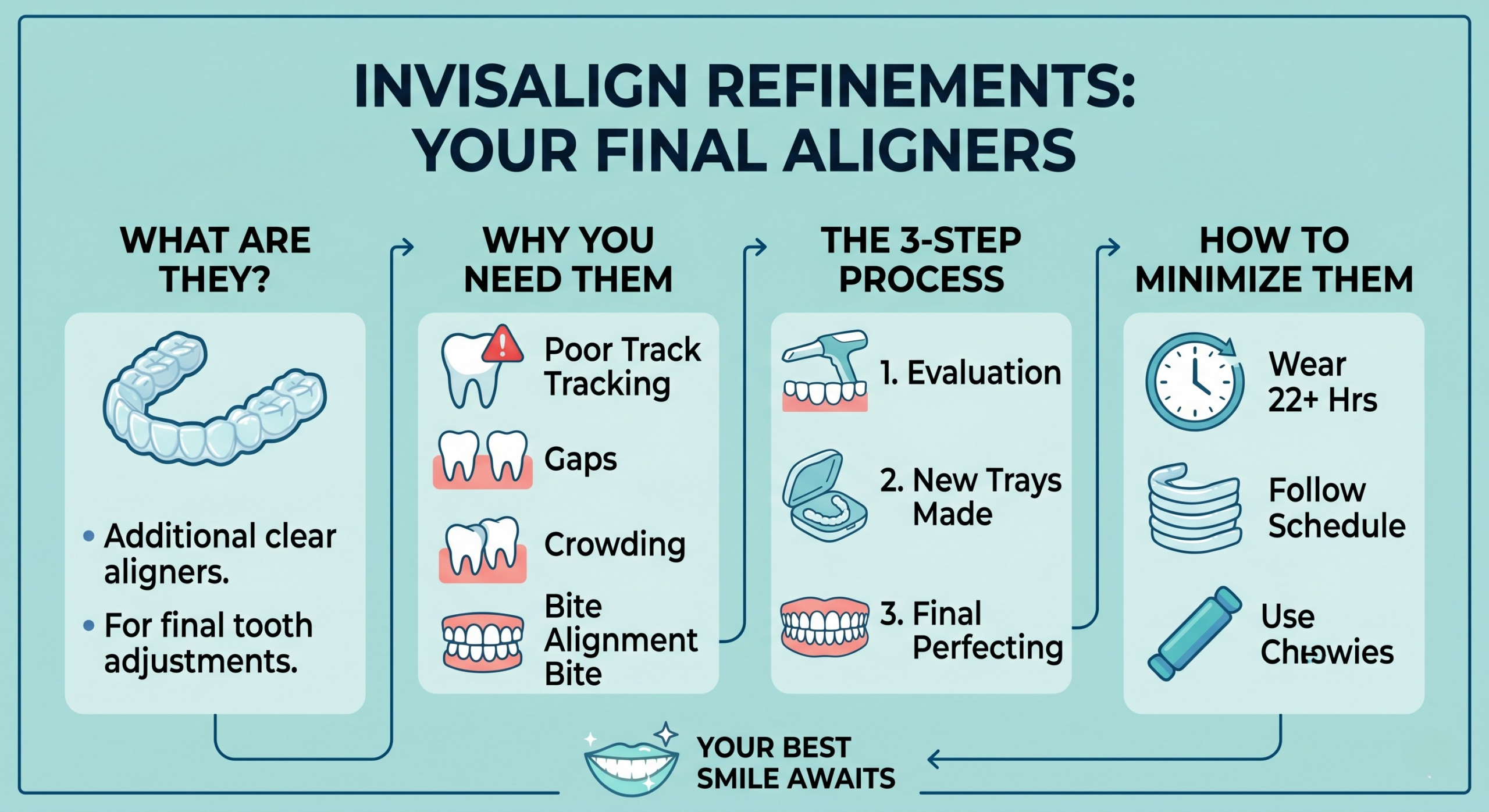
Invisalign refinements are additional aligners prescribed after the initial treatment series is completed. These refinement trays are designed to make final adjustments when teeth have not moved exactly as predicted in the original treatment plan.
Although Invisalign uses advanced digital orthodontics and customized aligners, tooth movement remains a biological process. Every patient responds differently to orthodontic forces, which means some teeth may require extra guidance before reaching their ideal position.
Think of refinements as the finishing phase of treatment. Their purpose is to optimize smile aesthetics, improve occlusion, and achieve the most accurate treatment outcome possible.
Why Are Invisalign Refinements So Common?
Many patients assume that their last aligner will perfectly complete treatment. In reality, orthodontic treatment involves several variables that can affect tooth movement predictability.
The original treatment plan is created using a digital model known as a ClinCheck treatment plan. This software simulates how teeth should move throughout treatment. However, actual tooth movement can differ slightly from the virtual prediction.
An Invisalign refinement may be recommended because:
- Teeth did not track properly during treatment.
- Small gaps remain between teeth.
- Crowding was not completely resolved.
- Bite alignment requires additional correction.
- Rotated teeth need further adjustment.
- Midline correction is incomplete.
- Posterior or anterior open bite issues remain.
These situations do not indicate treatment failure. Instead, they reflect the normal biological response of teeth and supporting structures.
How Teeth Move During Invisalign Treatment
To understand why refinements may be necessary, it’s important to understand how Invisalign works.
Clear aligners apply controlled orthodontic force to specific teeth. This pressure stimulates the periodontal ligament and surrounding alveolar bone.
The process follows a predictable biological pattern:
- Aligners apply controlled force.
- Orthodontic force stimulates bone remodeling.
- Bone remodeling enables tooth movement.
- Tooth movement changes tooth position.
- Improved tooth position supports bite correction.
Since every person’s bone density, metabolism, age, and oral health differ, teeth may respond at different rates throughout treatment.
This is one reason why treatment predictability can vary, even when patients follow instructions carefully.
Tooth Tracking and Why It Matters
One of the most important concepts in Invisalign treatment is tooth tracking.
Tooth tracking refers to how accurately teeth follow the movements programmed into the aligners. When teeth track properly, the aligners fit snugly against the teeth without visible gaps.
Signs of tracking issues may include:
- Small spaces between aligners and teeth
- Loose-fitting trays
- Difficulty seating aligners completely
- Teeth appearing behind schedule
- Attachments not fitting correctly
When tracking issues occur, refinements may be needed to bring teeth back on course.
Many orthodontists recommend using chewies to improve aligner seating. Proper aligner seating helps ensure that the SmartTrack material can deliver the intended forces effectively.
Factors That Increase the Need for Refinements
Several factors can influence whether a patient requires Invisalign refinements.
Wear Time Compliance
One of the biggest factors is patient compliance.
Aligners should generally be worn for 20 to 22 hours per day. Insufficient wear time can cause teeth to fall behind the projected treatment schedule.
The relationship is straightforward:
- Patient compliance affects treatment duration.
- Insufficient wear time causes tracking issues.
- Tracking issues leads to refinements.
Even missing a few hours per day consistently can affect treatment efficiency.
Case Complexity
Certain orthodontic movements are more challenging than others.
These include:
- Root torque adjustments
- Tooth rotations
- Extrusion movements
- Intrusion movements
- Crossbite correction
- Overbite correction
- Overjet reduction
- Class II bite correction
- Class III bite correction
More complex cases naturally have a greater likelihood of requiring additional aligners.
Biological Response
Every patient’s body responds differently to orthodontic treatment.
Factors that may influence movement include:
- Bone density
- Age
- Periodontal ligament response
- Alveolar bone remodeling
- Gingival health
- Overall oral hygiene
These biological differences are beyond the patient’s control and can influence final results.
The Invisalign Refinement Process
If your orthodontist determines that refinements are necessary, the process is relatively simple.
Comprehensive Evaluation
First, your provider performs a treatment evaluation to compare your current tooth position with the original treatment goals.
This assessment may include:
- Clinical examination
- Bite analysis
- Digital impressions
- Intraoral scanner images
- Treatment progress photographs
- Radiographs when necessary
The goal is to identify any remaining discrepancies affecting smile aesthetics or function.
New Digital Scan
A refinement scan is then performed using an intraoral scanner.
The updated scan captures the exact position of your teeth after the initial aligner series. This information is uploaded into the ClinCheck software to create a new treatment plan.
Creation of Additional Aligners
Based on the updated digital treatment planning process, Invisalign manufactures a new series of refinement aligners.
These aligners are customized specifically to address the remaining concerns.
Depending on the case, your orthodontist may also add the following:
- SmartForce attachments
- Precision cuts
- Elastics
- Interproximal Reduction (IPR)
These tools help improve treatment precision and support difficult tooth movements.
What Problems Can Invisalign Refinements Correct?
Refinements are often used to address issues that become apparent near the end of treatment.
Common corrections include:
Residual Spacing
Small gaps may remain between teeth despite successful treatment.
Invisalign refinement corrects residual tooth movement and helps close these spaces for a more attractive smile.
Bite Alignment Problems
Refinement aligners can improve occlusion by correcting the following:
- Overbite
- Overjet
- Crossbite
- Open bite
- Edge-to-edge bite
A properly aligned bite supports long-term stability and overall oral health.
Tooth Rotation
Rotated teeth can sometimes require additional force to reach their final position.
Refinement trays provide targeted correction for these stubborn movements.
Midline Discrepancies
Even minor midline imbalances can affect smile symmetry.
Refinements help improve facial balance and create a more harmonious smile appearance.
Invisalign Refinements and Smile Aesthetics
Many patients seek Invisalign treatment primarily for cosmetic improvement.
Refinements play a significant role in enhancing:
- Smile symmetry
- Smile arc
- Tooth alignment
- Facial profile
- Dental esthetics
- Facial balance
Even small adjustments can dramatically improve the overall appearance of a smile.
This is why many orthodontists consider refinements an essential part of smile optimization rather than an optional extra.
Are Refinements Included in Invisalign Treatment?
Coverage varies depending on the Invisalign package selected.
Some common treatment options include:
- Invisalign Comprehensive
- Invisalign Moderate
- Invisalign Lite
- Invisalign Express
Comprehensive plans often include one or more rounds of refinements within the overall treatment fee. Limited plans may have restrictions regarding additional aligners.
Patients should discuss refinement policies with their Invisalign provider before beginning treatment.
How Long Do Invisalign Refinements Take?
The duration of refinements depends on the complexity of the remaining movements.
Typical timelines include the following:
| Refinement Type | Estimated Time |
| Minor Adjustments | 1-2 Months |
| Moderate Corrections | 2-4 Months |
| Complex Corrections | 4-6+ Months |
Most patients require significantly fewer aligners than during their original treatment phase.
Can You Avoid Invisalign Refinements?
While refinements cannot always be prevented, patients can reduce the likelihood of extensive additional treatment.
Helpful strategies include:
- Wearing aligners as directed
- Following tray change schedules
- Using chewies regularly
- Attending all appointments
- Maintaining excellent oral hygiene
- Keeping attachments intact
- Reporting tracking issues early
These habits improve treatment predictability and support efficient tooth movement.
What Happens After Refinements?
Once refinements are complete, patients enter the retention phase.
Retention is critical because teeth naturally tend to shift after orthodontic treatment.
The retention phase typically involves wearing custom retainers to maintain alignment.
Important relationships include the following:
- Retainers prevent orthodontic relapse.
- Orthodontic relapse alters tooth position.
- Long-term stability requires retainer compliance.
- The retention phase follows Invisalign treatment.
Consistent retainer wear is one of the most important factors in preserving your new smile.
Frequently Asked Questions
1. What is an Invisalign refinement?
An Invisalign refinement is a series of additional aligners prescribed after the initial treatment phase to make final adjustments to tooth positioning, bite alignment, and smile aesthetics. Refinement trays help correct any remaining issues that were not fully resolved during the original treatment plan.
2. Why do some patients need Invisalign refinements?
Not all teeth move exactly as predicted in the original ClinCheck treatment plan. Factors such as biological response, tooth tracking, case complexity, and wear time compliance can affect treatment outcomes. Refinements help ensure teeth reach their ideal final positions.
3. How common are Invisalign refinements?
Invisalign refinements are very common. Many patients require at least one round of additional aligners to improve treatment accuracy, optimize bite function, and enhance smile symmetry. Refinements are often considered a normal part of clear aligner therapy.
4. How do orthodontists determine if refinements are needed?
At the end of the initial aligner series, the orthodontist evaluates tooth alignment, occlusion, spacing, and overall treatment progress. Digital impressions or an intraoral scanner are typically used to compare current results with the original treatment goals.
5. How long do Invisalign refinements take?
The duration depends on the complexity of the remaining corrections. Minor refinements may take one to two months, while more complex adjustments involving bite correction or root torque movements can take several months.
6. Are Invisalign refinements included in the treatment cost?
Many Invisalign comprehensive plans include one or more rounds of refinements within the original treatment fee. However, coverage varies depending on the treatment package and provider. It’s always best to confirm refinement policies before starting treatment.
Final Thoughts
Invisalign refinements are a normal and often beneficial part of clear aligner therapy. They allow orthodontists to fine-tune treatment results, improve occlusion, enhance smile aesthetics, and ensure that teeth reach their ideal final positions.
Because tooth movement depends on biological response, treatment compliance, and case complexity, additional aligners are sometimes necessary even when everything appears to be progressing well.
Rather than viewing refinements as a setback, consider them the final step toward achieving a healthier bite, improved facial balance, greater long-term stability, and the confident smile you originally envisioned.