
Feeling nervous about a dental appointment is more common than you might think. Whether it is fear of pain, anxiety about needles, or concern over a lengthy procedure, these feelings can prevent people from getting the dental care they need. Fortunately, modern sedation dentistry makes it easier than ever to have a comfortable, anxiety-free dentistry experience.
Among the most popular sedation dentistry options are IV sedation and oral sedation. Both are designed to ease dental anxiety and help nervous dental patients relax, but they work differently and are suitable for different situations, different procedures, and different patients.
In this guide, we will compare IV sedation and oral sedation, explain their benefits and limitations, walk through the medications and monitoring equipment involved, and help you understand which comfortable dental treatment option may be right for you.
Understanding Dental Sedation Options
Dental sedation involves using medication to help patients feel calm during dental procedures. Contrary to popular belief, most forms of sedation dentistry do not put you completely to sleep. Instead, they create a relaxing dental visit by inducing conscious sedation, a state in which you remain responsive to your dentist while feeling deeply at ease. Sedation exists on a spectrum that ranges from minimal sedation to moderate sedation to deep sedation, with general anesthesia reserved for specific medical situations.
Common dental sedation options include:
- Oral sedation
- IV sedation (intravenous sedation)
- Nitrous oxide (laughing gas)
- General anesthesia (for specific medical situations)
The right choice depends on your level of dental anxiety or dental phobia, your medical history, the complexity of the procedure, and your sedation dentist’s recommendation. It is worth noting that sedation does not replace local anesthesia. Local anesthesia blocks pain directly at the treatment site using numbing injections such as lidocaine, while sedation manages anxiety and awareness. Most sedation appointments use both together for full pain control and comfort.
What Is Oral Sedation?
Oral sedation involves taking a prescribed sedative pill approximately 30 to 60 minutes before your appointment. Oral sedation is taken as a tablet, and the medication gradually helps you feel relaxed and less anxious while you remain awake throughout treatment.
Common sedative medications used for oral sedation include benzodiazepines such as diazepam (Valium), triazolam (Halcion), and lorazepam. These medications reduce anxiety and help the body settle into a calm state before treatment even begins.
Benefits of Oral Sedation
- Easy to administer
- No needles required
- Helps reduce mild to moderate dental anxiety
- Affordable compared to IV sedation
- Suitable for many routine dental procedures, including crown preparation and multiple restorations
Many patients become so relaxed that they experience some memory loss, or amnesia, and remember very little about the procedure afterward.
Limitations
Oral sedation has a slower onset than IV sedation, and the level of sedation cannot be adjusted once the medication has been taken, since it is a fixed dose. The effects may also vary depending on your body weight, metabolism, and medical history. Some patients report dry mouth, dizziness, or grogginess as the medication wears off.
What Is IV Sedation?
IV sedation, meaning intravenous sedation, is administered through an intravenous line placed by your sedation dentist or dental anesthesiologist, allowing the medication to take effect within minutes. An IV catheter delivers the sedative medication directly into the bloodstream.
Medications commonly used for IV sedation include midazolam and other benzodiazepines, chosen for their fast onset and ability to be adjusted throughout treatment. Unlike oral sedation, IV sedation allows dosage adjustment in real time, so your dental team can increase or decrease the sedative as needed during longer or more complex procedures such as dental implant placement, wisdom tooth removal, bone grafting, or periodontal surgery.
Patients remain conscious but feel deeply relaxed, and many have little or no memory of the treatment afterward.
Benefits of IV Sedation
- Fast-acting
- Adjustable throughout treatment
- Ideal for lengthy procedures and oral surgery
- Greater control over sedation levels
- Stronger anxiety relief for patients with severe dental phobia
This option is often recommended for patients with severe dental anxiety, a strong gag reflex, or those undergoing multiple procedures such as tooth extraction combined with root canal treatment during one visit.
IV Sedation vs. Oral Sedation: Key Differences
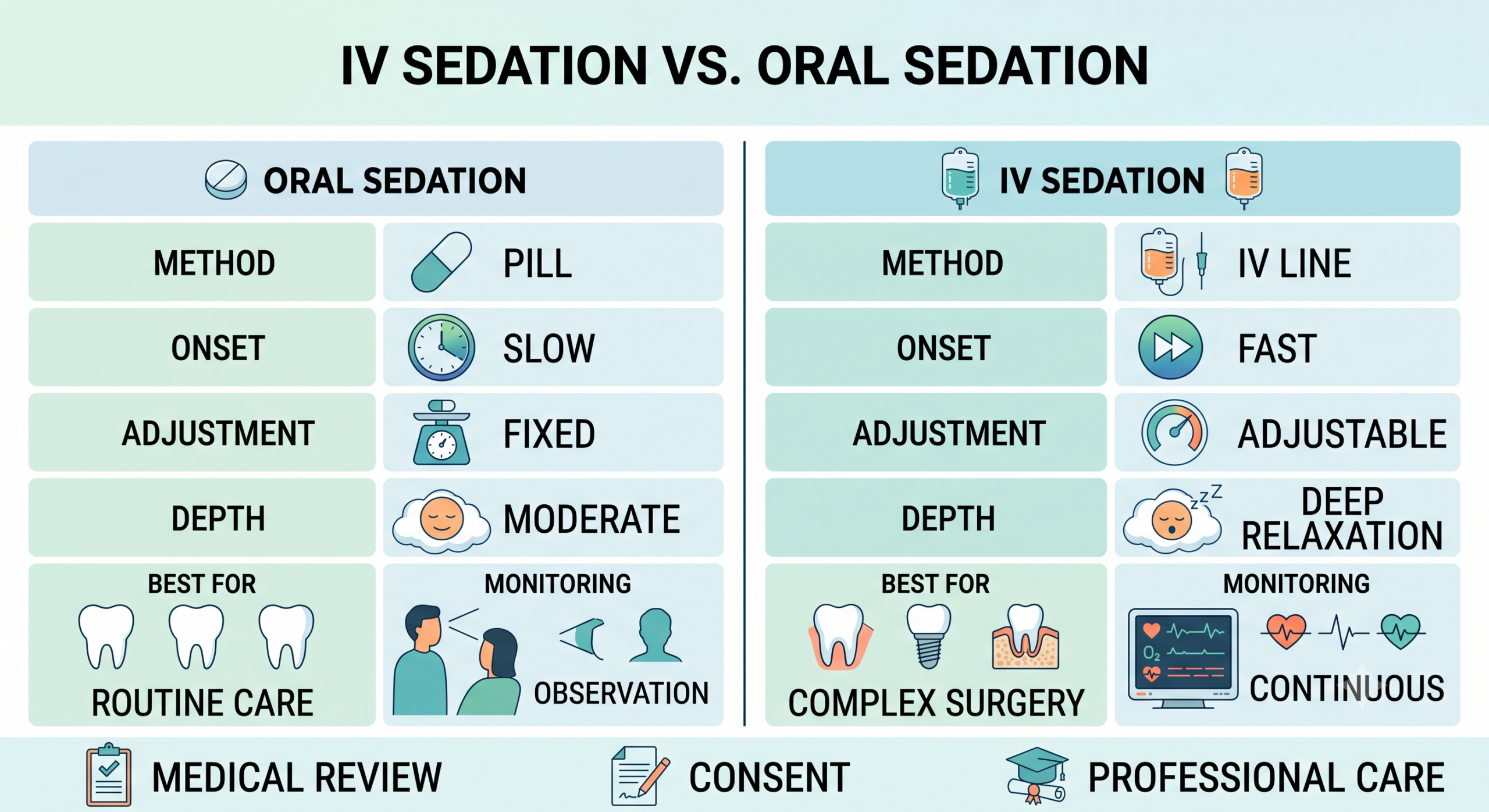
| Feature | Oral Sedation | IV Sedation |
| Administration | Tablet | Intravenous line (IV catheter) |
| Speed of onset | 30 to 60 minutes | Within minutes |
| Sedation control | Fixed dose | Easily adjustable |
| Anxiety relief | Moderate relaxation | Deep relaxation |
| Best for | Mild to moderate anxiety, routine dentistry | Severe anxiety, oral surgery, or complex procedures |
| Monitoring | Standard observation | Continuous monitoring with a pulse oximeter and blood pressure monitor |
| Recovery | Several hours of observation period at home | Several hours, with a recovery room observation period at the office |
| Cost | Generally lower | Usually higher |
How Sedation Medications Work
Understanding the medications behind sedation dentistry can help ease some of the mystery around the process. Both oral sedation and IV sedation commonly rely on benzodiazepines, a class of sedative medications that calm the central nervous system. Diazepam and triazolam are frequently used for oral conscious sedation, while midazolam is a common choice for IV sedation because of its rapid onset and short duration.
These sedative medications work alongside local anesthetic, such as lidocaine, which is still used to numb the specific area being treated. Sedation manages the anxiety and awareness of the appointment, while the local anesthetic handles pain control at the treatment site.
Monitoring and Safety During Sedation
Patient safety is the foundation of sedation dentistry, and monitoring equipment plays a central role in every appointment. During IV sedation in particular, your dental team continuously tracks vital signs using a pulse oximeter to measure oxygen saturation, a blood pressure monitor, a heart rate monitor, and in some cases ECG monitoring. Airway management and emergency equipment are always kept on hand, and the dental office maintains emergency preparedness protocols in case they are ever needed.
A qualified sedation dentist, oral surgeon, or dental anesthesiologist oversees the sedation, often supported by a registered dental assistant and dental hygienist. Before any sedation is administered, the dental team completes a medical history review and a health questionnaire and follows the ASA Physical Status Classification system, a guideline from the American Society of Anesthesiologists used to assess whether a patient is a safe candidate for sedation. This process reflects evidence-based dentistry and the clinical guidelines set out by organizations such as the American Dental Association and applicable state dental boards.
Sedation certification for the treating dentist, informed consent from the patient, and a clear review of allergies and current medications are all standard parts of a safe sedation consultation.
Who Can Receive Dental Sedation
Sedation dentistry is not one size fits all. Different patient types benefit from different approaches:
- Children may receive mild oral sedation for anxiety related to routine care
- Adults often choose sedation for both anxiety management and comfort during longer procedures
- Seniors may require extra consideration due to high blood pressure, sleep apnea, or other health conditions
- Patients with disabilities or special needs patients, including those with autism spectrum disorder or movement disorders, may benefit from the predictability of sedation
- Patients with dental phobia, a strong gag reflex, or PTSD often find that sedation makes treatment possible when it otherwise would not be
Your sedation dentist will always weigh these individual factors against the complexity of the planned procedure, whether that is a simple cleaning or more involved oral surgery.
Which Dental Sedation Option Is Right for You?
Choosing between IV and oral sedation depends on several factors, including your anxiety level, medical history, and the type of procedure you need.
Oral sedation may be best if you:
- Feel mildly to moderately anxious
- Need a routine dental procedure
- Prefer avoiding needles
- Want a more affordable sedation option
IV sedation may be better if you:
- Experience severe dental fear or dental phobia
- Need oral surgery, dental implant placement, or multiple procedures in one visit
- Have a strong gag reflex
- Want deeper relaxation and adjustable dosing throughout treatment
Your dentist will evaluate your medical history and treatment plan, including pre-operative instructions and informed consent, before recommending the safest option.
Benefits of Choosing the Right Dental Sedation Options
Selecting the appropriate sedation method offers several advantages for the overall treatment experience:
- Reduced dental anxiety
- Greater patient comfort during treatment
- Easier completion of complex procedures such as periodontal surgery or bone grafting
- Less awareness of time passing
- Improved overall dental experience and treatment experience
For many nervous dental patients, sedation makes it possible to receive necessary dental care that they might otherwise postpone out of fear.
Are Dental Sedation Options Safe?
Yes. When administered by trained dental professionals following established clinical guidelines, dental sedation options are considered very safe. Before recommending sedation, your dentist will review:
- Medical history
- Current medications and possible drug interactions
- Allergies
- Previous experiences with anesthesia
- Overall health, including conditions like sleep apnea or high blood pressure
During IV sedation, continuous monitoring tracks your heart rate, blood pressure, oxygen levels, and breathing throughout the procedure. Rare but possible risks include allergic reaction, respiratory depression, or a temporary drop in blood pressure, which is why airway management tools and emergency equipment remain close at hand. Following all pre-operative and post-operative instructions helps ensure a smooth recovery and reduces the chance of complications.
Preparing for Sedation Dentistry
Proper preparation helps minimize risks and improve your experience. Your dentist may recommend that you:
- Avoid eating or drinking for several hours before treatment, known as fasting or having an empty stomach
- Complete a medication review and health questionnaire ahead of time
- Sign consent forms as part of the informed consent process
- Wear comfortable clothing
- Arrange an escort home, since a responsible adult must provide transportation
- Take medications only as instructed
- Inform the dental team about any recent illnesses
Following these guidelines helps ensure your procedure goes smoothly and safely.
Recovery After Sedation
Recovery varies depending on the type of sedation used, but both oral sedation and IV sedation typically involve a period of rest in a recovery room or observation area before you are cleared to leave.
After oral sedation or IV sedation:
- You may feel drowsy, groggy, or dizzy for several hours
- Avoid driving or operating machinery
- Rest for the remainder of the day
- Drink plenty of water
- Follow your dentist’s post-operative care instructions closely
Most patients return to their normal routine by the following day, though some grogginess or memory loss from the sedation medication may linger briefly.
Frequently Asked Questions
Is IV sedation stronger than oral sedation?
Yes. IV sedation generally produces a deeper level of relaxation and allows dosage adjustment during treatment, making it suitable for more complex procedures and patients with severe anxiety.
Can you talk during IV sedation?
Yes. IV sedation is a form of conscious sedation, meaning patients typically remain responsive and able to communicate with the dental team, even though they are deeply relaxed.
Do you feel pain with IV sedation?
No. IV sedation is paired with local anesthetic to manage pain control at the treatment site, so patients should not feel pain during the procedure itself.
Which sedation works faster?
IV sedation takes effect within minutes, while oral sedation typically takes 30 to 60 minutes to take full effect.
Is oral sedation enough for wisdom teeth removal?
It depends on the complexity of the extraction. Straightforward cases may be managed with oral sedation, while more involved wisdom tooth removal often calls for IV sedation.
Can children receive oral sedation?
Yes, in many cases. A pediatric dentist or sedation dentist will determine the appropriate sedative medication and dosage based on the child’s age, weight, and health history.
Is IV sedation safe for seniors?
IV sedation can be safe for seniors, but a full medical history review is essential, particularly for conditions like high blood pressure or sleep apnea that may affect sedation planning.
How long does IV sedation stay in your system?
Effects typically last several hours, though this varies by medication and individual metabolism. Some grogginess or memory loss may persist into the following day.
What is the difference between sedation and anesthesia?
Sedation reduces anxiety and awareness while patients generally remain conscious, whereas general anesthesia induces a fully unconscious state and is reserved for specific medical or surgical situations.
How long does oral sedation last?
The effects typically last several hours, although this varies depending on the medication used and the individual.
Conclusion
Modern sedation dentistry has transformed the way patients experience dental care. Whether you choose oral sedation for mild to moderate anxiety or IV sedation for more extensive treatment and severe dental phobia, both methods rely on careful medical history review, trained dental professionals, and continuous attention to patient safety to make your visit more comfortable and less stressful.
The best choice depends on your anxiety level, the complexity of your procedure, and your overall health. By discussing your concerns openly during a sedation consultation, you can select the sedation method that provides the right balance of comfort, safety, and effectiveness for your next appointment.