
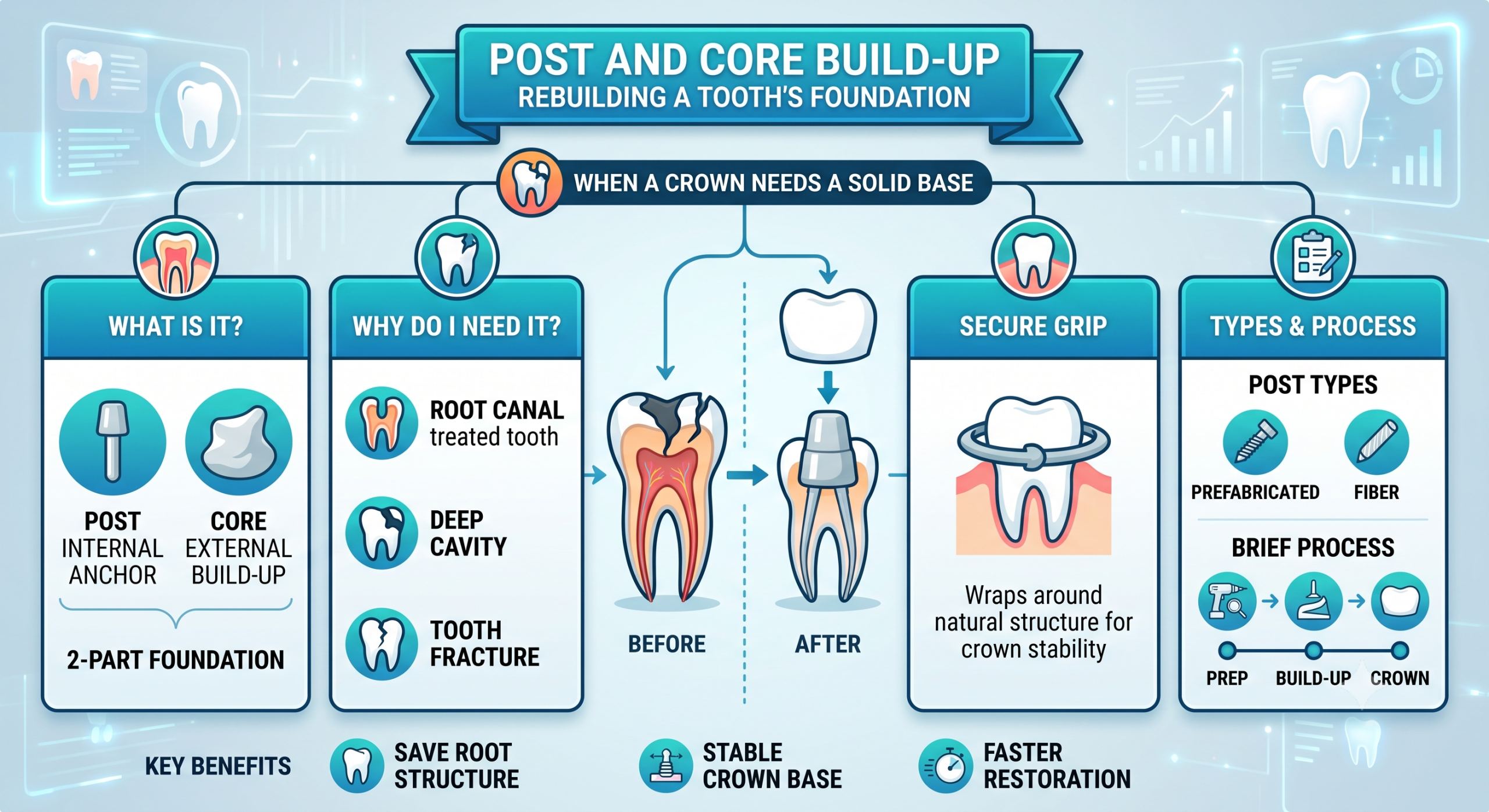
When a tooth has lost too much of its natural structure, a crown alone often will not have enough to hold onto. That is where a post and core build-up comes in. This procedure rebuilds the foundation of a damaged tooth so a crown can be placed securely, and it plays a quiet but critical role in modern restorative dentistry.
If you have been told you need a post and core build-up before your crown, you are probably wondering what that actually involves. Let’s walk through it, step by step, so you know exactly what to expect.
What Is a Post and Core Build-Up?
A post and core build-up is a two-part dental restoration used to rebuild a tooth that does not have enough natural structure, meaning enamel and dentin, left to support a crown on its own. The “post” is a small rod, made of metal or fiber, that is inserted into the tooth’s root canal space, anchoring into the space once occupied by the pulp chamber. The “core” is the material built up around and over the post to recreate the shape of the tooth, ready to be shaped down for a crown.
Think of it like rebar in a concrete pillar. The post reinforces the structure from the inside, while the core material forms the outer shape that everything else relies on. This concept in dentistry is often described through retention and resistance form, essentially, how well a restoration resists being dislodged and how well it resists rotating or shifting under the forces of chewing.
This approach is most common after root canal therapy, since a tooth that has had its pulp removed often loses a significant portion of its coronal structure to decay or the access needed for treatment.
How It Differs From a Standard Filling
A filling repairs a small to moderate area of tooth decay while leaving most of the natural enamel and dentin intact. A post and core build-up, on the other hand, is used when there is so little natural tooth left that a filling would not hold up under occlusal forces, the pressure generated when your upper and lower teeth come together. Instead of patching a gap, the dentist is essentially reconstructing the tooth’s core framework from the inside out.
Why Some Teeth Need a Post and Core Before a Crown
Not every tooth that gets a crown needs a post and core first. It is generally reserved for teeth that have lost a significant amount of their original structure.
Extensive Tooth Decay
When decay has spread deep into a tooth, removing it can leave very little healthy dentin behind. In these cases, a standard filling will not provide enough support for a crown, so a post and core build-up steps in to rebuild what was lost.
Root Canal Treated Teeth
Teeth that have undergone root canal therapy are more prone to structural weakness. The access opening created during the procedure, combined with the loss of the tooth’s internal pulp tissue, can leave the tooth brittle. A post and core restores strength and gives the crown a stable base, while the gutta-percha placed during the root canal continues sealing the lower portion of the canal against reinfection.
Fractured or Broken Teeth and Cracked Tooth Syndrome
Trauma, biting down on something hard, or long term wear can crack or break a tooth above the gumline. Dentists refer to certain patterns of this damage as cracked tooth syndrome, where a tooth develops a fine crack that causes sharp pain on biting, often before the fracture is even visible on an X-ray. If enough of the tooth remains below the fracture, a post and core build-up can often save it, avoiding the need for an extraction. A true vertical root fracture, however, one that runs down through the root itself rather than across the crown, usually cannot be saved with a post and core and often leads to extraction instead.
The Ferrule Effect: Why Remaining Tooth Structure Matters Most
If there is one concept that determines whether a post and core build-up will succeed, it is the ferrule effect. A ferrule refers to a band of natural tooth structure, ideally at least one to two millimeters of solid dentin, that a crown can grip onto above the core material. This remaining tooth acts like a metal band wrapped around the base of a wooden post, resisting the wedging forces that would otherwise crack the root over time.
Without adequate ferrule height, even a perfectly placed post and core is at a much higher risk of failure, since the crown ends up relying almost entirely on the post and cement rather than on natural tooth structure. This is why your dentist evaluates the crown-to-root ratio and the amount of remaining structure so carefully before recommending this treatment. If too little sound structure remains to create a ferrule, your dentist may recommend crown lengthening surgery to expose more of the root, or may suggest extraction if the outlook is not favorable.
Types of Post and Core Materials
Dentists have several material options for posts and cores, each with its own strengths depending on the tooth’s location, biocompatibility needs, and the forces it will face.
Prefabricated Metal Posts
These are ready-made posts, typically made of stainless steel or titanium, that a dentist selects and fits during the appointment. They are strong, affordable, and widely used, especially for back teeth that handle heavier chewing forces.
Fiber Posts
Fiber posts are made from resin reinforced with glass or quartz fibers. They flex slightly, similar to natural dentin, which can reduce the risk of root fracture compared to more rigid metal options. Fiber posts are also tooth-colored and highly biocompatible, making them a popular choice for front teeth where esthetics matter and where a metal post might otherwise create a visible gray shadow beneath a translucent crown.
Cast Metal Posts and Cores
For teeth with unusual root shapes or minimal remaining structure, a dentist may take an impression and send it to a lab to create a custom cast metal post and core. This option is precise but requires an extra lab step and a temporary restoration in the meantime.
| Material Type | Best For | Key Advantage |
| Prefabricated Metal | Back teeth, standard cases | Cost-effective, readily available |
| Fiber Post | Front teeth, esthetic zones | Flexes like natural dentin, tooth-colored |
| Cast Metal | Unusual root shapes | Custom fit, high precision |
Once the post and core are complete, the tooth is typically restored with a zirconia, e.max, or porcelain-fused-to-metal crown, depending on the tooth’s location and the bite forces it will need to withstand.
The Post and Core Procedure Step by Step
Understanding the process can ease a lot of the uncertainty around this treatment. Here is what typically happens in the chair.
Step 1: Diagnosis and Imaging
Your dentist starts with a periapical X-ray, and sometimes a cone beam CT scan for a more detailed three-dimensional view, to evaluate the remaining tooth structure, the shape of the root canal, and the health of the surrounding bone and periodontal ligament. A percussion test, gently tapping the tooth, may also help confirm whether there is inflammation at the root tip. This step determines whether a post and core is the right approach, and if so, which type of post will work best.
Step 2: Root Canal Preparation and Post Space Preparation
If the tooth has not already had root canal therapy, it will usually be completed first, sealing the canal with gutta-percha. The post space is then prepared within the canal using a specialized drill, leaving enough sealed root filling material at the bottom to maintain the apical seal created during the root canal.
Step 3: Placing the Post
After local anesthesia and often isolation with a rubber dam to keep the area dry and free of saliva, the post is cemented into the canal using a resin cement or bonding agent. It needs to sit securely without disturbing the apical seal of the root canal filling, so precision matters quite a bit here.
Step 4: Building the Core
Once the post is in place, the dentist builds up the core material, usually a composite resin or amalgam, around it. This recreates the shape of the tooth’s remaining coronal structure and gives the crown something solid to grip, working together with any remaining natural ferrule.
Step 5: Shaping for the Crown
Finally, the core is shaped and trimmed to the correct dimensions for a crown, much like a natural tooth would be prepared. An impression or digital scan is taken, and the crown fabrication process, whether zirconia, e.max, or porcelain-fused-to-metal, moves forward from there.
Who Performs a Post and Core Build-Up?
A general dentist can often complete a post and core build-up, especially when the case is straightforward. For teeth with complicated root canal anatomy, an endodontist typically handles the root canal therapy first, and in more complex restorative cases, a prosthodontist may be involved in planning the crown and core together to make sure everything works as one stable system.
Benefits of a Post and Core Build-Up
There are several reasons dentists reach for this technique rather than simply extracting a badly damaged tooth:
- Preserves the natural tooth root and periodontal ligament, which helps maintain jawbone density
- Provides a stable, predictable foundation for a long-lasting crown
- Avoids the cost and complexity of tooth replacement options like implants or bridges
- Can be customized in material and shape to suit the specific tooth
- Often completed in a single office visit for the post and core portion
Risks and Limitations to Consider
No dental procedure is entirely without risk, and post and core build-ups are no exception.
- Root fracture: In rare cases, especially with rigid metal posts, excessive force can crack the root itself, and a true vertical root fracture usually cannot be repaired.
- Insufficient ferrule or remaining structure: If too little natural tooth remains to create an adequate ferrule, even a post and core may not be enough, and extraction could be the better option.
- Cement or bonding failure: Over time, the bond between the post and the tooth can weaken, particularly if oral hygiene habits slip.
- Secondary caries: New decay can develop around the margins of the restoration if it is not properly maintained.
- Resorption: In rare cases, internal or external resorption, where the body begins to break down root structure, can compromise the long-term success of the restoration.
Your dentist will weigh these factors carefully before recommending the procedure, and they will usually walk you through the alternatives too.
Recovery and Aftercare Tips
Recovery after a post and core build-up is generally straightforward, especially compared to more invasive procedures. A few tips can help protect your investment:
- Avoid chewing on the treated tooth until the permanent crown is placed.
- Stick to softer foods for the first day or two if you experience any tenderness.
- Maintain regular brushing and flossing, being gentle around the temporary restoration.
- Keep your follow-up appointment for the permanent crown, since delaying this step can put the core at risk of fracture.
- Contact your dentist promptly if you notice sharp pain, swelling, or a temporary crown that feels loose.
How Long Does a Post and Core Restoration Last?
With proper care, a post and core build-up combined with a well-fitted crown can last well over a decade, and many patients keep theirs for a lifetime. Longevity depends on a mix of factors: the amount of remaining ferrule and natural tooth structure, the material used, occlusal forces, and how consistently you keep up with oral hygiene and dental checkups.
Grinding your teeth at night, known as bruxism, can shorten the lifespan of the restoration by placing uneven stress on the post and core, so your dentist may recommend an occlusal splint, or nightguard, if this applies to you.
Cost Considerations for Post and Core Build-Ups
Costs vary depending on your location, the material chosen, and whether root canal therapy is needed alongside the build-up. In general, prefabricated posts tend to be the most budget-friendly option, while custom cast posts carry a higher lab fee. Dental insurance claims for this treatment are typically filed under specific CDT codes, such as D2952 for a cast post and core and D2954 for a prefabricated post and core, and your dentist’s office can often submit a pre-authorization request so you know your expected coverage before treatment begins.
Frequently Asked Questions
1. Is a post and core build-up painful?
Most patients feel little to no discomfort during the procedure since the tooth is numbed with local anesthesia, and if a root canal has already been completed, the nerve tissue causing pain is no longer present.
2. Can any tooth get a post and core build-up?
Not quite. The tooth needs enough remaining structure to create an adequate ferrule, along with a healthy root and periodontal ligament to anchor the post. Your dentist will assess this with an X-ray and sometimes a CBCT scan before recommending the procedure.
3. Do I need a root canal before a post and core?
In most cases, yes. Posts are placed into the root canal space, so the canal typically needs to be cleaned and sealed with gutta-percha first, unless it was already treated previously.
4. How long does the procedure take?
The post and core portion usually takes one appointment, often between 45 minutes and an hour, though timing can vary depending on the complexity of the case and whether an endodontist is involved.
5. Will my tooth feel different after a post and core?
Once the permanent crown is in place, most patients say the tooth feels and functions just like a natural one, with no noticeable difference in daily use or bite.
Conclusion
A post and core build-up might sound like a small technical detail, but it often makes the difference between saving a badly damaged tooth and losing it altogether. By rebuilding the tooth’s foundation, respecting principles like the ferrule effect and proper retention and resistance form, before a crown is placed, this procedure offers a reliable, well-established way to restore both function and confidence in your smile. If your dentist has recommended one, rest assured it is a time-tested solution designed to give your tooth the best possible chance at a long, healthy future.