
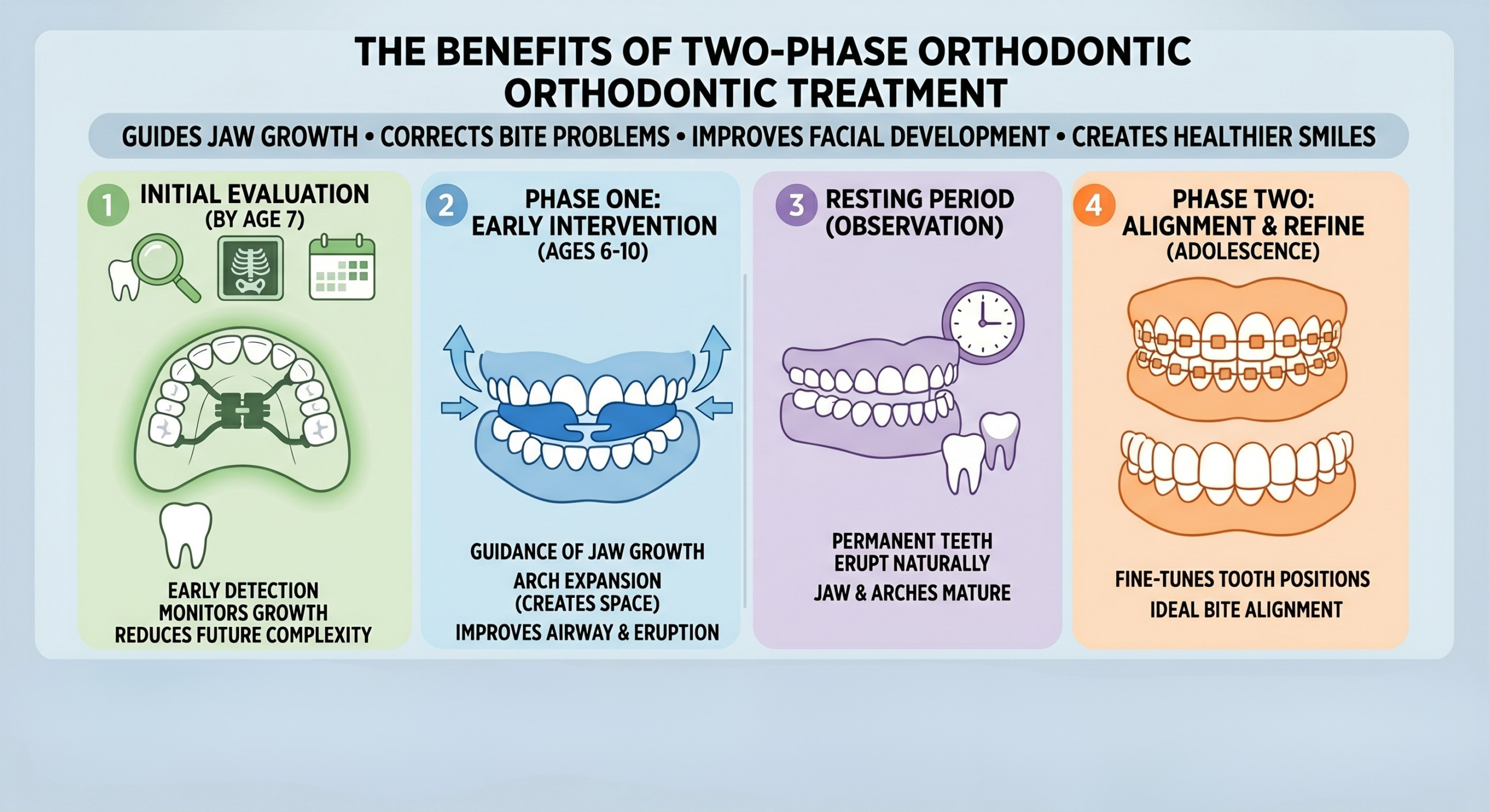
Two-phase orthodontic treatment helps guide jaw growth, correct bite problems early, improve facial development, and create healthier smiles for children.
Understanding Two-Phase Orthodontic Treatment
A healthy smile is about more than straight teeth. Proper jaw growth, bite alignment, airway development, and oral function all play critical roles in a child’s long-term dental health. That’s why many orthodontists recommend two-phase orthodontic treatment for certain children with developing orthodontic problems.
Unlike traditional orthodontic care that begins only after all permanent teeth erupt, two-phase orthodontic treatment starts earlier and takes advantage of a child’s natural growth patterns. By addressing issues while the jaws and facial bones are still developing, orthodontists can often achieve results that may be more difficult to accomplish later in life.
Parents frequently wonder whether early intervention is necessary or if they should simply wait for braces during adolescence. The answer depends on the child’s dental development, growth stage, and treatment goals. In many cases, early orthodontic intervention can prevent more serious complications from developing.
Two-phase orthodontic treatment is a specialized approach that combines interceptive orthodontics and dentofacial orthopedics. It divides care into two separate stages.
The first phase begins during mixed dentition, when children have a combination of primary teeth and permanent teeth. This stage focuses on correcting developmental problems involving jaw growth, bite alignment, skeletal discrepancies, and tooth positioning.
The second phase occurs later, usually after most permanent teeth have erupted. During this stage, braces or aligners are used to refine tooth alignment and achieve a healthy, functional bite.
The primary goal is to maximize the benefits of natural growth while creating an ideal environment for permanent teeth to emerge properly.
Key objectives include:
- Guiding craniofacial growth
- Influencing skeletal development
- Correcting bite discrepancies
- Creating space for erupting teeth
- Improving eruption guidance
- Reducing crowding
- Improving facial harmony
- Enhancing oral function
- Supporting long-term stability
When recommended appropriately, two-phase orthodontic treatment can significantly improve both dental health and smile aesthetics.
Why Early Orthodontic Evaluation Matters
Many parents assume orthodontic care begins during the teenage years. However, the American Association of Orthodontists recommends an orthodontic evaluation by age seven.
At this age, an orthodontic specialist can identify:
- Posterior crossbite
- Anterior crossbite
- Underbite
- Overbite
- Deep bite
- Open bite
- Midline discrepancy
- Jaw growth abnormalities
- Class II malocclusion
- Class III malocclusion
- Severe crowding
- Impacted teeth
- Harmful oral habits
Early evaluation does not always mean immediate treatment. Instead, it allows orthodontists to monitor growth and intervene when necessary.
Children experience rapid growth during childhood, making this an ideal time to assess maxillary growth, mandibular growth, and overall facial development. Addressing problems during active growth can reduce treatment complexity later.
A comprehensive evaluation may include:
- Panoramic X-rays
- Cephalometric analysis
- Digital impressions
- Orthodontic records
- Clinical photographs
- Bite analysis
These diagnostic tools help orthodontists assess facial growth patterns, airway development, and the risk of ectopic eruption or impacted canines.
For example, a narrow upper jaw may respond well to a rapid palatal expander (RPE) during childhood but become significantly more difficult to correct in adulthood.
What Is Phase One Treatment?
Phase One treatment focuses on developing the jaws and creating conditions for healthy tooth eruption.
This phase typically begins between ages six and ten, depending on the child’s growth and orthodontic needs.
The treatment generally lasts between 9 and 18 months.
Goals of Phase One include:
- Expanding narrow dental arches
- Correcting harmful bite relationships
- Guiding jaw growth
- Managing skeletal discrepancies
- Preventing trauma to protruding teeth
- Improving airway development
- Managing severe crowding
- Improving oral function
- Supporting proper tongue posture
Orthodontists design individualized treatment plans based on the child’s specific condition and stage of development.
Common Appliances Used in Phase One
Several appliances may be used during Phase One treatment:
| Appliance | Purpose |
| Rapid Palatal Expander (RPE) | Widens a narrow upper jaw and increases arch width |
| Twin Block Appliance | Encourages forward lower jaw growth |
| Herbst Appliance | Corrects Class II jaw discrepancies |
| Lingual Arch | Maintains space for erupting permanent teeth |
| Nance Appliance | Helps preserve arch length |
| Space Maintainer | Prevents space loss after premature tooth loss |
| Partial Braces | Aligns selected teeth |
| Habit Appliance | Stops thumb sucking and tongue thrusting |
These appliances work because children’s bones are still developing.
Palatal expansion increases arch width and creates additional room for erupting permanent teeth. Functional appliances help guide jaw development and improve facial balance.
When used correctly, they can significantly improve craniofacial growth and reduce future orthodontic complications.
What Happens During the Resting Period?
After Phase One treatment ends, children enter a resting or observation period.
This phase is essential because it allows the following:
- Permanent teeth to erupt naturally
- Jaw growth to continue
- Orthodontists to monitor development
- Additional corrections to stabilize
- Dental arches to mature
Parents sometimes worry that treatment has stopped entirely. In reality, orthodontists carefully monitor progress during this period.
Regular follow-up appointments help ensure that permanent teeth are erupting correctly and that jaw growth continues as expected.
During this observation phase, orthodontists monitor:
- Tooth eruption sequence
- Dental arch development
- Eruption guidance
- Premolar eruption
- Incisor alignment
- Impacted canine risk
- Facial growth patterns
The observation phase may last several years depending on the child’s age and dental development.
What Is Phase Two Treatment?
Phase Two treatment begins after most permanent teeth have erupted.
This stage focuses on fine-tuning tooth alignment and achieving optimal bite function.
Common goals include:
- Straightening teeth
- Closing spaces
- Refining bite relationships
- Improving smile aesthetics
- Achieving functional occlusion
- Enhancing long-term stability
- Supporting relapse prevention
Unlike Phase One, which focuses on growth modification, Phase Two concentrates on detailed tooth movement.
The result is a healthy, functional, and attractive smile.
Braces and Aligners in Phase Two
Orthodontists may use:
- Traditional metal braces
- Ceramic braces
- Self-ligating braces
- Clear aligners
Treatment duration varies but often ranges from 12 to 24 months.
The specific approach depends on the complexity of the case, treatment goals, and patient preferences.
Conditions That May Require Two-Phase Orthodontic Treatment
Not every child requires two-phase orthodontic treatment, but several conditions commonly benefit from early intervention.
Class II Malocclusion
Class II malocclusion occurs when the upper teeth significantly overlap the lower teeth, often due to a retrusive lower jaw. This condition can increase the risk of trauma to protruding front teeth and may affect facial balance.
Class III Malocclusion
Class III malocclusion, commonly known as an underbite, develops when the lower jaw extends beyond the upper jaw. Early growth modification can help guide jaw development and reduce the severity of skeletal discrepancies.
Posterior or Anterior Crossbite
Crossbites can affect jaw symmetry and normal craniofacial growth. Left untreated, a crossbite may contribute to uneven jaw development and functional bite problems.
Severe Crowding
When insufficient space exists for incoming permanent teeth, early treatment may create room through arch development and eruption guidance, reducing the need for future extractions.
Open Bite or Deep Bite
These bite conditions can interfere with chewing, speech articulation, and long-term occlusal stability.
Narrow Dental Arches
A narrow upper arch may contribute to crowding, mouth breathing, and improper tongue posture. Expansion can improve arch width and overall function.
Impacted Teeth Risk
Early orthodontic monitoring can reduce the likelihood of impacted canines and other eruption problems.
Harmful Oral Habits
Persistent thumb sucking, tongue thrusting, and chronic mouth breathing can alter facial growth and dental arch development.
12 Powerful Benefits of Two-Phase Orthodontic Treatment
The advantages of two-phase orthodontic treatment extend beyond cosmetic improvements and can positively influence oral health, facial growth, and overall well-being.
1. Encourages Proper Jaw Growth
Early treatment guides craniofacial growth while a child’s bones are still developing.
2. Improves Bite Function
Proper bite alignment improves chewing efficiency and supports healthy oral function.
3. Reduces Crowding
Creating space early helps permanent teeth erupt into more favorable positions.
4. Lowers Risk of Tooth Trauma
Children with excessive overjet often have a greater risk of damaging front teeth during sports and play.
5. Improves Facial Development
Balanced jaw growth contributes to improved facial symmetry and harmony.
6. Reduces the Need for Tooth Extraction
Early space management can often decrease the likelihood of future extractions.
7. Minimizes the Need for Jaw Surgery
Growth modification may reduce the severity of skeletal discrepancies that could otherwise require orthognathic surgery later.
8. Supports Better Oral Hygiene
Straighter teeth are easier to clean, reducing plaque accumulation and lowering the risk of gingivitis and dental caries.
9. Improves Speech Development
Certain bite problems affect speech articulation. Early correction may improve pronunciation and communication.
10. Enhances Self-Confidence
A healthier smile can positively impact a child’s confidence and social interactions.
11. Creates Better Long-Term Stability
Correcting skeletal and developmental issues early often leads to more stable results.
12. Simplifies Future Orthodontic Care
Phase Two treatment is frequently more efficient when significant growth-related issues have already been addressed.
Supports Healthy Airway Development
Proper jaw development can promote healthier airway function and encourage nasal breathing. Airway development supports healthy facial growth and oral function.
Improves Tongue Posture and Swallowing Patterns
Correcting narrow arches and bite discrepancies often encourages proper tongue posture and swallowing habits, both of which influence dental arch stability.
Helps Prevent Impacted Teeth
Early eruption guidance creates space for developing canines and premolars, lowering the risk of impaction.
Reduces the Risk of Relapse
Addressing skeletal problems during growth can improve long-term stability and support relapse prevention after treatment is completed.
Improved Jaw Development
One of the greatest benefits of two-phase orthodontic treatment is its ability to influence skeletal growth patterns. Since children’s bones remain adaptable, orthodontists can guide jaw development in ways that become much more difficult later in life.
Reduced Risk of Tooth Damage
Correcting protruding front teeth helps protect them from fractures and other injuries.
Better Facial Symmetry
Balanced maxillary and mandibular growth contributes to improved facial proportions and aesthetics.
Easier Future Orthodontic Care
Many children who complete Phase One require less complex treatment during Phase Two.
Ideal Age for Treatment
The ideal timing depends on the child’s individual condition and growth pattern.
| Age Range | Purpose |
| 7–9 Years | Initial orthodontic evaluation |
| 6–10 Years | Phase One treatment when indicated |
| 11–14 Years | Phase Two treatment |
| Adolescence | Retention and long-term monitoring |
Growth patterns vary considerably among children, making individualized assessment essential.
Signs Your Child May Need Early Orthodontic Care
Parents should consider scheduling an orthodontic evaluation if they notice:
- Early or late loss of primary teeth
- Difficulty chewing or biting
- Chronic mouth breathing
- Thumb sucking beyond age five
- Tongue thrusting
- Poor tongue posture
- Crowded or overlapping teeth
- Misaligned jaws
- Facial asymmetry
- Excessive overjet
- Crossbite, deep bite, or open bite
- Frequent cheek biting
- Speech difficulties
- Clicking or discomfort near the temporomandibular joint (TMJ)
Early detection allows orthodontists to determine whether two-phase orthodontic treatment is appropriate.
How Parents Can Support Treatment Success
Parents play a major role in achieving successful outcomes.
Strong treatment compliance is one of the most important factors influencing success.
Helpful strategies include:
- Encouraging consistent appliance wear
- Maintaining excellent oral hygiene habits
- Preventing plaque buildup and gingivitis
- Attending scheduled follow-up appointments
- Monitoring dietary recommendations
- Supporting healthy breathing habits
- Encouraging proper tongue posture
- Communicating concerns promptly
Children tend to experience better results when families actively participate in treatment.
Frequently Asked Questions
1. What is two-phase orthodontic treatment?
Two-phase orthodontic treatment is an orthodontic approach that combines early growth guidance with later tooth alignment to create healthier, more stable results.
2. Does every child need two-phase orthodontic treatment?
No. Many children only require traditional orthodontic treatment during adolescence. Early intervention is recommended when significant developmental concerns exist.
3. At what age should my child see an orthodontist?
Most orthodontists recommend an evaluation by age seven.
4. How long does Phase One treatment last?
Phase One treatment typically lasts between 9 and 18 months, depending on the child’s needs.
5. Will my child still need braces after Phase One?
In most cases, yes. Phase Two treatment is usually needed to achieve final tooth alignment and bite correction.
6. Is two-phase orthodontic treatment painful?
Children may experience mild discomfort after appliance adjustments, but most adapt quickly.
7. Can early treatment prevent tooth extraction?
In some cases, yes. Early arch development and space management may reduce the need for future extractions.
8. Can two-phase orthodontic treatment improve airway development?
For some children, proper jaw development may contribute to healthier airway function and improved breathing patterns.
Conclusion
Two-phase orthodontic treatment is much more than an early set of braces. It is a carefully timed combination of interceptive orthodontics, dentofacial orthopedics, and comprehensive orthodontic care designed to guide craniofacial growth while children are still developing.