
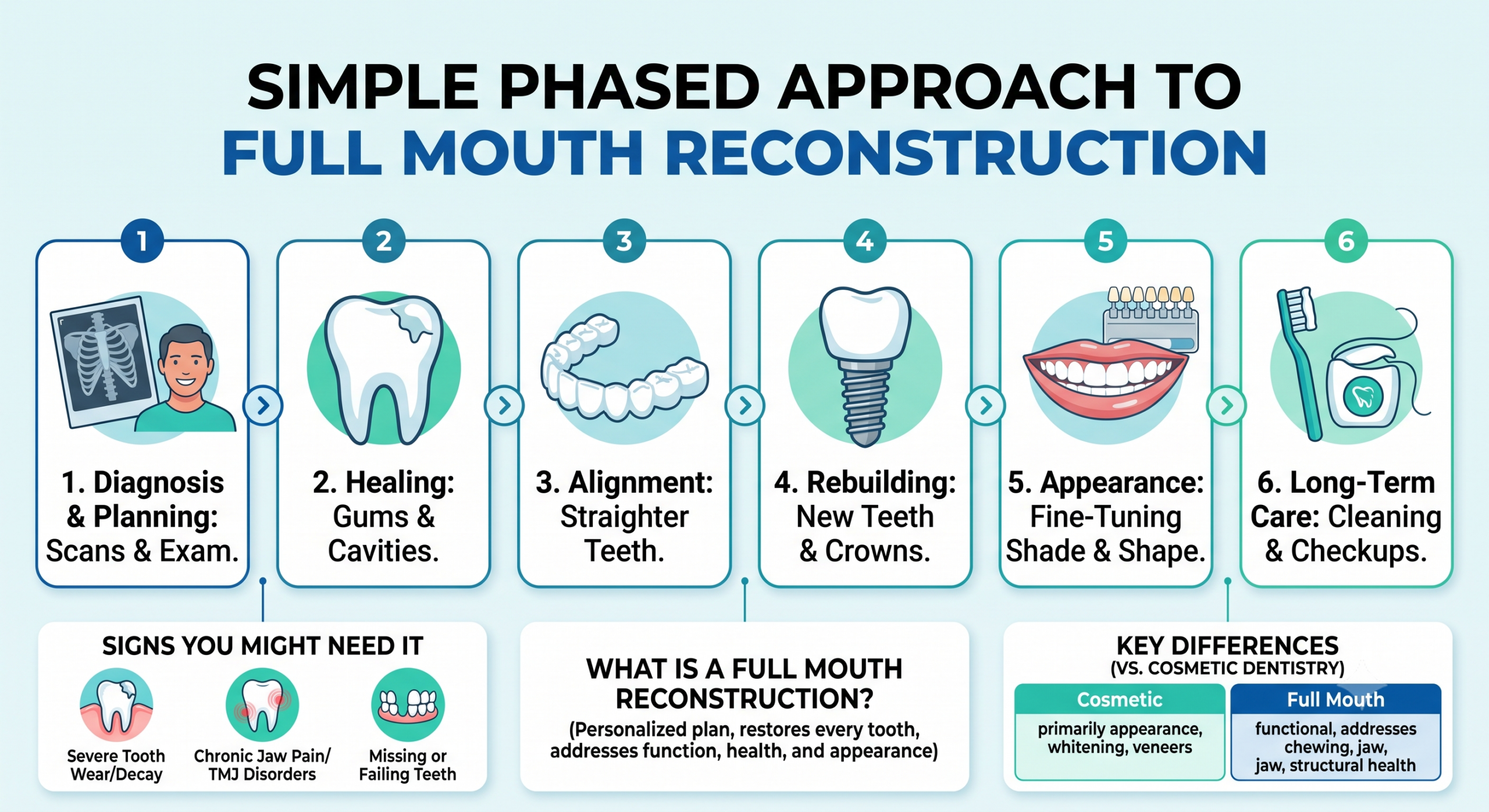
Full mouth reconstruction rebuilds your entire smile in seven proven phases. Discover the powerful path from diagnosis to a healthy, confident bite.
If you’ve spent years dealing with broken teeth, constant jaw pain, or a bite that just doesn’t feel right, you’re not alone. A full mouth reconstruction offers a way forward that’s methodical, evidence-based, and genuinely life-changing. Rather than fixing one tooth at a time and hoping for the best, this approach treats your entire mouth as one connected system. Let’s walk through exactly how it works, phase by phase, so you know what to expect.
What Is a Full Mouth Reconstruction?
A full mouth reconstruction is a personalized treatment plan that rebuilds or restores every tooth in your upper and lower jaw. It’s not a single procedure; it’s a coordinated series of treatments designed to address function, health, and appearance all at once. Dentists typically recommend it when a patient has multiple, interconnected problems: worn-down teeth, missing teeth, gum disease, and bite misalignment that have built up over years or even decades.
Because so many factors are at play, a full mouth reconstruction pulls from several dental specialties. You might work with a general dentist, a periodontist (gum specialist), an orthodontist, an oral surgeon, and a prosthodontist, all coordinating toward one goal: a mouth that works well and looks great.
How It Differs From Cosmetic Dentistry
It’s easy to confuse full mouth reconstruction with a “smile makeover,” but they’re not the same thing. Cosmetic dentistry, like teeth whitening or a few porcelain veneers, focuses mainly on appearance. A full mouth reconstruction, on the other hand, is primarily functional. It addresses how you chew, how your jaw opens and closes, and whether your teeth are structurally sound. Any aesthetic improvement is a welcome byproduct of restoring genuine oral health, not the main goal.
Signs You Might Need a Full Mouth Reconstruction
Not everyone needs this level of care, but certain warning signs suggest it’s worth a conversation with your dentist.
Severe Tooth Wear or Decay
If you’ve ground your teeth for years or dealt with untreated cavities, your enamel can wear down to the point where teeth become short, sensitive, or prone to fracture. Once several teeth reach this stage, isolated fillings or crowns often aren’t enough.
Chronic Jaw Pain or TMJ Disorders
Persistent jaw pain, clicking, or headaches can point to a bite that’s out of alignment. When your upper and lower teeth don’t meet correctly, your jaw joint takes on extra strain, and that strain doesn’t go away on its own.
Missing or Failing Teeth
Losing multiple teeth, whether from decay, injury, or gum disease, changes how the remaining teeth function. Neighboring teeth can shift, your bite can collapse, and chewing becomes difficult. This is one of the clearest indicators that a whole-mouth approach makes more sense than piecemeal repairs.
Phase 1: The Comprehensive Evaluation
Every successful reconstruction starts with a thorough evaluation. This isn’t a quick look inside your mouth; it’s a deep dive into your entire oral health history.
Diagnostic Imaging and Bite Analysis
Your dental team will typically take a full set of X-rays, 3D scans, and photographs. They’ll also study how your jaw moves and how your teeth come together when you bite down. Some practices use digital bite analysis technology to map out exactly where your bite is off and by how much. This data becomes the blueprint for everything that follows.
Building Your Treatment Team
Depending on what the evaluation reveals, your general dentist may bring in specialists. A periodontist might handle gum health, an endodontist might manage root canal needs, and a prosthodontist often leads the design of crowns, bridges, or implants. Having this team communicate closely is what makes the phased approach so effective; nobody works in isolation.
Phase 2: Foundational and Restorative Health
Before any cosmetic or structural work begins, your mouth needs a clean, healthy foundation. Building restorations on top of untreated disease simply doesn’t last.
Treating Gum Disease First
Healthy gums are the bedrock of a successful reconstruction. If gum disease is present, it must be brought under control first, whether that means deep cleanings, scaling and root planing, or in more advanced cases, gum surgery. Skipping this step risks the failure of everything built afterward.
Addressing Decay and Infection
Any active cavities, infections, or teeth that need root canal therapy are treated next. This phase is all about stopping damage before it spreads and making sure the mouth is stable enough to support the restorative work ahead.
Phase 3: Structural and Bite Correction
Once your mouth is healthy, attention shifts to structure and alignment.
Orthodontics When Needed
Some patients need braces or clear aligners before restorations go in, particularly if teeth are severely crowded, tilted, or spaced unevenly. Straightening teeth first often means restorations fit better and last longer.
TMJ and Bite Realignment
If jaw joint issues were identified during the evaluation, this is when they’re addressed, sometimes through a custom oral appliance that gradually guides the jaw into a healthier position. Getting the bite right at this stage prevents problems from resurfacing after the final restorations are placed.
Phase 4: Restorative Reconstruction
This is often the phase people picture when they think of a full mouth reconstruction: the actual rebuilding of teeth.
Dental Implants
For missing teeth, implants are frequently the gold standard. A titanium post is placed in the jawbone, and once it fuses with the bone, a custom crown is attached on top. Implants function and feel remarkably close to natural teeth.
Crowns, Bridges, and Veneers
Damaged or weakened teeth are often capped with crowns, while bridges can replace one or more missing teeth by anchoring to neighboring teeth. Veneers, thin shells bonded to the front of teeth, are sometimes added for teeth that need a cosmetic finishing touch rather than a full crown.
Full or Partial Dentures
For patients missing many or all of their teeth, full or partial dentures may be part of the plan, sometimes stabilized by implants for a more secure fit. Modern dentures are far more comfortable and natural-looking than many people expect.
| Restoration Type | Best For | Typical Lifespan |
| Dental Implants | Single or multiple missing teeth | 20+ years, often a lifetime |
| Crowns | Cracked, weakened, or heavily decayed teeth | 10-15 years |
| Bridges | Replacing 1-3 missing teeth in a row | 10-15 years |
| Veneers | Cosmetic correction of front teeth | 10-20 years |
| Dentures | Extensive tooth loss | 5-10 years, with adjustments |
Phase 5: Fine-Tuning and Aesthetics
With the structural work complete, your dental team will check bite balance one more time and make small adjustments to shape, shade, and symmetry. This phase is where a functional mouth becomes a smile you’re genuinely proud of. Even small tweaks, like polishing edges or adjusting how teeth meet during chewing, can make a noticeable difference in comfort and confidence.
Phase 6: Maintenance and Long-Term Care
A full mouth reconstruction is an investment, and protecting it matters just as much as building it.
Daily Habits That Protect Your Investment
- Brush twice daily with a soft-bristled brush
- Floss or use interdental brushes every day, especially around implants and bridges
- Wear a nightguard if you grind your teeth
- Keep up with regular dental checkups, usually every three to six months
- Avoid chewing ice or extremely hard foods that can chip restorations
How Long Does the Process Take?
Timelines vary quite a bit depending on how many phases apply to you. A relatively straightforward case might wrap up in three to six months, while more complex reconstructions involving implants, bone grafting, or orthodontics can take twelve to eighteen months or longer. Your dentist will give you a realistic timeline once your evaluation is complete, and it’s worth remembering that a slower, well-sequenced process tends to produce more durable results than rushing ahead.
What Does Full Mouth Reconstruction Cost?
Costs vary widely based on how many teeth are involved, which restorations you need, and where you live. Because every treatment plan is different, it’s genuinely hard to give an accurate number without a full evaluation. According to the American Dental Association’s guidance on treatment planning, costs should always be discussed and itemized clearly before treatment begins, so patients understand exactly what they’re paying for at each stage.
Insurance and Financing Options
Dental insurance typically covers only a portion of reconstructive work, especially procedures viewed as elective or cosmetic. Many practices offer in-house financing, third-party payment plans, or phased billing that spreads costs across the treatment timeline. It’s worth asking your dental office about all available options before you commit.
Choosing the Right Dental Team
Not every dental office offers full mouth reconstruction, and that’s okay; it’s a specialized service that benefits from experience. Look for a practice that coordinates closely with specialists, uses modern diagnostic technology, and takes the time to walk you through each phase before moving forward. A good team won’t rush you. They’ll explain the reasoning behind every recommendation and adjust the plan as your needs become clearer.
Frequently Asked Questions
1. Is full mouth reconstruction painful?
Most phases involve local anesthesia or sedation, so discomfort during treatment is minimal. Some soreness afterward is normal, similar to recovering from any dental procedure, and it typically fades within a few days.
2. How is full mouth reconstruction different from a full mouth rehabilitation?
The terms are often used interchangeably, though “rehabilitation” sometimes emphasizes restoring function specifically, while “reconstruction” covers both function and aesthetics. Your dentist can clarify which term applies to your specific plan.
3. Will my insurance cover any of this?
It depends on your plan and which procedures are considered medically necessary versus cosmetic. Restorative work like crowns or implants needed due to decay or injury is more likely to receive partial coverage than purely cosmetic additions.
4. Can I eat normally during treatment?
You’ll likely need to stick to softer foods during certain phases, particularly right after implant placement or extractions. Your dental team will give you specific guidance for each stage.
5. Am I too old for a full mouth reconstruction?
Age alone isn’t a barrier. What matters more is overall health and bone density, both of which your dentist will assess during the evaluation phase.
Conclusion
A full mouth reconstruction can feel like a big undertaking, and honestly, it is. But breaking it down into these clear phases makes an overwhelming problem manageable. From that first comprehensive evaluation all the way through long-term maintenance, each step builds toward a mouth that’s healthier, more comfortable, and more confident to show off. If you’ve been living with dental pain or a smile you’ve been avoiding, this phased path might be exactly the powerful, structured plan you’ve been looking for.