
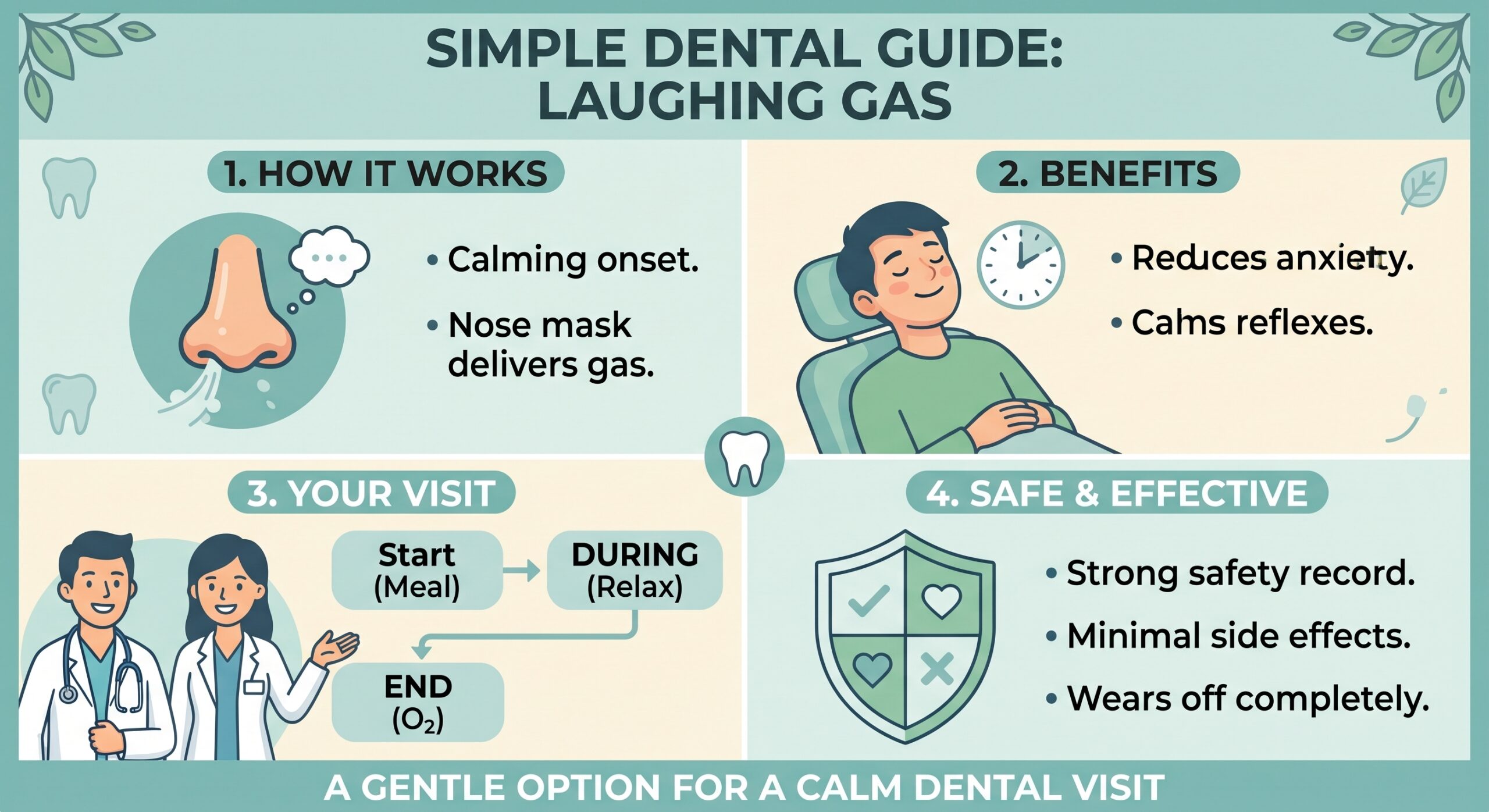
Nitrous oxide dentistry helps anxious patients relax safely. Learn how laughing gas works, who can use it, its side effects, and what to expect at your visit.
Let’s be honest. Nobody gets excited about sitting in a dental chair. For some people, though, the fear goes far beyond a little nervousness. That’s where nitrous oxide dentistry comes in. It’s a gentle, well-tested way to calm your nerves so you can get the care you need. In this guide, you’ll learn how it works, how safe it is, and whether it’s right for you.
Why Dental Anxiety Keeps So Many People Away
Dental anxiety is far more common than most people think. Surveys suggest that a sizable share of adults feel at least some fear before a dental visit. A smaller group feels so afraid that they skip appointments for years. That’s a real problem, because small issues like cavities or early gum disease tend to grow into big, painful, and costly ones when left alone.
The causes vary. Some people had a rough experience as a child. Others dislike the sound of the drill, the feeling of being out of control, or the fear of needles. Some simply feel embarrassed about the state of their teeth. Whatever the reason, the feelings are valid, and you’re not alone.
Avoiding the dentist often creates a frustrating cycle:
- You feel anxious, so you put off your visit.
- Your dental problem gets worse.
- A bigger problem means a more involved treatment.
- The more involved treatment makes you even more anxious.
Breaking that cycle is exactly what nitrous oxide dentistry is designed to do. It takes the edge off, helps you feel comfortable, and lets your dentist work without you tensing up. Many patients say it turned dreaded appointments into something they could handle and even forget about.
What Is Nitrous Oxide Dentistry?
Nitrous oxide dentistry is the use of nitrous oxide gas, mixed with oxygen, to help patients relax during dental treatment. You breathe the mixture through a small mask that fits over your nose. Within a few minutes, you feel calm, light, and a little detached from the worry. Most people stay fully awake, can talk with the dental team, and can respond to instructions.
It’s classed as a form of minimal sedation. That means you’re relaxed, not asleep. You’re also not “knocked out” the way you would be under general anesthesia. For many routine procedures, that’s the perfect balance.
A Short History of Laughing Gas
Nitrous oxide has a surprisingly long and colorful past. English scientist Joseph Priestley first made the gas in the 1770s. Later, chemist Humphry Davy noticed that it made people giddy and could dull pain, and the nickname “laughing gas” stuck. It even became a party attraction in the 1800s.
The turning point for dentistry came in 1844. Dentist Horace Wells, after watching a public demonstration, realized the gas might make tooth extractions less painful. He tried it on himself, and the idea took off. Since then, nitrous oxide dentistry has been refined for nearly two centuries. Today’s equipment is far more precise, and the technique is backed by modern safety standards.
How Nitrous Oxide Works in Your Body
When you breathe in the gas, it’s absorbed through your lungs and reaches your brain quickly. Scientists don’t fully understand every detail, but it appears to affect certain brain pathways that influence mood, anxiety, and the way you perceive pain. The result is a warm, floaty, relaxed feeling. Some people feel tingling in their hands or feet. Others feel heavy, as if they were sinking into the chair.
Two traits make it a favorite among dentists:
- It acts fast. You’ll usually feel the effects within a few minutes.
- It wears off fast. Once the dentist switches you to pure oxygen, the effects fade within minutes.
Because of this quick on-and-off quality, your dentist can adjust the dose throughout your visit, giving you more or less as needed. That level of control is one reason nitrous oxide dentistry has stayed so popular.
What to Expect During Nitrous Oxide Dentistry
Knowing what’s coming is a great way to ease your nerves. Here’s a simple walk-through, from the day you book to the minute you head home.
Before Your Appointment
First, tell your dentist about your health history. That includes any medications, existing conditions, and whether you could be pregnant. Your dentist will use this information to decide whether laughing gas is a good fit for you.
On the day of your visit, keep these tips in mind:
- Eat a light meal beforehand. A heavy meal can add to the chance of feeling queasy, so most dentists suggest avoiding a big one.
- Wear comfortable clothing.
- Let the team know if you have a stuffy nose or a cold, since you need to breathe easily through your nose.
- Share your fears openly. Dental teams hear it all the time, and they want to help.
During the Procedure
Once you’re settled in the chair, the dental team places a small, soft mask over your nose. You’ll start with pure oxygen. Then the nitrous oxide is slowly added, and you’re asked to breathe normally through your nose.
Over the next few minutes, you’ll likely notice:
- A sense of calm and well-being
- Mild tingling or warmth
- A floating or “lighter” feeling
- Time seeming to pass faster than it really is
The dentist will check in often and adjust the gas level to keep you comfortable. If your procedure involves a sharp sensation, like a filling or an extraction, you’ll typically still get a local anesthetic. Nitrous oxide dentistry relaxes you, but it doesn’t always replace numbing medication. Think of it as a partner to the local anesthetic, not a substitute.
Recovery After the Gas Wears Off
When treatment is done, the team switches you to 100 percent oxygen for about three to five minutes. This flushes the nitrous oxide out of your system. Then they’ll have you sit for a moment while you clear your head.
Here’s some good news. In most cases, patients can drive themselves home and go back to normal activities right after the visit. That’s a big difference from stronger forms of sedation, which usually require a ride home and a rest day. Still, if you feel at all woozy, it’s smart to wait a bit longer before you get behind the wheel.
Safety of Nitrous Oxide in Dentistry
Safety is the first question most people ask, and it’s a fair one. The short answer is that nitrous oxide is considered one of the safest sedation methods in dentistry when a trained professional gives it.
Its Track Record
Nitrous oxide has been used on millions of patients over many decades. Several features support its strong safety record:
- Oxygen is always delivered. Modern equipment is designed so the machine can’t deliver a mix with too little oxygen.
- You stay awake. Your protective reflexes, like swallowing and coughing, remain active.
- It leaves the body quickly. Your body doesn’t break the gas down much. You simply breathe it out.
- It’s easy to adjust. The dentist can raise or lower the dose in seconds.
Dental offices also use scavenging systems. These carry exhaled gas away from the treatment room, which helps protect staff from long-term exposure. When you choose a practice that follows proper protocols, you’re choosing a safer experience for everyone.
Common Side Effects
Side effects are usually mild and short-lived. Because the gas leaves your body so fast, most of it fades soon after the mask comes off. Here are the ones people mention most:
| Side Effect | How Common | What Helps |
| Nausea | Occasional | Lower the gas level, and eat lightly beforehand |
| Dizziness | Occasional | Breathe pure oxygen, and rest for a few minutes. |
| Headache | Less common | Rest and hydration |
| Sweating or shivering | Less common | Adjust the dose, stay warm. |
| Fatigue | Occasional | Take it easy for the rest of the day. |
Most of these problems happen when the gas level is a bit too high. Speaking up the moment you feel off lets your dentist fix it right away.
Who Should Avoid Laughing Gas
While nitrous oxide dentistry is safe for most people, it isn’t perfect for everyone. Your dentist may suggest another approach if you have:
- Severe chronic lung conditions that make breathing difficult
- A significant nasal blockage or a bad cold
- A vitamin B12 deficiency or certain rare metabolic conditions
- Recent eye surgery that involved gas bubbles in the eye
- Certain mental health conditions or a history of substance misuse, where your dentist may want to be cautious
- A current pregnancy, in which case you should talk with your dentist and doctor first
Pregnancy deserves a special note. Many professionals prefer to avoid or limit sedation in the first trimester unless it’s truly needed. Always check with both your dentist and your doctor before deciding.
How Effective Is Laughing Gas for Dental Anxiety?
Safe is good, but does it actually work? For most people with mild to moderate anxiety, the answer is yes. Studies and clinical experience show that nitrous oxide dentistry can lower fear, reduce restlessness, and make long visits feel shorter. Many patients also report less awareness of discomfort and less gagging, which helps with procedures that trigger the gag reflex.
Here’s why it tends to work so well:
- It targets the feelings behind the fear. You feel relaxed, so the sounds and sensations of dental work seem less threatening.
- It helps you cooperate. A calm patient can hold still, open wide, and follow instructions, which makes treatment smoother and often quicker.
- It builds confidence. When your first visit goes well, the next one feels less scary. Over time, some people find they need less and less sedation.
Of course, it has limits. If you have a severe dental phobia or you need a long, complex treatment, nitrous oxide alone may not be enough. In those cases, your dentist might combine it with other techniques or recommend a deeper level of sedation. Some people also don’t respond strongly to the gas, and that’s perfectly normal. Everyone’s body is a little different.
Nitrous Oxide vs. Other Sedation Options
Nitrous oxide is just one tool in the toolbox. Here’s how it compares with other common choices:
| Feature | Nitrous Oxide | Oral Sedation | IV Sedation | General Anesthesia |
| Level of sedation | Minimal | Minimal to moderate | Moderate to deep | Unconscious |
| Onset | Minutes | 30-60 minutes | Almost immediate | Almost immediate |
| Recovery time | Minutes | Several hours | Several hours | Several hours or more |
| Can you drive afterward? | Usually yes. | No | No | No |
| Best for | Mild to moderate anxiety | Moderate anxiety | Severe anxiety, longer procedures | Complex surgery, extreme phobia |
As you can see, nitrous oxide dentistry offers the fastest recovery and the most flexibility. If you want to be relaxed but still in control, it’s often the first option worth trying. If your fear runs deeper, your dentist can walk you through the next steps.
Nitrous Oxide Dentistry for Children
Many parents worry about their kids’ dental visits, and children can be even more anxious than adults. Fortunately, nitrous oxide dentistry is widely used in pediatric dental care. It’s considered a safe, gentle option for children who are nervous but able to cooperate.
Kids often enjoy the experience. Dentists sometimes call the mask a “space helmet” or give it a fun scent to make it less scary. That kind of friendly language can go a long way.
A few tips for parents:
- Explain the visit in simple, positive terms. Avoid words like “hurt” or “shot.”
- Let the dentist describe what the mask feels like.
- Make sure your child can breathe through their nose comfortably.
- Follow any pre-visit eating instructions from the dental team.
Children with special healthcare needs can benefit too. For many of them, a calmer visit means safer and more effective treatment. Pediatric dentists are trained to judge when laughing gas is appropriate and how much to use.
Tips for Getting the Best Experience
You can do a few simple things to make nitrous oxide dentistry work even better for you:
- Choose an experienced provider. Ask whether the team is trained in sedation and follows safety protocols.
- Be honest about your fears. The more your dentist knows, the better they can tailor the plan.
- Agree on a signal. A raised hand tells the team you need a break or an adjustment.
- Practice slow, steady breathing. Breathing calmly through your nose helps the gas work smoothly.
- Bring headphones if allowed. Music or a podcast can add another layer of comfort.
- Plan a relaxed day. Even though you can usually return to normal activity, avoid big commitments right after your visit.
Small steps like these can turn a stressful appointment into a manageable one. And the sooner you book, the sooner you can protect your smile.
Frequently Asked Questions
1. Is nitrous oxide dentistry safe?
Yes, for most people it’s very safe when a trained dental professional administers it. The gas is always mixed with oxygen, you stay awake, and its effects fade quickly. Your dentist will review your health history first to make sure it suits you.
2. Will I fall asleep with laughing gas?
No. Nitrous oxide is a minimal sedative, so you stay awake and aware. You’ll feel relaxed, and some people get drowsy, but you can still talk and respond to the dental team.
3. How long does it take for laughing gas to work and wear off?
You’ll usually notice the effects in about two to five minutes. After treatment, you breathe pure oxygen for several minutes, and the effects clear soon after.
4. Can I drive after nitrous oxide dentistry?
In most cases, yes. Because the gas leaves your body quickly, many patients drive themselves home. If you feel dizzy or foggy, wait until you feel completely normal before driving.
5. Does nitrous oxide take away pain?
It can reduce your awareness of discomfort, but it isn’t a full pain blocker. For procedures like fillings or extractions, your dentist will usually add a local anesthetic to numb the area.
6. Is laughing gas safe for kids and pregnant women?
It’s commonly used for children and considered safe when given by a trained provider. For pregnant women, dentists often take extra caution, especially in the first trimester. Always talk with your dentist and your doctor before deciding.
Conclusion
Dental fear is real, but it doesn’t have to control your oral health. Nitrous oxide dentistry offers a safe, fast-acting, and flexible way to feel calm in the chair. It works quickly, wears off quickly, and lets most people get back to their day right away. While it isn’t right for every patient or every procedure, it’s an excellent starting point for many anxious patients and parents.
The key is to talk openly with your dentist. Share your worries, review your health history, and ask questions. With the right plan, your next visit can feel a whole lot easier. Don’t let fear keep you from a healthy smile. Call your dental practice today and ask whether laughing gas is right for you.