
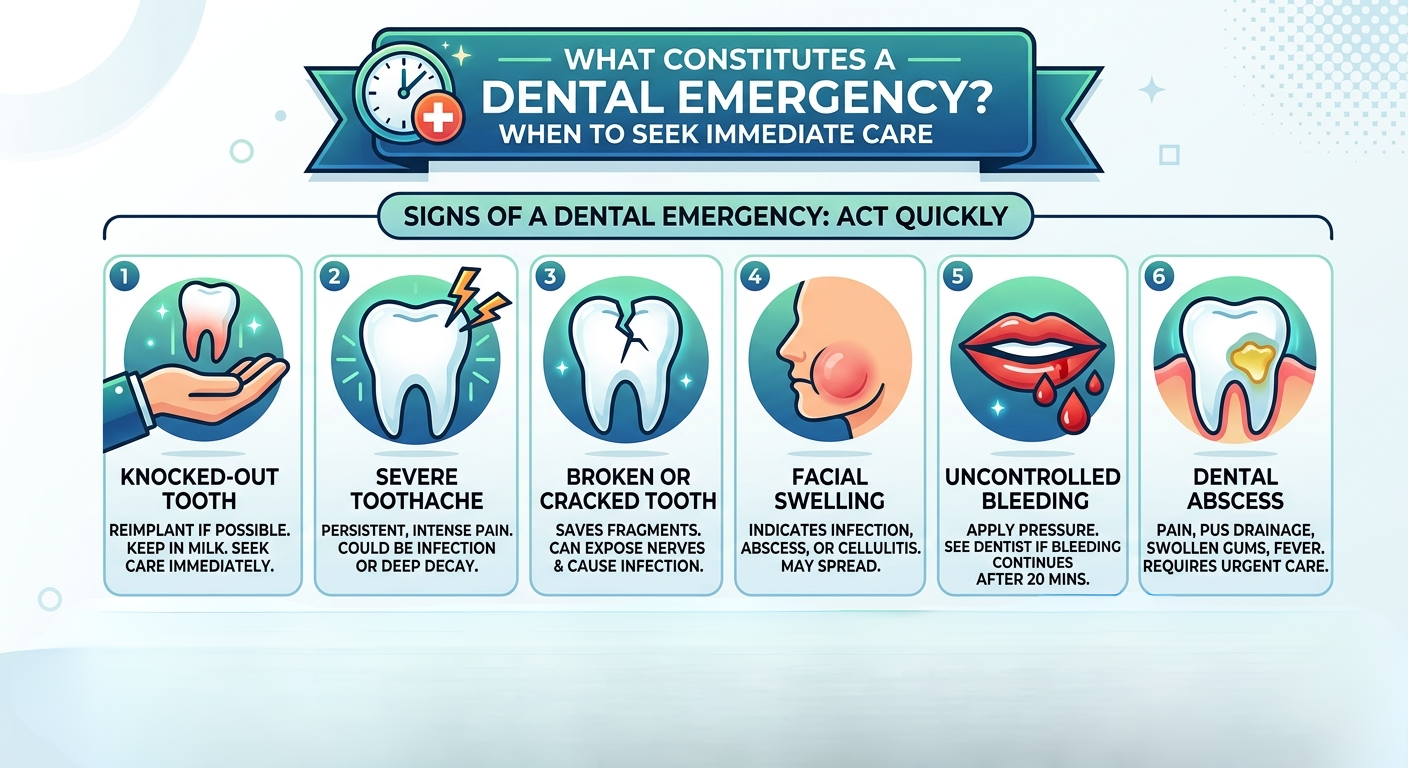
Dental problems don’t always happen during regular office hours. A sudden toothache, facial swelling, or a broken tooth can occur on a Friday night or during a holiday weekend, leaving you wondering whether the situation requires immediate treatment. Understanding what qualifies as a dental emergency can help you make informed decisions, protect your oral health, and potentially save a tooth.
While some dental concerns can safely wait until your dentist reopens, others require urgent attention. Conditions involving severe pain, uncontrolled bleeding, infection, or dental trauma should never be ignored. In some cases, delaying treatment may result in permanent tooth loss, worsening infection, or even serious health complications.
This guide explains what constitutes a dental emergency, which symptoms require immediate weekend care, and what steps you should take before seeing an emergency dentist.
What Is Considered a Dental Emergency?
A dental emergency is any oral health condition that requires prompt professional treatment to relieve severe pain, stop bleeding, prevent infection from spreading, or save a damaged tooth.
Emergency dental situations often involve damage to the tooth structure, surrounding soft tissues, or supporting oral anatomy such as the periodontal ligament, alveolar bone, gums, and dental pulp. These conditions frequently require urgent dental care because they can worsen rapidly without intervention.
Common dental emergencies include:
- Severe tooth pain
- Knocked-out teeth
- Broken or fractured teeth
- Dental abscesses
- Significant facial swelling
- Uncontrolled oral bleeding
- Dental trauma
- Loose adult teeth
- Serious infections
By contrast, minor sensitivity, small chips without pain, or routine dental concerns can often wait until regular business hours.
Why Weekend Dental Emergencies Should Not Be Ignored
Many people try to manage symptoms at home until Monday morning. However, some dental emergencies progress quickly and become far more serious when treatment is delayed.
For example, a severe toothache may be caused by irreversible pulpitis, a condition in which inflammation affects the dental pulp and causes intense pain. If left untreated, pulpitis may progress into a periapical abscess, allowing bacterial infection to spread beyond the tooth root.
Likewise, untreated oral infections can extend into surrounding tissues, leading to facial cellulitis, swollen lymph nodes, and, in rare cases, systemic infection or sepsis. Severe infections can even create airway obstruction, making immediate medical attention necessary.
Seeking timely care can often prevent complications while preserving natural teeth and supporting oral health.
Signs You Need Immediate Emergency Dental Care
Severe Tooth Pain That Doesn’t Go Away
Persistent, intense tooth pain is one of the most common reasons patients seek emergency dental treatment.
Pain may result from:
- Deep tooth decay
- Irreversible pulpitis
- Root fractures
- Periapical abscesses
- Cracked teeth
- Exposed tooth nerves
A severe toothache that interferes with sleep, eating, or daily activities should be evaluated as soon as possible. Emergency dentists often perform a clinical examination, pulp vitality testing, and dental X-rays to identify the underlying cause.
A Knocked-Out Tooth
A knocked-out permanent tooth, also known as tooth avulsion, is one of the most time-sensitive dental emergencies.
Research consistently shows that tooth reimplantation has the highest success rate when performed within 30 to 60 minutes of the injury. The periodontal ligament cells attached to the root surface begin to deteriorate rapidly once the tooth is outside the mouth.
If a tooth is knocked out:
- Pick it up by the crown, not the root.
- Rinse it gently if dirty.
- Attempt to place it back into the socket if possible.
- If reimplantation is not possible, store it in milk.
- Seek immediate emergency dental care.
Quick action may allow the dentist to successfully save the tooth.
Broken, Cracked, or Fractured Teeth
A cracked tooth is more than a cosmetic issue. Cracks can expose dentin and the dental pulp, increasing sensitivity and creating a pathway for bacterial infection.
Depending on the severity, the injury may involve the following:
- Enamel fractures
- Dentin exposure
- Root fractures
- Vertical tooth fractures
Emergency treatment may include composite bonding, dental crown placement, root canal therapy, or extraction if the damage is extensive.
Loose or Displaced Adult Teeth
Adult teeth should never feel loose.
Dental trauma can cause several types of tooth displacement injuries, including:
- Tooth luxation
- Tooth intrusion
- Tooth extrusion
These injuries affect the periodontal ligament and supporting alveolar bone. Prompt treatment may involve dental splinting to stabilize the tooth and encourage healing.
The sooner stabilization occurs, the greater the likelihood of preserving the natural tooth.
Swelling of the Face, Jaw, or Gums
Facial swelling should always be taken seriously.
Swelling may indicate:
- Acute dental infection
- Periodontal abscess
- Periapical abscess
- Facial cellulitis
- Impacted wisdom tooth infection
Infections affecting the lower jaw can spread into deeper tissue spaces and potentially interfere with breathing or swallowing.
Any swelling accompanied by fever requires immediate professional evaluation.
A Dental Abscess
A dental abscess is a localized collection of pus caused by bacterial infection.
Abscesses may develop around the tooth root or within the gum tissue. Common symptoms include:
- Severe throbbing pain
- Pus drainage
- Swollen gums
- Bad taste in the mouth
- Fever
- Facial swelling
A periapical abscess affects tissues near the tooth root, while a periodontal abscess affects gum structures surrounding the tooth.
Treatment may involve drainage, antibiotic therapy, root canal therapy, or extraction depending on the severity of the infection.
Uncontrolled Bleeding
Bleeding that continues despite applying pressure for 15 to 20 minutes requires emergency care.
Potential causes include the following:
- Oral trauma
- Gum injuries
- Post-surgical complications
- Tooth extraction complications
Prompt treatment helps prevent excessive blood loss and supports proper healing.
Dental Emergencies Related to Wisdom Teeth
Wisdom teeth can sometimes trigger emergency situations.
One common condition is pericoronitis, an infection affecting the gum tissue surrounding a partially erupted wisdom tooth.
Symptoms may include:
- Jaw pain
- Swelling
- Difficulty opening the mouth
- Bad breath
- Gum tenderness
Because the infection can spread into surrounding tissues, prompt treatment is often necessary.
What Is a Dry Socket and Is It an Emergency?
Dry socket is a painful complication that occasionally occurs after tooth extraction.
Normally, a blood clot forms within the extraction site to protect underlying bone and nerves. When that clot becomes dislodged prematurely, the alveolar bone becomes exposed.
Symptoms include:
- Severe pain several days after extraction
- Bad breath
- Unpleasant taste
- Visible bone in the socket
Although dry socket is not typically life-threatening, patients often require urgent treatment for pain relief and healing support.
What to Do Before Seeing an Emergency Dentist
While waiting for professional care:
For Tooth Pain
- Rinse with warm salt water.
- Floss gently around the affected area.
- Use approved pain relievers.
- Apply a cold compress if swelling is present.
For Broken Teeth
- Save any broken fragments.
- Avoid chewing on the affected side.
- Rinse with warm water.
- Contact an emergency dentist.
For Oral Injuries
- Apply gentle pressure with clean gauze.
- Use a cold compress to reduce swelling.
- Seek immediate care if bleeding continues.
These temporary measures help manage symptoms but do not replace professional treatment.
How Emergency Dentists Diagnose Serious Problems
Emergency dentists use several diagnostic tools to determine the cause of pain or injury.
These may include:
- Clinical examination
- Dental X-rays
- Panoramic radiographs
- Mobility assessment
- Percussion testing
- Infection assessment
- CBCT scans for complex trauma cases
Advanced imaging allows dentists to identify hidden fractures, root damage, bone injuries, and deep infections that may not be visible during a standard examination.
How Emergency Dental Care Is Provided
Treatment depends on the specific condition and severity.
Common emergency procedures include:
- Root canal therapy
- Emergency tooth extraction
- Tooth reimplantation
- Dental splinting
- Incision and drainage
- Composite bonding
- Dental crown placement
- Antibiotic therapy
- Pain management
In some cases, patients may be referred to specialists in endodontics, periodontics, or oral and maxillofacial surgery for advanced care.
When Should You Go to the Emergency Room Instead?
Certain symptoms require medical rather than dental intervention.
Visit an emergency room immediately if you experience:
- Difficulty breathing
- Difficulty swallowing
- Severe facial trauma
- Suspected jaw fracture
- Uncontrolled bleeding
- High fever with facial swelling
These symptoms may indicate a serious infection, airway compromise, or medical emergency requiring hospital treatment.
How to Prevent Dental Emergencies
Although accidents can happen, many dental emergencies are preventable.
Helpful strategies include:
- Brushing twice daily
- Flossing every day
- Attending routine dental examinations
- Wearing a sports mouthguard
- Avoiding chewing hard objects
- Seeking treatment for small dental problems before they worsen
Regular preventive care helps identify issues early and reduces the risk of unexpected dental emergencies.
Frequently Asked Questions
1. What is considered a dental emergency?
A dental emergency is any oral health problem that requires immediate treatment to relieve severe pain, stop bleeding, save a tooth, or prevent infection from spreading. Common examples include knocked-out teeth, dental abscesses, severe toothaches, facial swelling, and traumatic dental injuries.
2. Can a severe toothache be a dental emergency?
Yes. A severe toothache may indicate irreversible pulpitis, a deep cavity, a root fracture, or a dental abscess. If the pain is persistent, worsens over time, or interferes with eating and sleeping, you should seek emergency dental care as soon as possible.
3. How long do I have to save a knocked-out tooth?
A knocked-out permanent tooth has the highest chance of being saved if it is reimplanted within 30 to 60 minutes. Proper handling is essential. Hold the tooth by the crown, avoid touching the root, and store it in milk or saliva while seeking immediate treatment.
4. Is facial swelling from a tooth infection dangerous?
Facial swelling can be a sign of a serious dental infection, such as a periapical abscess or cellulitis. If swelling is accompanied by fever, difficulty swallowing, or breathing problems, seek immediate medical attention because the infection may be spreading.
5. What is a dental abscess, and why is it an emergency?
A dental abscess is a pocket of pus caused by a bacterial infection. It can develop around the tooth root or within the gum tissue. Without treatment, the infection may spread to nearby tissues, the jawbone, or even the bloodstream, creating potentially serious health risks.
6. Should I go to the emergency room or an emergency dentist?
Most dental emergencies should be treated by an emergency dentist. However, if you experience difficulty breathing, difficulty swallowing, severe facial trauma, uncontrolled bleeding, or signs of a rapidly spreading infection, you should visit the emergency room immediately.
7. Can a cracked tooth become infected?
Yes. A cracked tooth can expose the dentin and dental pulp to bacteria, increasing the risk of infection. Even small cracks should be evaluated promptly to prevent further damage and potential complications.
8. What is the difference between urgent dental care and routine dental care?
Urgent dental care focuses on treating immediate problems such as severe pain, infection, trauma, or bleeding. Routine dental care includes preventive services like cleanings, exams, fillings, and cosmetic treatments that can usually be scheduled in advance.
9. What should I do if my dental crown falls off on the weekend?
If your crown falls off, keep it in a safe place and avoid chewing on the affected tooth. If the tooth becomes painful, sensitive, or sharp, contact an emergency dentist. Temporary dental cement may provide short-term protection until professional treatment is available.
Conclusion
Knowing what constitutes a dental emergency can help you act quickly when oral health problems arise outside normal office hours. Severe tooth pain, tooth avulsion, facial swelling, dental abscesses, uncontrolled bleeding, and traumatic dental injuries should never be ignored.
Prompt treatment often allows emergency dentists to preserve teeth, control infection, relieve pain, and prevent more serious complications. If you’re unsure whether a situation qualifies as a dental emergency, it’s always safer to contact an emergency dental provider and seek professional guidance rather than waiting for symptoms to worsen.