
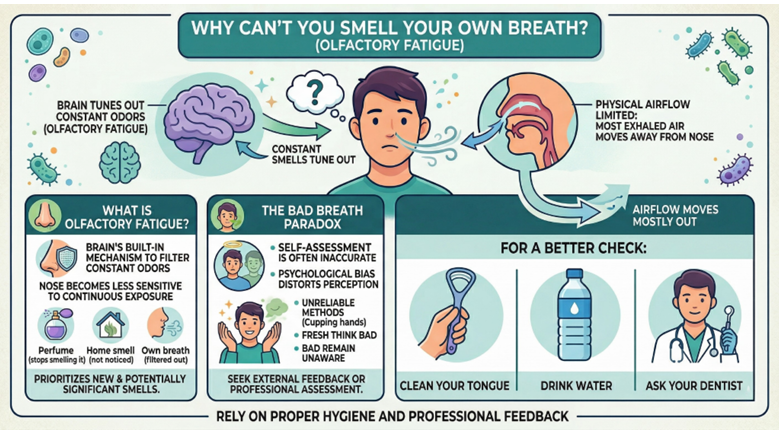
Why Can’t You Smell Your Own Breath? (Olfactory Fatigue)
Have you ever found it hard to tell whether your own breath is fresh or not? This is actually a very common experience, and it comes down to a fascinating biological phenomenon called olfactory fatigue, which is also referred to as sensory adaptation. This is a built-in mechanism your brain uses to filter out smells that are constantly around you, so you can stay focused on detecting new and potentially significant ones.
What Is Olfactory Fatigue?
Olfactory fatigue is what happens when your nose gradually becomes less sensitive to a smell after being exposed to it continuously. Put simply, your brain begins to “tune out” odors that are always present, and your own breath is one of them.
This is exactly why:
- You stop being aware of your own perfume just a few minutes after applying it
- You no longer notice the way your home smells, even though visitors pick up on it immediately
- And of course, you struggle to detect whether your own breath smells unpleasant
Your brain is constantly prioritising new sensory input over things that are already familiar, and this is actually a crucial part of how we survive and function.
Can You Smell Your Own Breath?
There isn’t one single straightforward explanation for why detecting your own breath is so difficult. The main reason, however, is olfactory fatigue.
This occurs because your nose becomes progressively less responsive to smells that you are around all the time. Since you are breathing every single moment of the day, your brain slowly adjusts to the odour of your own breath and essentially stops paying attention to it.
This is all part of a larger biological process known as sensory adaptation, in which sensory input that is repeated over and over again becomes less and less noticeable as time goes on.
Your sense of smell is specifically designed to detect and respond to meaningful changes happening around you. It is constantly working alongside signals from all five of your senses:
- Smell
- Hearing
- Taste
- Touch
- Vision
It is particularly attuned to new or potentially harmful smells, such as the scent of something burning or food that has gone bad. However, smells that are familiar and pose no threat, like your own breath, get quietly filtered out.
To put it plainly:
- Ongoing exposure reduces your awareness of a smell
- Familiar odours get dismissed by your brain
- New or unfamiliar smells immediately grab your attention
Since your breath is present every second of every day, your brain has essentially categorised it as background noise and stopped registering it.
How Your Brain Filters Smells
Your brain does not treat every smell the same way. Instead, it directs its attention towards changes and new developments in your environment.
To give some examples:
- An unexpected burning smell will instantly demand your attention
- A perfume you’ve been wearing starts to fade from your awareness after just a few minutes
- The general smell of your own living space becomes something you no longer consciously notice
The exact same principle applies to your breath. Because it doesn’t change significantly from one moment to the next, your brain gradually loses interest in it and stops bringing it to your conscious attention.
The Role of Airflow and Anatomy
The physical structure of your body also contributes to why you can’t reliably detect your own breath on your own.
Even though your mouth and nose are connected internally, the way airflow works tells a different story:
- When you breathe out, the majority of the air travels outward, moving away from your nose
- Only a very small amount of that exhaled breath actually reaches your nasal receptors
- This significantly limits your ability to directly sense your own breath odour
So even though the internal connection between your mouth and nose does exist, the direction in which air naturally flows makes it genuinely difficult for you to fully pick up on your own breath.
The “Bad Breath Paradox”
The “bad breath paradox” is a term used to describe the confusion that many people experience when they try to assess the quality of their own breath.
Some people whose breath is completely fine become convinced that they have a problem, while others who genuinely suffer from halitosis remain completely unaware of it. This contradiction comes about as a result of several overlapping factors:
- Olfactory fatigue
- Normal sensory adaptation
- Psychological bias in the way we perceive ourselves
Because of this, your own assessment of how your breath smells is frequently inaccurate and not something you can rely on.
How to Test Your Breath
If you try the well-known trick of cupping your hands over your mouth and nose and sniffing, you probably won’t get an accurate reading even though you’ve likely seen it done in movies plenty of times.
A somewhat more effective method is to lick the inside of your wrist, give it a few seconds to dry slightly, and then smell it. This tends to give a more realistic idea of how your breath comes across to the people around you, although even this method isn’t entirely foolproof.
Other Reliable Ways to Check
At Home
One of the most straightforward options is to ask someone you genuinely trust to give you an honest answer about how your breath smells. You can also use a tongue scraper, since the back of the tongue is one of the main areas where odour-causing buildup tends to accumulate.
At the Dentist
Dentists are equipped with more precise tools and methods for evaluating breath odour:
- Halimeter Test: This involves measuring volatile sulphur compounds (VSCs), which are gases produced by bacteria living in the mouth and are closely associated with bad breath.
- Organoleptic Test: In this method, the dentist directly assesses the odour of your breath through their own sense of smell.
What’s Happening Inside Your Mouth
Bad breath isn’t simply a matter of hygiene; it is closely tied to the activity of microorganisms living in your mouth.
Here’s what’s going on:
- Bacteria feed on leftover food particles inside your mouth
- As they break down these particles, they release volatile sulphur compounds (VSCs)
- These compounds are what produce the unpleasant odours associated with bad breath
The community of bacteria living in your mouth is known as the oral microbiome. When this ecosystem becomes unbalanced, the bacteria responsible for producing odour can multiply rapidly and make the problem significantly worse.
Common Causes of Bad Breath
Poor Oral Hygiene
This is one of the most frequent culprits. When food debris and bacteria aren’t properly removed through brushing and flossing, plaque begins to build up on the teeth. If left untreated, plaque hardens into tartar, which traps even more bacteria and leads to stronger odours over time.
Diet
Foods with strong smells, such as garlic and onions, contain sulphur compounds that don’t just linger in your mouth; they get absorbed into the bloodstream and can affect your breath for several hours. Other dietary contributors include:
- Coffee
- Alcohol
- Smoking
Dry Mouth
Saliva serves as a natural cleaning agent for your mouth. When your body produces less of it, bacteria and food particles stick around longer than they should, leading to a noticeable increase in odour.
Health Conditions
Certain underlying health issues can also play a role in causing or worsening bad breath, including:
- Sinus infections
- Lung infections
- Liver disease
- GERD (gastroesophageal reflux disease)
Why Self-Checking Is Not Always Accurate
Even when you make a conscious effort to evaluate your own breath, the result is often unreliable for several reasons:
- Your brain has already adapted to your own natural scent
- Your ability to perceive smells shifts throughout the day
- Psychological bias can significantly distort the way you assess yourself
This is precisely why external feedback from another person or a professional evaluation tends to be far more trustworthy than your own self-assessment.
Tips to Maintain Fresh Breath
- Brush and floss every day, ideally after meals
- Make a habit of cleaning your tongue on a regular basis
- Drink enough water throughout the day to prevent dry mouth from developing
- Use an antibacterial mouthwash whenever necessary
- Keep up with regular dental cleanings and check-ups
- Sugar-free gum can offer a temporary boost of freshness when needed
- Quitting smoking can lead to a significant and lasting improvement in breath quality
Final Thoughts
Bad breath is something a large number of people deal with at some point, yet it is also one of the hardest things to accurately judge in yourself. The primary reason you are unable to reliably detect your own breath odour is olfactory fatigue, the natural process by which your brain learns to filter out smells that are constantly present.
Because of this built-in sensory limitation, self-evaluation is simply not dependable enough to be your main method of checking. The most effective approach is to stay consistent with your oral hygiene routine and to seek trusted feedback or a professional assessment whenever you have genuine concerns.
Frequently Asked Questions (FAQs)
Q1: What is olfactory fatigue, and why does it happen?
Olfactory fatigue is a natural process in which your nose becomes less sensitive to a smell after being exposed to it continuously. It happens because your brain is wired to prioritise new and unfamiliar sensory information over things that are already constant and familiar. Since your own breath is always present, your brain eventually stops registering it altogether.
Q2: Is it normal to not be able to smell your own bad breath?
Yes, it is completely normal. Because of olfactory fatigue and sensory adaptation, your brain filters out your own breath odour the same way it filters out the smell of your home or your perfume. This does not mean your breath is fine; it simply means your nose has stopped paying attention to it.
Q3: Can other people smell my breath even when I can’t?
Absolutely. Since other people are not constantly exposed to your breath the way you are, their noses have not adapted to it. This means they can detect odours in your breath far more easily and accurately than you can yourself.
Q4: Why do some people with bad breath not realise they have it?
This is largely due to the combination of olfactory fatigue, sensory adaptation, and psychological bias. People tend to assume their breath is fine because they cannot smell anything unusual themselves. However, their brain has simply learned to ignore the odour over time, which creates a false sense of confidence about their breath quality.
Q5: How can I tell if I have bad breath without asking someone?
One of the more reliable DIY methods is to lick the inside of your wrist, wait a few seconds, and then smell it. This can give you a rough idea of how your breath comes across to others. However, this method is still not entirely accurate, and the most dependable way to know is to ask a trusted person or consult a dentist.
Q6: What is the most accurate way to test for bad breath?
The most accurate tests are performed by a dentist. Two commonly used professional methods are the Halimeter test, which measures volatile sulphur compounds produced by bacteria in the mouth, and the organoleptic test, in which the dentist directly evaluates your breath through their sense of smell. Both methods are significantly more reliable than self-assessment.